
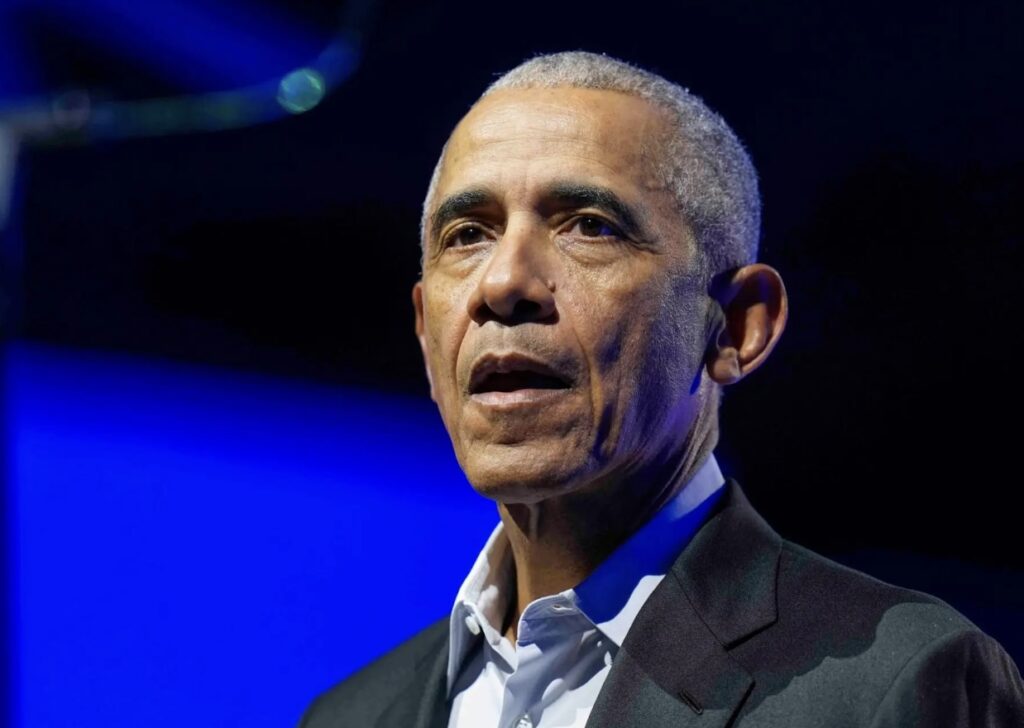
 Former President Barack Obama speaks at an event. Photo courtesy of Erin Hooley/Associated Press.
By Carol Khorramchahi
Boston University News Service
Barack Obama has spent most of his public life dodging people’s projections. This week, he had to dodge something stranger: the internet’s insistence that he had just confirmed the existence of extraterrestrial life.
In a podcast speed round with progressive host Brian Tyler Cohen, Obama was asked, “Are aliens real?” He answered, “They’re real,” before adding that he had not seen them and that they were not being hidden at Area 51, as a transcript posted by Barack Obama’s Medium account shows.
It was delivered like a joke, in the same breezy rhythm as his follow-up line where he revealed that the first thing he wanted to know as president was “Where are the aliens?” The problem is that jokes do not stay online. They get cropped.
Within hours, the clip was traveling as a standalone “Obama admits aliens are real” moment, stripped of context and reposted into the digital ecosystem that treats every wink as disclosure. Coverage from TIME captured the familiar pattern: a quick line, a big reaction and a narrative vacuum big enough for conspiracy theories to move in.
By Monday, Obama was clarifying what he actually meant. He said he saw no evidence during his presidency that aliens have made contact with humans, according to the Associated Press.
That clarification is the story and also the point. The former president was not walking back a revelation. He was walking back the internet’s craving to turn a punchline into proof.
What Obama actually said, and what he was clarifying
The easiest way to understand this episode is to read it as it happened, not as it was memed.
The exchange took place during a quick questions segment, and the transcript on Medium shows that Obama’s answer was immediately qualified. First with “I haven’t seen them,” and then with a riff on Area 51 and the idea of a conspiracy so massive it would have been hidden “from the president of the United States.”
The clarification that followed did not add new information: it reaffirmed an old one. Obama said he had not seen evidence of alien contact while in office, the AP reported. A statement that aligns with the reality that much of the recent government conversation has been about unidentified aerial phenomena, not verified extraterrestrial beings.
In other words, the internet heard “aliens are real,” but Obama was speaking in the casual, almost philosophical sense people use when they mean, life is a big universe, anything is possible. The distinction is obvious in full context. It disappears in a ten-second clip.
How the comment spread and why it stuck
This is not the first time Obama has been pulled into the alien conversation. He has joked about it before, including in past interviews where he played along with the idea that presidents get asked about Area 51. What made this moment different was the simplicity of the quote and the current online climate.
The “they’re real” line is short, clean and perfectly designed for the algorithm. It fits in a caption. It fits in a reaction video. It fits on a screenshot with a shocked emoji and no context.
The clip then fell into a familiar pipeline: mainstream outlets write about the viral moment, social media accounts repost the punchiest fragment and the fragment becomes bigger than the full exchange. The Washington Post described the moment as briefly appearing to confirm decades-old conspiracy theories before being clarified.
Even Obama himself weighed in through social media, emphasizing that he was matching the “spirit” of a speed round, according to a post shared from his verified account and amplified by other outlets covering the clarification.
That is the core dynamic here. The internet does not reward the second sentence. It rewards the first one.
Why it matters beyond the joke
This might feel harmless, a moment of levity that got mildly out of hand. But the political ecosystem around misinformation is built on moments like this.
Conspiracy narratives thrive on ambiguity, especially when it comes from authoritative figures. When a former president says a phrase that can be read two ways, one serious and one playful, the serious interpretation will travel farther in certain corners of the internet, because it confirms what those audiences already want to believe.
That matters because “aliens” online is rarely just about aliens. It is often shorthand for government secrecy, elite cover-ups, and the broader idea that the public is being lied to by default. It is a narrative that can be easily repurposed into other claims, some merely silly, others more corrosive.
This is why the clarification is worth more attention than the original joke. Obama’s follow up undercuts the “government has proof” narrative directly by saying he saw no evidence of contact while in office, the AP reported.
It is also why this episode is a clean case study in how misinformation works in 2026. It does not always require a lie. Sometimes it only requires a clip, a missing sentence and an audience trained to treat ambiguity as evidence.
Obama made a joke. The internet tried to make it a revelation. He responded by insisting on something boring, which is exactly what misinformation hates most.
The truth, in this case, is not out there. It is in the context everyone scrolled past.