

Astronomers have made an unprecedented discovery with the identification of TIC 120362137, a highly compact quadruple star system, recently published in Nature. This system is the most tightly bound “3+1” star system ever found and provides valuable insight into stellar evolution and orbital mechanics. The study, led by a team from the University of Szeged in Hungary, reveals the intricate dance of stars within a system that could fit between Jupiter and the Sun. Understanding such systems helps scientists decipher the complex processes of star formation and their long-term stability.
The Record-Breaking Quadruple Star System TIC 120362137
TIC 120362137 is a groundbreaking discovery in the field of astronomy. This system is considered the most compact known 3+1-type quadruple star system, according to Tamás Borkovits, the team leader and a researcher at the University of Szeged, Hungary. The system consists of a tightly bound trio of stars orbiting each other, along with a more distant fourth star. The inner trio of stars is packed so closely that it would easily fit within the orbit of Mercury, the closest planet to the Sun. This compact structure challenges previous assumptions about the size and formation of multi-star systems and offers new opportunities to study the forces that govern such systems.
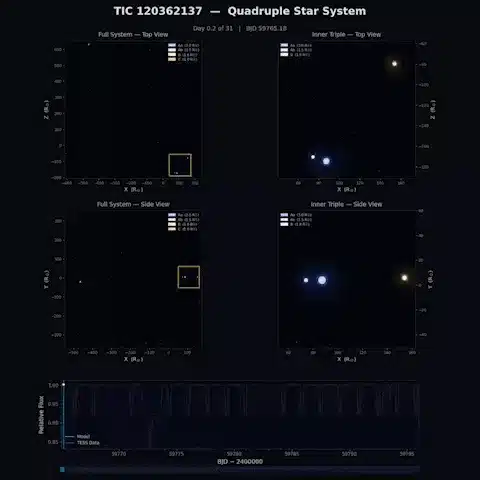 The uppermost row shows the system from top view, while the middle one from side view (as seen by TESS). The lowest part shows the TESS observed light curve and the photodynamical-model light curve between 2022-07-22 and 2022-08-04, practically a part of the Sector 54 observations of the TESS spacecraft. In the left columns, one can see the entire quadruple star system, while in the right columns, the movement of the inner triple subsystem is shown. (Image credit: Brian P. Powell, NASA Goddard Space Flight Center)
The discovery of this tight star system was not immediately apparent. Initially, the astronomers thought they were observing a more common eclipsing binary system, two stars that periodically eclipse each other, creating slight variations in brightness. Borkovits recalled,
“By a simple inspection of the early TESS data, we realized that TIC 120362137 is a compact, tight, triply eclipsing triple star system.”
At first, the researchers saw a pair of stars eclipsing every 3.3 Earth days, causing brief dips in brightness lasting between one and two hours. These kinds of systems are not uncommon in astronomy, so the team didn’t expect anything extraordinary at that stage.
The Revelation of a Fourth Star
It wasn’t until further investigation that the true complexity of the system became clear. Borkovits continued,
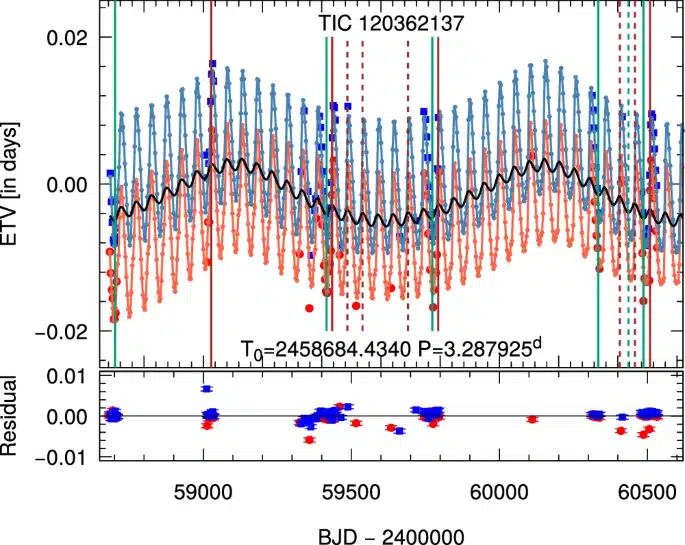
“Then, we realized that there are extra one-to-two-day-long fadings every 25 to 26 days, which made it clear that there must be a third star also in the system, with an orbital period of around 51 days.”
The researchers soon realized that TIC 120362137 wasn’t just a binary or even a triple system, but a triply eclipsing triple system, marking a significant departure from more typical star systems.
 Two typical third-body eclipses of TIC 120362137 from TESS Sector 54. a
A third-body eclipse which had occurred around a primary eclipse of the inner binary and, therefore, the three stars were seen almost along a straight line by TESS; hence, the two inner stars eclipsed the more distant tertiary star at the same time, producing only a single long-duration extra eclipse (superposed on the regular primary eclipse of the inner binary). b During the next event, the tertiary star eclipsed the two inner binary members separately; hence, one could detect two extra dips (the first of which had begun before the end of a regular primary eclipse of the inner pair). Note also that the sharp, regular eclipses are the usual primary and secondary eclipses of the inner eclipsing binary. It can readily be seen that every second regular eclipse has a flat bottom, indicating total (secondary) eclipses. Blue points represent the observed, but 1800-s-binned TESS data, while the red smooth curves represent the best-fit photodynamical solutions (see Methods subsection Spectro-photodynamical analysis). The lower parts of both panels display the residual light curves. At the beginning of both residual curves, a few typical observational error bars are shown in black. Source data are provided as a Source data file.
However, even after this revelation, the team had not yet identified the fourth star. It wasn’t until more data was collected, using the Tillinghast Reflector Echelle Spectrograph (TRES) on the 1.5-meter Tillinghast telescope in Arizona, that the existence of the distant fourth star was confirmed.
“TIC 120362137 is a record-holder in the sense that we found that the outermost star has an orbital period of only around 1,046 days, which is the shortest amongst all the currently known 3+1 quadruple stars by far,” Borkovits explained.
This makes TIC 120362137 the most compact 3+1 system discovered to date, and its outer star orbits the inner trio in just over three years.
The Challenge of Discovering Such Systems
The discovery of multi-star systems like TIC 120362137 is an immense challenge for astronomers. Identifying the presence of a fourth star is a rare occurrence, requiring extensive time and observations. As Borkovits pointed out,
“The discovery of such systems, however, is very, very difficult. To discover a fourth, most distant component by checking eclipses in the same way as the inner system requires much more time, maybe even several decades or longer.”
The task is so intricate that the identification of the fourth star often happens only by chance, making the discovery of TIC 120362137 even more remarkable.
Evolution of TIC 120362137: A Future of White Dwarfs
The team’s study published in Nature, also examined the long-term future of the system. Through computer simulations, they modeled the eventual fate of the stars in TIC 120362137. According to their findings, the system will evolve into a binary system of white dwarfs.
“First, the most massive star, which is the primary component of the innermost binary, will reach the red giant state. In that state, it will merge with its mate, the secondary star of the innermost binary. We call this daughter stellar body A’,” Borkovits said.
This will initiate a series of mergers, with the newly formed star eventually merging with the third star in about 276 million years.
As the process continues, the system will eventually collapse into two white dwarfs, stellar remnants that are no longer capable of fusion. “Finally, therefore, our evolutionary model predicts the binary of these two white dwarfs with an orbital period of around 44 days,” Borkovits explained. This final state marks the end of the system’s stellar lifecycle, offering a glimpse into the eventual fate of star systems similar to our own.