
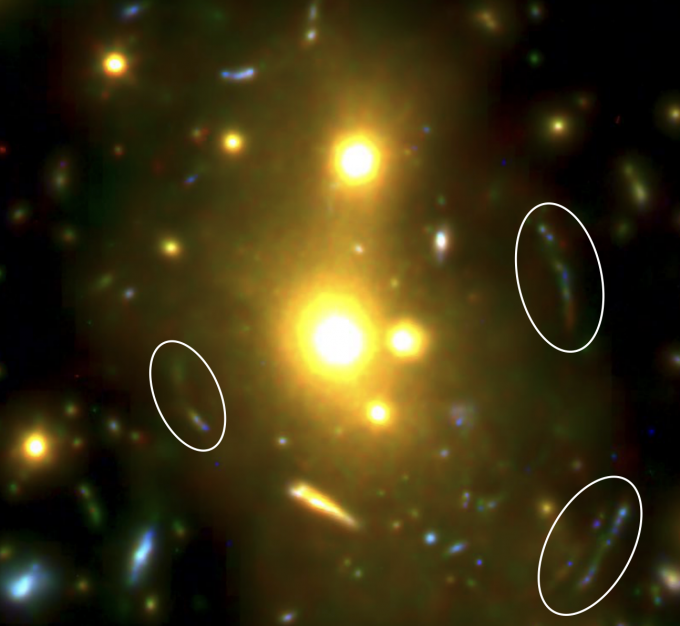
The central region of the galaxy cluster XLSSC 122, observed by NASA’s James Webb Space Telescope. The object circled by the ellipse is a background galaxy located behind the cluster. Credit: Yonsei University
The period about 10 billion years ago, when star formation and galaxy growth were most active in the universe’s history, is called ‘Cosmic Noon.’ This name signifies the universe’s most vigorous golden age, much like noon is when the sun is highest in the sky. A new study has revealed the internal structure of a massive galaxy cluster from this era, which was previously difficult to observe in detail due to its immense distance.
Yonsei University announced on the 4th that a team led by Professor Myungkook Jee from the Department of Astronomy has precisely reconstructed the dark matter distribution of a massive galaxy cluster from about 10.5 billion years ago using data from NASA’s James Webb Space Telescope (JWST). Galaxy clusters are mostly composed of invisible dark matter. The research findings were published as two separate papers in ‘The Astrophysical Journal Letters’ on December 1 of last year and March 1 of this year.
The research team analyzed the massive galaxy cluster ‘XLSSC 122,’ located in the Cosmic Noon era. They restored a detailed dark matter distribution map by analyzing the ‘weak gravitational lensing’ phenomenon, where the shapes of background galaxies are slightly distorted by gravity.
The analysis confirmed that XLSSC 122 is a colossal structure with a mass approximately 160 trillion times that of the Sun. Notably, its mass was found to be highly concentrated at its center. This indicates that this massive structure was already far more mature than expected at a time when the universe was only about 3 billion years old.
Amid a series of recent observations showing mature celestial objects appearing earlier than theory predicts in the early universe, this study suggests a need to re-examine theories on the formation and evolution of early galaxy clusters.
Through multi-wavelength observations, the team also captured a ‘separation between matter components.’ The center of mass, presumed to be dark matter, generally coincided with the center of hot gas identified by X-ray observations and the location of the brightest galaxy.
However, observations using the Sunyaev-Zel’dovich (SZ) effect, which tracks the gas pressure distribution, showed a discrepancy of about 320,000 light-years from the center of mass.
The misalignment between the centers of dark matter and gas components is a known characteristic that can occur during a galaxy cluster merger. Based on this, the team suggested the possibility that XLSSC 122 was undergoing an active merger process 10.5 billion years ago. This is interpreted as an example showing that even in the early universe, large-scale structures grew through dynamic collisions and mergers.
Galaxy clusters contain ‘Intracluster Light (ICL),’ starlight that is not bound to any specific galaxy but drifts throughout the entire cluster space. The team also confirmed through JWST observations that even during Cosmic Noon, the distribution of ICL showed a spatially similar trend to the mass distribution of dark matter.
ICL can serve as an important secondary indicator for studying the dark matter distribution of distant objects where gravitational lensing observations are difficult. Gravitational lensing observations can be challenging to apply when the signal is weak, such as when a galaxy cluster is too far away, has low mass, or lacks suitable background galaxies.
The team analyzed the density distribution and concentration in the cluster’s core using strong gravitational lensing and reconstructed the overall mass distribution map, including the outer regions, using weak gravitational lensing.
Ph.D. student Jack Schofield said, “By combining strong and weak gravitational lensing data, we were able to understand the structure of the galaxy cluster more three-dimensionally.”
The team plans to conduct more systematic research on the formation and evolution of large-scale structures in the early universe by combining their findings with observations from NASA’s Nancy Grace Roman Space Telescope, scheduled for launch this year.
– doi.org/10.3847/2041-8213/ae1d80
– doi.org/10.3847/2041-8213/ae447a
Copyright ⓒ DongA Science. All rights reserved.