
Back to Article List
The facility launched real-time monitoring of the sky by sending out 800,000 alerts.
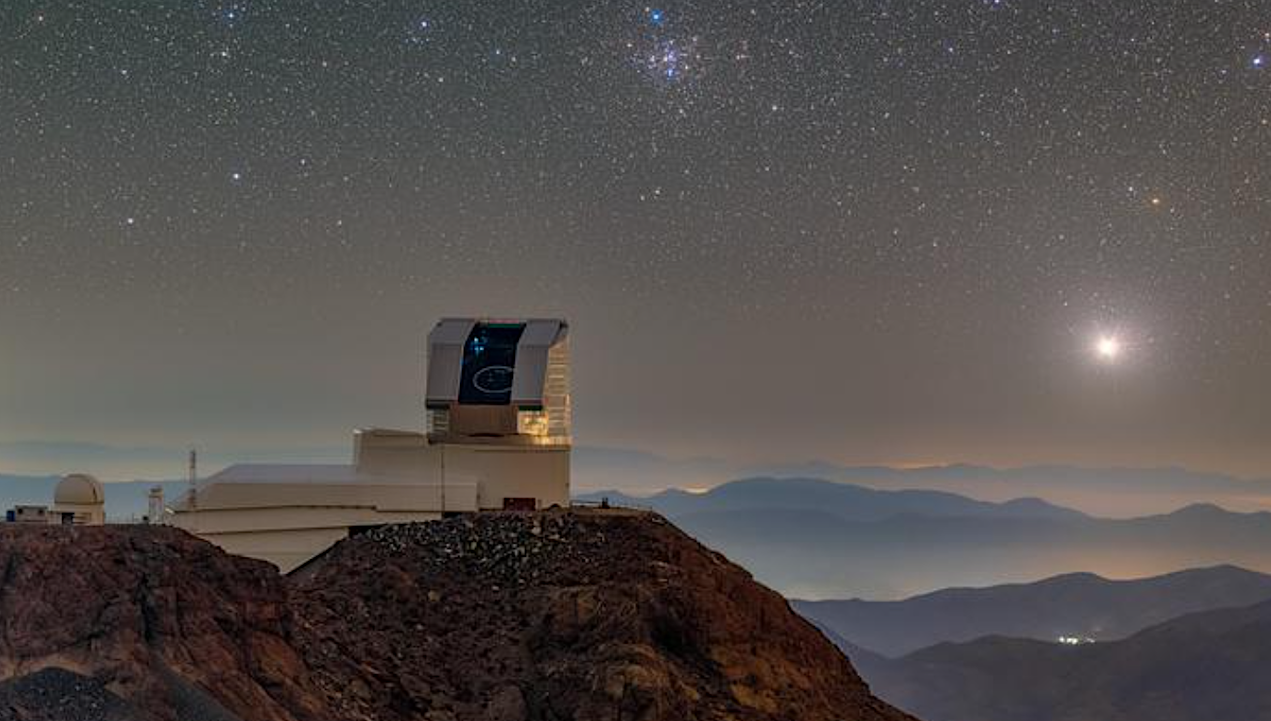
The Vera C. Rubin Observatory sits on a mountain peak in Chile. The observatory will soon begin real-time monitoring of the entire southern sky.
Credit: RubinObs/NOIRLab/SLAC/NSF/DOE/AURA/P. Horalek (Institute of Physics in Opava)
February 24 was the date a new information pipeline began for astronomers around the world. Their computers received a deluge of cosmic notifications — 800,000 alerts about new asteroids, supernovae, and other noteworthy changes in the night sky. The discoveries were made by the Simonyi Survey Telescope at the NSF-DOE Vera C. Rubin Observatory in Chile and distributed globally within about two minutes.
Those notifications began the observatory’s Alert Production Pipeline, software developed at the University of Washington (UW) that may eventually produce up to seven million alerts per night.
“Rubin’s alert system was designed to allow anyone to identify interesting astronomical events with enough notice to rapidly obtain time-critical follow-up observations,” said Eric Bellm, a research associate professor of astronomy at the UW who leads the Alert Production Pipeline Group for the Rubin Observatory. “Rubin will survey the sky at an unprecedented scale and allow us to find the most rare and unusual objects in the universe. We can’t wait to see the exciting science that comes from these data.”
A 10-year survey is coming
Sending out these alerts is one of the final steps before Rubin Observatory launches its Legacy Survey of Space and Time (LSST) later this year. During the LSST, Rubin will scan the Southern Hemisphere sky each night for 10 years to capture visible changes. To do that, it will use the largest digital camera ever built. In the LSST’s first year, Rubin is expected to capture images of more objects than all other optical observatories combined. Ever.
The alert pipeline was developed by a team of researchers and software developers in the UW’s astronomy department. The team spent the past decade working with other data management teams around the country to figure out how to process the 10 terabytes of images that Rubin will produce every night.
“Enabling real-time discovery on such a massive data stream has required years of technical innovation in image processing algorithms, databases and data orchestration. We’re thrilled to continue the UW’s legacy of excellence in data-driven science.” Bellm said.
Alert!
Each alert signals something that’s changed in the sky since Rubin last looked. By receiving them, scientists may catch supernovae in their earliest moments, discover and track possible Earth-threatening asteroids, and spot rare interstellar objects moving through the solar system.
“The discoveries reported in these alerts reflect the power of NSF-DOE Rubin Observatory as a tool for astrophysics and the importance of sustained federal support,” said Kathy Turner, program manager in the High Energy Physics program in the U.S. Department of Energy’s Office of Science. “Rubin Observatory’s groundbreaking capabilities are revealing untold astrophysical treasures and expanding scientists’ access to the ever-changing cosmos.”
Every 40 seconds each night, Rubin captures a new region of the sky. It then sends the data from Chile to the U.S. Data Facility at the SLAC National Accelerator Laboratory in California for initial processing. There, it’s compared to a template made from previous images of the same region to detect variations. With every change, the system generates a public alert within two minutes.
“The scale and speed of the alerts are unprecedented,” says Hsin-Fang Chiang, a SLAC software developer leading operations for data processing at the USDF. “After generating hundreds of thousands of test alerts in the last few months, we are now able to say, within minutes, with each image, ‘Here is everything. Go.’”
Finally, Rubin’s alerts are public, meaning anyone — researchers, students, or citizen scientists — can access and explore them.