


Researchers found that cognitive benefits were most pronounced in study participants who consumed two to three cups of caffeinated coffee or one to two cups of tea daily.
| Photo Credit: K.R. Deepak
Coffee and tea intake reduces dementia risk and slows cognitive decline
Current treatments for dementia are limited and typically offer only modest benefits once symptoms appear; this makes early prevention crucial. Focus on prevention has led researchers to investigate the impact of lifestyle factors like diet on dementia development.
Medical scientists from Mass General Brigham, the Harvard T.H. Chan School of Public Health, and the Broad Institute analysed 1,31,821 participants from the Nurses’ Health Study (NHS) and the Health Professionals Follow-Up Study (HPFS) and found that moderate consumption of caffeinated coffee or tea reduced dementia risk, slowed cognitive decline, and preserved cognitive function. Their results were recently published in The Journal of the American Medical Association.
“When searching for possible dementia prevention tools, we thought something as prevalent as coffee may be a promising dietary intervention,” said the senior author Daniel Wang, a scientist at Mass General Brigham’s Department of Medicine and an assistant professor at the Harvard Medical School. “Our unique access to high quality data through studies that have been going on for more than 40 years allowed us to follow through on that idea,” he added.
“While our results are encouraging, it is important to remember that the effect size is small, and there are lots of important ways to protect cognitive function as we age. Our study suggests that caffeinated coffee or tea consumption can be one piece of that puzzle,” he cautioned against over-interpreting the findings.
Coffee and tea contain bioactive ingredients like polyphenols and caffeine that have emerged as possible neuroprotective factors able to reduce inflammation and cellular damage while protecting against cognitive decline. Although promising, findings about the relationship between coffee and dementia have been inconsistent as studies thus far have had limited follow-up to capture long-term intake patterns, differences by beverage type, or the full profile of brain ageing in study subjects from early cognitive decline to clinically diagnosed dementia.
Data from the NHS and the HPFS helped this study overcome these limitations. There were repeated assessments of participants’ diet, dementia, subjective cognitive decline, and objective cognitive function, and they were followed for up to 43 years, enabling comparison of how caffeinated coffee, tea, and decaffeinated coffee influenced the dementia risk and brain health of each participant.
Of the more than 1,30,000 participants, 11,033 developed dementia. Both male and female participants with the highest intake of caffeinated coffee had an 18 per cent lower risk of dementia compared with those who reported little or no caffeinated coffee consumption. Caffeinated coffee drinkers also had lower prevalence of subjective cognitive decline (7.8 per cent versus 9.5 per cent). By some measurements, those who drank caffeinated coffee also showed better performance on objective tests of overall cognitive function.
While higher tea intake showed similar results, decaffeinated coffee did not. This suggests that caffeine may be the active factor producing these neuroprotective results, though further research is needed to validate the responsible factors and mechanisms.
The cognitive benefits were most pronounced in participants who consumed two to three cups of caffeinated coffee or one to two cups of tea daily. Contrary to several previous studies, higher caffeine intake did not yield negative effects; instead, it provided similar neuroprotective benefits. People with different genetic predispositions to developing dementia also showed similar results.
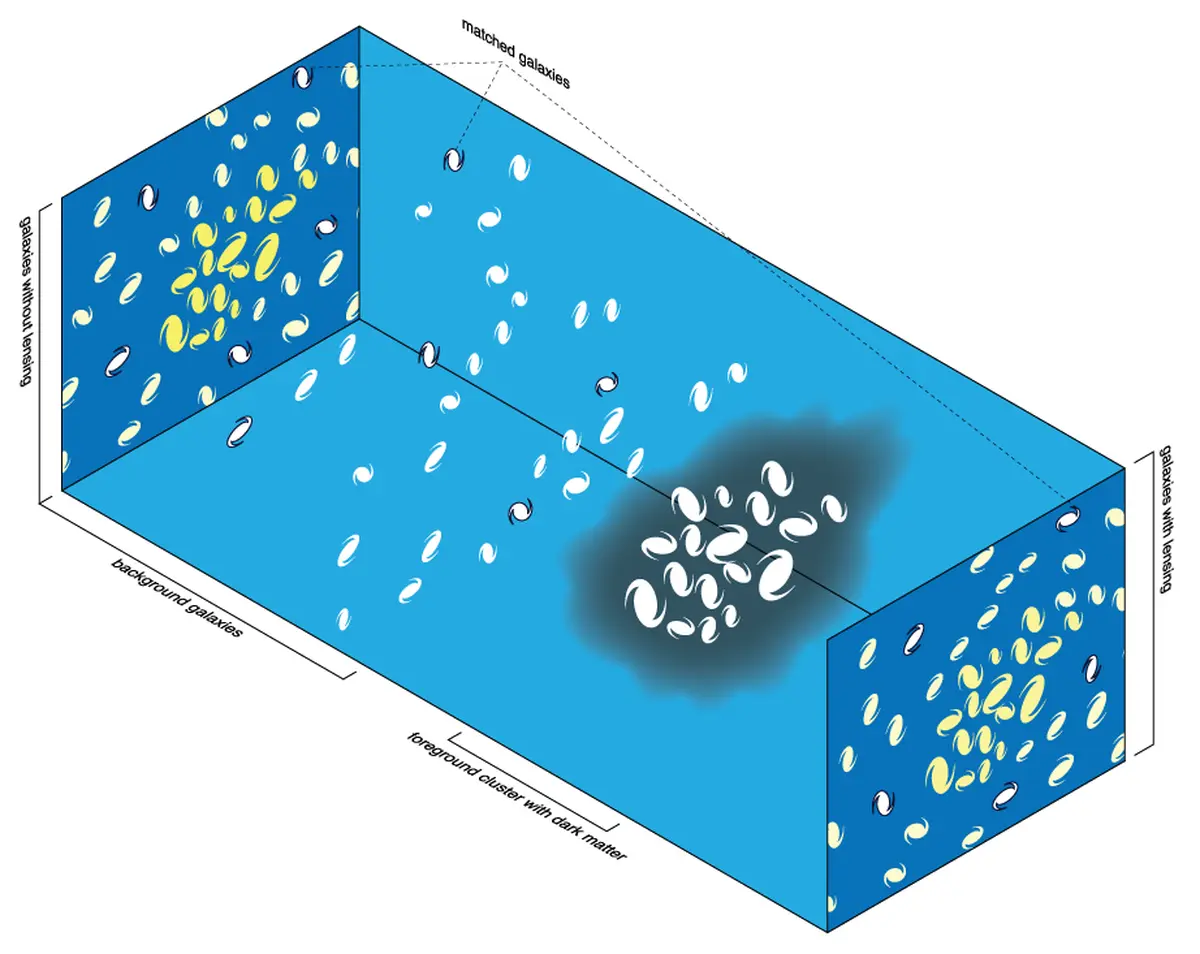
The effects of foreground galaxy cluster mass on background galaxy shapes. The upper left panel shows (projected onto the plane of the sky) the shapes of cluster members (in yellow) and background galaxies (in white), ignoring the effects of weak lensing. The lower right panel shows this same scenario but includes the effects of lensing. The middle panel shows a 3D representation of the positions of cluster and source galaxies, relative to the observer. Note that the background galaxies appear stretched tangentially around the cluster.
| Photo Credit:
Michael Sachs/Wikipedia
Scientists find evidence dark matter and neutrinos may interact
DARK matter (DM) is the mysterious, invisible substance that makes up around 85 per cent of the matter in the universe, and neutrinos are one of the most fundamental and yet elusive subatomic particles. Scientists believe they have indirect but overwhelming evidence on the existence of DM. However, since it does not seem to interact with ordinary matter, hence the name, it has neither been detected nor is it known what it is made of. On the other hand, neutrinos, which have an extremely small mass and do not interact with light and are therefore invisible, have been observed using huge underground detectors.
The standard model of cosmology, with its origins in Einstein’s general theory of relativity and built on the premise of the standard model of particle physics, posits that DM and neutrinos, two of the least understood components of the universe, exist independently and do not interact with one another.
There is no evidence to suggest that DM interacts with itself, though the point has been debated. Observational evidence suggests that DM is also cold. Neutrinos themselves cannot constitute DM as they travel at close to the velocity of light and are, therefore, hot. Now, new research from the University of Sheffield, recently published in Nature Astronomy, argues that these two elusive components of the universe may be interacting, thus challenging the long-standing cosmological model and offering a rare window into the dark sector of the cosmos.
Evidence for the new hypothesis came from combining data from different eras, spanning the history of the universe. If DM and neutrinos interact, there should be an effect on the large-scale structure of the universe: the way galactic clusters and voids formed and have got aligned over time. The study looked at an effect known as cosmic shear, a subtle distortion in this intrinsic alignment. This cosmic shear can be measured by large surveys of gravitationally lensing galaxies.
For data regarding the early universe, the work used measurements by the highly sensitive ground-based Atacama Cosmology Telescope and the Planck Telescope, a space observatory operated by the European Space Agency. Both instruments were specifically designed to study the faint afterglow of the Big Bang. Late-universe data came from observations by the Blanco Telescope in Chile, along with galaxy maps from the Sloan Digital Sky Survey. Using cosmic shear data gathered by the three-year Dark Energy Survey based on Blanco data, the authors found an interaction level of about 1 in 10,000.
In statistical parlance, the significance of this result is only 3-sigma, which is only suggestive of an interaction between the two and not strong enough to be considered proof. Only the “gold standard” of 5-sigma—a one-in-three-million chance that the interaction is not an artefact of the data—would imply a definitive evidence.
“Measurements of the early universe predict that cosmic structures should have grown more strongly over time than what we observe today. However, observations of the modern universe indicate that matter is slightly less clumped than expected, pointing to a mild mismatch between early- and late-time measurements,” Eleonora Di Valentino of the university said. “This tension does not mean the standard cosmological model is wrong, but it may suggest that it is incomplete,” she added.
Further testing, using more precise data from future cosmic microwave background experiments and cosmic shear measurements using weak lensing surveys by the Vera Rubin Observatory should shed more light on whether there is any DM-neutrino interaction.

The whinny represents an unusual vocal phenomenon known as “biphonation”, in which a vocalisation has two independent frequency components: low and high.
| Photo Credit:
Elodie Briefer/University of Copenhagen
Horse’s whinny: whistling and singing
Although domesticated horses have lived closely with humans for over 4,000 years, horse vocal communication was poorly understood. Larger mammals generally make lower-pitched sounds because the size of the larynx typically increases in step with body size. But researchers have noted exceptions to this rule, horses’ whinnies being a prominent example. The whinny represents an unusual vocal phenomenon known as “biphonation”, in which a vocalisation has two independent frequency components: low and high.
While the low frequency is made by vocal-fold vibration, just like a human singing, the origin of the high-frequency component had remained mysterious until now. It had been puzzling how horses could produce these high-frequency sounds that defy their large size while simultaneously producing lower tones.
To learn more about this high-frequency sound, a team of European researchers gathered a wide range of data through careful study of the animals’ vocal anatomy, clinical data, and acoustic analysis. The team was able to demonstrate how horses whistle through their larynx even as their vocal folds vibrate. Horses, the researchers said, likely evolved these vocalisations to convey multiple messages to one another concurrently. The findings were published in Current Biology.
“We now finally know how the two fundamental frequencies that make up a whinny are produced by horses,” said Elodie Briefer of the University of Copenhagen. “In the past, we found that these two frequencies are important for horses as they convey different messages about the horses’ own emotions. We now have compelling evidence that they are also produced through distinct mechanisms.”
They found that the high-frequency component of the whinny is generated by a laryngeal whistle. The researchers describe it as similar in principle to a normal human whistle, except that the turbulent airstream that creates the whistle sound is created within the horse’s larynx. Although small rodents like rats and mice produce laryngeal whistles, the horse is the first large mammal found to whistle in this way and the only animal known to do so simultaneously with vocal-fold vibration.
To demonstrate this whistle, the researchers blew a stream of air through larynges removed from dead horses. While doing so, they switched the airstream into the larynx from air to helium and back again. Because the speed of sound is higher in helium, it causes whistles to shift to higher frequencies, while the frequency of normal vocal-fold vibration remains unchanged. The findings explain how biphonation happens.
The researchers also note that the Przewalski’s horses—a species closely related to the domesticated horse—also has a biphonated neigh, but more distant relatives like donkeys and zebras appear to lack the high component, suggesting that horses have unique vocal adaptations that allow them to produce a richer and more complex spectrum of calls compared with other mammals.
Also Read | Search for dark matter in the Milky Way and beyond continues