
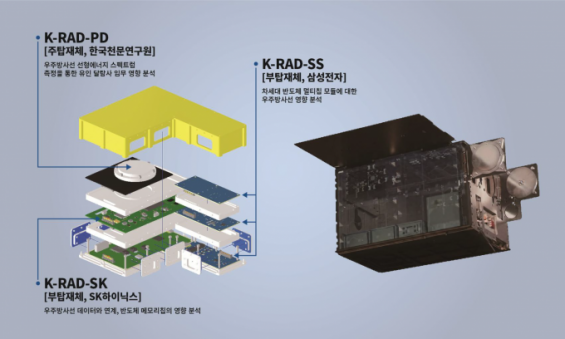
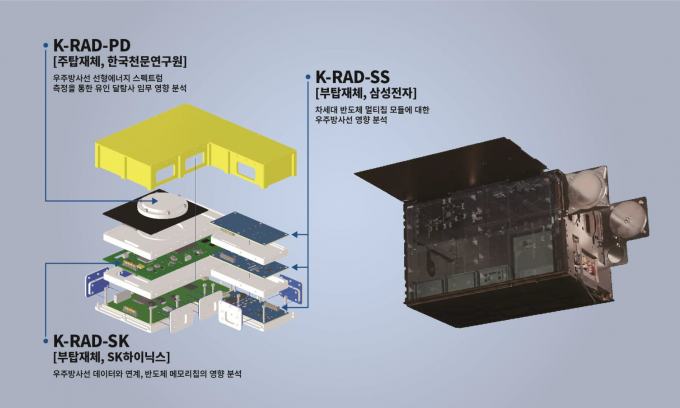
The ‘K-RadCube,’ set to be on board Artemis II, will carry a space radiation analyzer from the Korea Astronomy and Space Science Institute and secondary payloads from Samsung Electronics and SK hynix to analyze the effects of space radiation on semiconductors. Courtesy of the Korea AeroSpace Administration
Chips from South Korean semiconductor giants Samsung Electronics and SK hynix are also on board the U.S. lunar exploration rocket Artemis II, whose launch has been tentatively postponed since April due to rocket defects. The purpose is to intentionally ‘break’ the semiconductor chips in the extreme space environment. The data collected during this process will be used to develop radiation-hardened semiconductors that can withstand space radiation.
According to industry and science and technology sources on the 2nd, the importance of ‘space heritage’—a track record of using materials, devices, and components in an actual space environment—is growing. The analysis suggests that securing space heritage for domestic companies will substantially help strengthen South Korea’s space industry capabilities, including semiconductors.
● Why the Same Component Can Cost 10 Times More
Scientists and engineers developing satellites expect components to operate in space just as they do on the ground. However, the farther a satellite travels from Earth, the more it is exposed to high-energy cosmic radiation, which is normally blocked by the Earth’s magnetic field, and it experiences extreme temperature changes.
In the case of memory semiconductors, radiation exposure can corrupt stored data and lead to erroneous commands. The higher the circuit density of a semiconductor, the more prone it is to errors. This is why semiconductors used in space often have lower performance than their terrestrial counterparts, and why proven, older products are preferred over cutting-edge computers.
Han Jae-heung, director of the KAIST Space Research Institute, explained, “From the perspective of building an entire satellite system, it becomes frightening when you have to use a component without space heritage for any reason.” He noted that since satellites and launch vehicles in space cannot be physically repaired, there is no choice but to use proven components.
“Even for the same onboard computer, having heritage from withstanding space conditions can add another zero to its price,” Han said.
Manufacturing a single memory semiconductor involves hundreds of process steps. Han suggested that considering the current demand for space-grade semiconductors, a realistic approach is to improve the final packaging process of existing semiconductor manufacturing to increase radiation resistance.
Kang Chang-koo, a principal researcher at the Advanced Radiation Technology Institute of the Korea Atomic Energy Research Institute, explained, “There are various approaches, such as solving the issue at the material, device design, or circuit level. The easiest solution is to implant multiple identical semiconductors so that if one fails, another can take over.”
● Space Heritage Boosts Competitiveness of Domestic Space Industry
“At the device level for satellites, we are in a situation where we cannot procure domestic components with space heritage,” Han said. “The technological difficulty isn’t necessarily high; rather, the current demand is not large enough.” This can be interpreted to mean that the economic incentive is lacking more than the technological barrier being high.
Han added, “If the construction of space data centers is pursued in the future, the demand for memory semiconductors, a Korean strength, is likely to increase in space.”
Hahm Sun-jung, a managing director at TelePIX’s satellite business division, stated, “Looking at planned satellite launches worldwide, demand is expected to increase, not decrease, in the future.” From a startup’s perspective, she explained, “It’s difficult to use components with space heritage for every part of a satellite.” She added, “Unlike the ‘Old Space’ approach of spending large budgets over long periods on guaranteed components, the private-led ‘New Space’ era requires building up experience.”
TelePIX’s ‘TetraPLEX,’ the first GPU-based onboard Artificial Intelligence (AI) processor launched into space on a domestic satellite, has been operating stably since its launch in August 2024. While the onboard processor cannot match the computing power on the ground, it has the advantage of improving video processing efficiency by pre-processing image data during the time the satellite is not communicating with a ground station.
Hahm added, “Just the fact that TetraPLEX is operational has generated a huge number of inquiries. When there’s interest, demand follows.”
Within the domestic space industry, there are consistent calls for more opportunities to acquire space heritage, centered around the Korea AeroSpace Administration.
Han emphasized, “Providing opportunities to build space heritage would be a great help to domestic space companies,” but added, “From the perspective of these companies, a strategy of developing specialized expertise would be effective.”
He stated, “We don’t need many prime contractors in the country. If we have more ‘super subcontractors’ with highly advanced technology in specific fields, the competitiveness of the Korean space industry will increase.”
● Ground-Based Tests Simulating Space Environment Also Active
There are limits to testing every developed device and component by launching it into space. Therefore, ground-based experiments, such as shooting radiation beams with accelerators to observe changes, are also actively conducted. This is a process of refining performance as much as possible by simulating the space environment on the ground.
The accelerator facilities at KAERI’s branches in Jeongeup and Gyeongju are equipped with ground verification systems that can shoot radiation to observe changes in samples. The allocated testing time, known as ‘beam time,’ is so popular that it is often fully booked and difficult to secure.
“Space has a complex mix of radiation like gamma rays, protons, and heavy ions, but on the ground, we test one type at a time, so there’s a difference from the actual environment,” said Principal Researcher Kang.
He added, “Not all onboard components need to be radiation-hardened. Some components used on the ground can be used immediately after testing.”
Copyright ⓒ DongA Science. All rights reserved.