
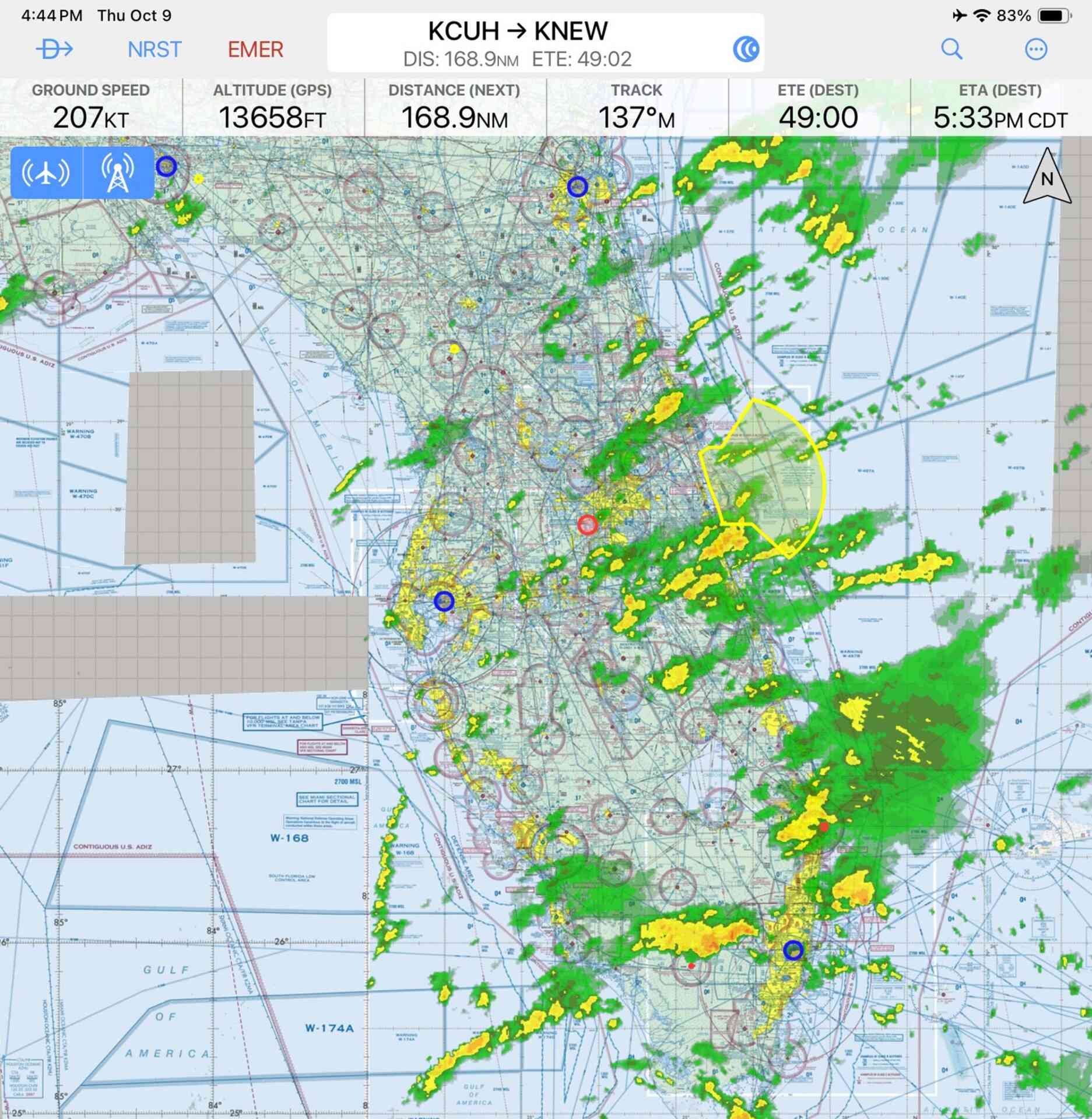
 That’s Starlink Wi-Fi delivered radar graphics on a cockpit iPad running the Garmin Pilot app.
Credit where it’s due: AvBrief reader Scott Dyer flagged this one before I even got out of bed. This morning, Starlink began notifying customers detected operating above 100 mph that Roam and Priority plans are now capped at that speed effective immediately, while simultaneously introducing two aviation-specific tiers: Aviation 300MPH at $250 per month, and Aviation 450MPH at $1,000 per month. Both plans include just 20 GB of data. For context, I’ve been running Starlink in my Cessna T310R on a plan that cost $50 per month and included 100 GB of data. The math on that comparison is not subtle.
When I first began using the system, aviation use existed in something of a gray area. There was no clearly enforced speed cap, and many GA operators quietly worked the service into their workflows. As usage became more visible, Starlink formalized speed-based tiers, initially moving customers who exceeded 100 mph into plans costing roughly $160 per month. That structure lasted only about six months before evolving again.
In early 2025, the company introduced Local Priority and Global Priority plans, expanding supported speeds to approximately 350 mph for Priority and up to 550 mph for Global. For piston aircraft owners, the Local Priority tier felt like a workable middle ground, offering a modest base fee with optional 50 GB data blocks priced at manageable levels. Early this year, supported speeds were standardized to 450 mph across plans, and the base plan was expanded to include 100GB of data without a corresponding price increase. At that point, the product appeared to be stabilizing. Speeds aligned with real-world GA operations, and data allotments were sufficient for meaningful in-flight use.
Today’s restructuring reverses much of that progress. The system returns to a 100 mph cap for Roam and Priority users, while aviation access now begins at $250 per month for 20 GB—a plan that requires identity verification. For operators whose aircraft cruise above 300 mph, the only option is the $1,000 per month tier, also capped at 20 GB. Compared to the 100 GB structures many operators were recently using, the shift represents both a sharp reduction in included data and a significant increase in recurring cost. The economics have changed quickly and materially.
 Starlink Mini in the rear window of a Twin Cessna.
This is not simply about subscription pricing. Starlink has introduced tangible operational and safety value into general aviation, and many operators have incorporated that capability thoughtfully. On cross-country flights, the system provides access to higher-resolution weather products, icing forecasts, turbulence guidance, and much more with clarity that exceeds FIS-B alone. When operating in mountainous terrain, the ability to review FAA camera feeds and assess pass conditions in real time adds a layer of situational awareness that historically was limited to on-the-ground use. Connectivity has quietly become part of modern risk management—and that’s exactly what makes the instability in Starlink’s plan structure so frustrating.
Since 2024, speed limits, data allotments, standby options, and pricing tiers have shifted multiple times. Some iterations introduced workable middle-ground solutions; others removed them. For owners attempting to forecast annual operating expenses and build connectivity into their safety toolkit, that inconsistency creates real friction. The Aviation 300MPH tier at $250 per month may make sense for higher-utilization aircraft, but for piston operators flying 100 hours or less annually, the structure feels increasingly disconnected from typical GA use profiles. And the $1,000 tier—for the same 20 GB of data—is simply not a conversation most GA pilots are going to have with themselves. SiriusXM’s $30 per month weather subscription is starting to look considerably more stable by comparison. We’re also hearing that the company is working on new weather products. We’ll be watching.
Starlink has demonstrated that it can deliver meaningful operational benefits to smaller aircraft. We found Starlink-delivered Wi-Fi weather to be a winner in our recent cockpit weather shootout. But now the open question is whether the company views general aviation as a long-term segment to develop thoughtfully or primarily as a premium revenue tier, a question pilots are going to answer with their credit cards.