
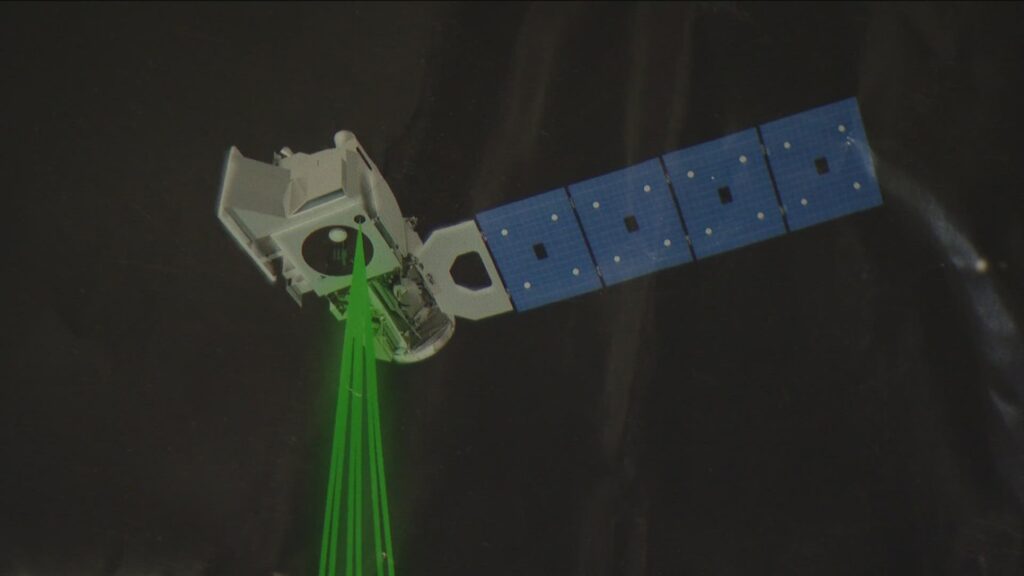
NASA’s upcoming EDGE satellite mission, led by UC San Diego, uses lasers to deliver unprecedented 3D mapping of Earth.
SAN DIEGO — Picture this: A powerful laser system in space, scanning Earth over and over again. That’s exactly what a team at the Scripps Institution of Oceanography is building after being selected by NASA to lead an entire satellite mission.
It’s called Earth Dynamics Geodetic Explorer, EDGE for short, and it marks the first time NASA has chosen the University of California, San Diego, to lead a satellite mission.
“Just by simply tracking height, you can actually get a really good handle on the state of the Earth and what’s happening with it, how it’s changing,” said Helen Amanda Fricker, a professor of geophysics at Scripps, who is leading the mission. “Gratitude, because, you know, this was a big deal, a big project. We had a lot at stake. What an incredible achievement.”
Getting here wasn’t easy. Her team’s proposal was one of four finalists, and only two missions could be selected; the odds were 50%. EDGE was ultimately chosen with a target launch date of 2030 and a major NASA review scheduled for 2027.
So what will it actually do? The satellite sends a laser pulse down to Earth. The light hits the ground, trees, or ice, then bounces back.
Scientists measure how long that takes, and from that data, they calculate height with incredible precision. “What that does is it just gives an incredible amount of spatial coverage every time the satellite orbits the Earth, so that we just cover the Earth with so many LiDAR points, basically tracking three-dimensional height of the Earth’s surface,” Fricker said.
It’s not just one laser. It’s five, split into eight separate beams. Unlike earlier missions that scanned in narrow tracks, EDGE will provide broader coverage in more detail than ever before.
“We’re actually tracking vital signs of Earth, just like a person determining their physical state, blood pressure, all these different parameters that you can map with the Earth,” Fricker said.
With data that could be critical. “For example, if you have a forest fire, sample it before the fire. You know how much biomass, how much carbon was stored. You go again after the fire, and you can get a very, very accurate measurement of how much was lost,” Fricker said.
Better measurements mean better decisions, from disaster response to water planning, transportation, and environmental policy, and for Fricker and her team, the payoff is clear. “Information is power for us living on the planet. We need to understand how our planet is changing and evolving,” she said.
The mission, born right here in San Diego, could deliver the most detailed 3D map of Earth ever created.