
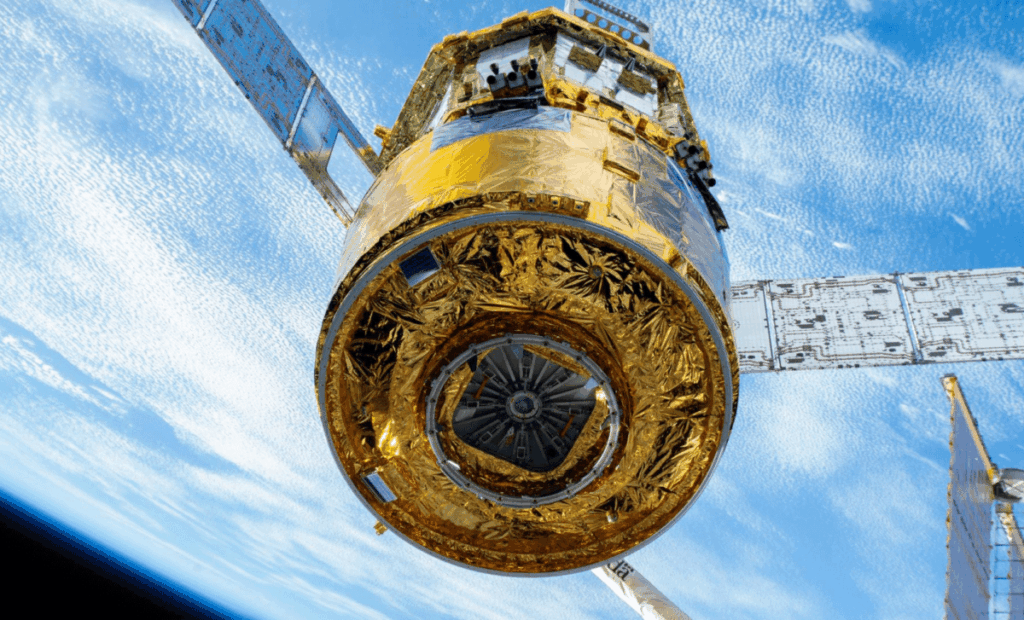
On March 5, 2026, NASA and the Japan Aerospace Exploration Agency (JAXA) will coordinate the departure of the HTV-X1 cargo spacecraft from the International Space Station (ISS), marking another milestone in international space exploration. After delivering over 12,000 pounds of critical supplies and scientific equipment to the ISS, HTV-X1 is preparing for its departure, which will be broadcasted live by NASA on various platforms.
The Vital Role of HTV-X1 in Space Research and Supply Deliveries
HTV-X1’s mission is a crucial component in the ongoing operations of the ISS, providing essential supplies and equipment for both scientific experiments and daily functions. This spacecraft is part of JAXA’s long-standing partnership with NASA, which continues to be vital to the success of the space station. The spacecraft’s primary goal is to deliver more than 12,000 pounds of cargo, including food, scientific experiments, and other hardware that support the astronauts aboard the ISS. NASA astronauts on board rely on these supplies to continue their vital research and daily activities, which contribute to advancements in space exploration and technology.
The HTV-X1 spacecraft’s departure signifies a significant moment in its mission, but the work it does before leaving the station is just as important. As NASA explained,
“The HTV-X1 spacecraft will remain in orbit for more than three months acting as a scientific platform for JAXA’s experiments.”
This extended time in orbit allows JAXA to carry out essential research and experiments, which can provide valuable data for future missions to the Moon, Mars, and beyond.
HTV-X1’s Final Mission: A Controlled Re-Entry
Once its mission as a scientific platform concludes, HTV-X1 will begin its final operation. The spacecraft will re-enter Earth’s atmosphere in a controlled deorbit, where it will burn up harmlessly upon entry. This final procedure serves both as an effective waste disposal method and a safety measure, ensuring that any remaining trash or equipment is eliminated in a controlled manner. According to a statement from NASA,
“Following the deorbit command, the spacecraft will dispose of several thousand pounds of trash during re-entry into Earth’s atmosphere, where it will burn up harmlessly.”
The burning of the spacecraft during re-entry is a necessary procedure, as it prevents any debris from making contact with Earth. The careful planning and execution of HTV-X1’s deorbit sequence underscore the importance of safety in space missions. By ensuring that this spacecraft safely disintegrates as it re-enters Earth’s atmosphere, both NASA and JAXA demonstrate their commitment to space sustainability and environmental responsibility.
Live Coverage of HTV-X1’s Departure
NASA has scheduled live coverage for the spacecraft’s detachment from the ISS, which will take place on March 5, 2026. The space station’s Canadarm2 robotic arm will be used by flight controllers to detach the spacecraft from the Harmony module’s Earth-facing port. Although NASA will not provide live coverage of the detachment itself, viewers can watch the spacecraft’s release, which is set for 12 p.m. EST on March 6. The broadcast will be available through several platforms, including NASA+, Amazon Prime, and YouTube. This live event will allow space enthusiasts and the general public to witness the smooth execution of an important stage in the spacecraft’s mission.
The detailed process of HTV-X1’s release from the ISS is a perfect example of the precision and teamwork required to manage operations in space. The space station’s robotic arm is a marvel of engineering, and its use to maneuver HTV-X1 into position before release is an integral part of ensuring the spacecraft’s safe departure. NASA astronauts, including Chris Williams, will monitor the spacecraft’s systems during the undocking process, ensuring that the operation is conducted smoothly.
The Significance of International Partnerships in Space Exploration
The partnership between NASA and JAXA has been a cornerstone of space exploration for many years. As both agencies collaborate to conduct experiments, maintain the ISS, and continue developing new technologies, their work together fosters a strong bond that advances global scientific knowledge. The HTV-X1 mission is a perfect example of how these international partnerships benefit not just the participating countries but humanity as a whole.
NASA’s focus on deep space exploration, including missions to the Moon and Mars, is well-supported by the research and technologies tested aboard the ISS. Meanwhile, JAXA’s contributions, such as those seen with HTV-X1, continue to play a significant role in the global effort to expand human presence in space. As space exploration progresses, these partnerships will only become more essential.