
Earth is awash in light that has traveled unfathomable distances after being created in some of the most energetic events in the universe as well as light that is reflecting off small rocky objects in our own solar system. But unless the right person with the right equipment is looking in the right place at the right time, many of these events go unnoticed.
That changed Tuesday when the Vera C. Rubin Observatory, jointly funded by the U.S. National Science Foundation and the U.S. Department of Energy’s Office of Science, released its first set of alerts from the Legacy Survey of Space and Time (LSST). These alerts are generated when something in the sky has changed from one visit to the next — maybe something gets brighter or dimmer or a new object comes into view.
People across the globe were given access to a glimpse of supernovae, variable stars, active galactic nuclei and objects such as asteroids whizzing around our solar system; 800,000 alerts, each representing one aspect of the dynamic nature of the seemingly static night sky.
Some of that access is the result of work done by University of Pittsburgh researchers who worked with Google to develop a distribution model that incorporates the company’s cloud services. The Pitt-Google alert broker, as it’s called, is one of seven similar systems that will ingest, process and distribute the full stream of alert data coming from LSST.
“LSST will discover all sorts of things that are changing,” said Michael Wood-Vasey, professor and co-director of undergraduate studies in the Kenneth P. Dietrich School of Arts and Sciences’ Department of Physics and Astronomy. “Whether that’s the variability of a variable star or a black hole feeding in another galaxy … our job as the broker is to ingest all of those changes, classify them and provide information to people who want it” — all within seconds of receiving LSST’s data.
The Pitt-Google alert broker will help researchers better understand cosmic events by putting the new data into context and connecting different types of data about the same event.
“Not only will we ingest data from LSST, but we’ve been ingesting data from the Zwicky Transient Facility in California, and from LIGO/Virgo/KAGRA, a network of gravitational wave detectors,” said Christopher Hernandez, a graduate student in Wood-Vasey’s lab.
A researcher with radio telescope data from one point in space can now get optical and gravitational wave data from the same event, helping them better understand the data they already have.
Wood-Vasey has been involved with the LSST since the early 2000s. At the time, public access wasn’t in the budget. That’s when the idea of the brokers was formed. The researchers just had to figure out how to make it work.
“But this is not an unsolved problem,” Wood-Vasey said. It’s content distribution, something that’s happening online all the time. “Astronomers didn’t have to re-solve the question about distributing data.”
He reached out to a company familiar with content distribution for collaboration: Google.
Troy Raen was also an integral collaborator during his time as a Pitt graduate student, and the project has the support of Daniel Perrefort, a consultant in astrophysics and software engineering at Pitt’s Center for Research Computing and Data.
Three years ago, Hernandez took the lead in the development of the broker. He’s formed collaborations to help build algorithms that can classify the data in various ways for different kinds of research. He’s also teaching researchers how to work with the raw data and tailor alerts to their specific needs.
For both Wood-Vasey and Hernandez, Type Ia supernovae are where the excitement is. These exploding stars can be used to more accurately calculate cosmic distances, allowing for more precise measurements of objects in space. They may also help solve one of the most pressing puzzles in cosmology today: discrepancies in the measured value of the force driving the universe’s accelerating expansion.
But the Pitt-Google alert broker won’t only be helpful for understanding these specific stellar events, because Wood-Vasey, Hernandez and their collaborators went beyond tailoring the broker for their specific needs.
They did that for a reason.
When it comes to all things astronomical, securing the telescope time needed to make observations is a severely limiting factor. As a graduate student at the University of California, Berkeley and a postdoctoral researcher at Harvard University, “I was at places with plenty of resources,” Wood-Vasey said, “but those aren’t the only places where great science is done.”
It’s not always easy for someone, say, teaching several classes at a small school, to gain that access.
“Now, if a teacher says, ‘I want to get my students involved,’ we can say, ‘OK, here are some supernovae that were literally discovered yesterday,’” immediately lowering the barrier to access, Wood-Vasey said.
In graduate school, Vasey-Wood said his research relied on fewer than 200 observations of Type Ia supernovae. Two days ago, a student could take advantage of about 5,000 such observations, thanks to data from the Dark Energy Survey, which has been observing the sky for the past decade.
“LSST will reach that number of Type Ia supernovae in a few months. In a few years, it will have at least 10,000 such observations,” Wood-Vasey said. “There’s science for everyone to do. And the more people who do it, the better.”
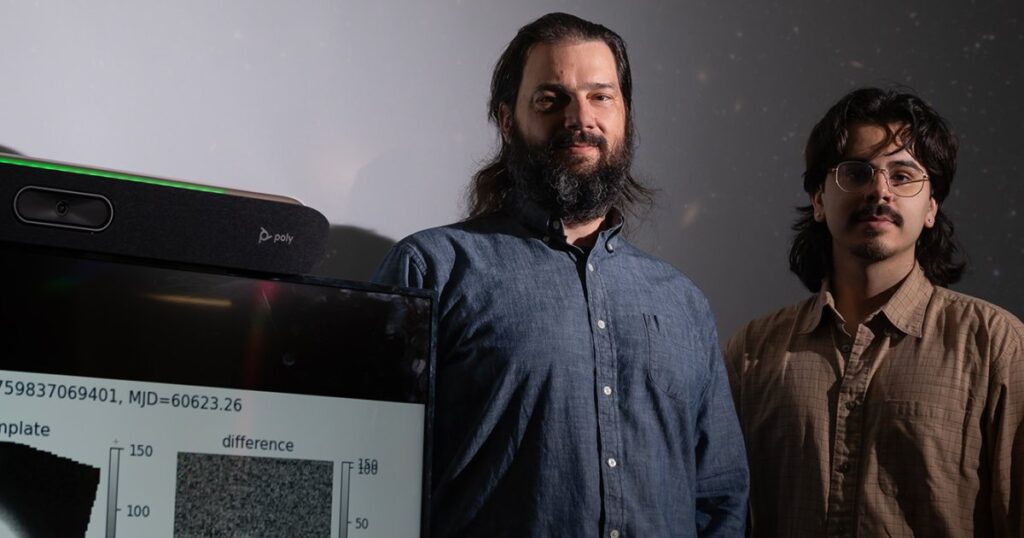
Photography by Aimee Obidzinski; from left, Professor Michael Wood-Vasey and Christopher Hernandez, a fifth-year graduate student in Wood-Vasey’s lab, worked with Google to develop an alert system that will make data from the LSST available worldwide.