
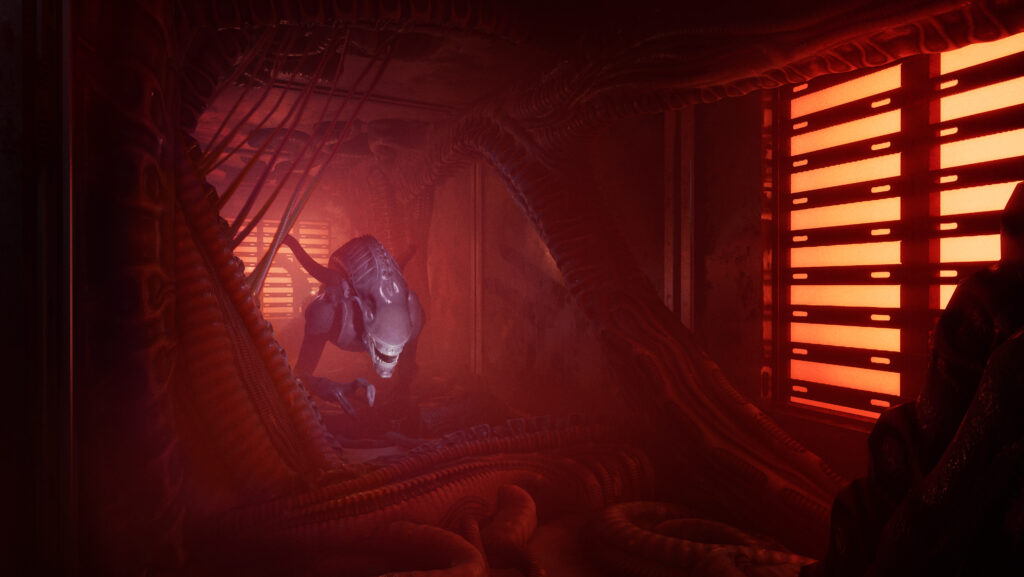
This is an interview with the developers of Alien: Rogue Incursion, TQ Jefferson (Chief Product Officer at Survios) and Eugene Elkin (Game Director at Survios) as featured on AvPGalaxy Podcast Episode 227. Survios initially released the game for virtual reality in December 2024 before it came to traditional PC and console platforms in September 2025 under the ‘Evolved Edition’ banner. The conversation focuses on the game’s transition to its new Evolved Edition, the immersion, story and cut content. You can watch the podcast below or read on for a transcription. Please note that the accompanying transcript has been edited for clarity and brevity.
Origins, Inspirations, and Building Immersion
Aaron: Thank you both for joining us today. Before we start nerding out about things wrapped around our faces, not just facehuggers, we have a tradition on the podcast when we’re joined by new guests and that is always to ask about the first time they encountered our favourite acid-blooded extraterrestrial nightmares. Can you guys remember the first time you came across the Alien franchise? Is it burnt into your memories as much as ours?
TQ: 100% I remember because it was all so traumatizing. When I saw Alien, the first Alien, I was eight years old, which is entirely too young to watch that film, in my opinion. I was watching it at home with my sisters. It was late at night, and the lights were off. I was watching the movie and I was a little tense already, but we got to the scene where Dallas is in the crawl space. The motion tracker is saying, “It’s coming right towards you.” Tom Skerritt turns around and the Xenomorph is there.
Just when that happens, my sister, who’s sitting behind me, grabs the top of my head and pulls back, and the screaming didn’t stop for 20 minutes. The shaking stopped maybe an hour afterwards. That was my intro to Alien.
A post-script to that story is, for Christmas, they bought me the Kenner Xenomorph whose head would glow in the dark. I had this floating skull in my room every night, reminding me of this trauma. For me, making an Alien game where we get to shoot Xenos, and shoot lots of Xenos, is coming full circle. It’s Rogue Incursion Therapy Edition.
Aaron: How about you, Eugene? Do you remember?
Eugene: Absolutely. When I was a kid, I actually grew up in what used to be the Soviet Union. I remember it was like 1991, so I was like nine years old. We weren’t getting American movies or anything yet. We kinda heard about it, but there was this like channel that would come on at 6:00 p.m. I think it was like a pirated channel, not an official sponsored channel, but it would show an American movie once a day. Everybody was at home watching. We didn’t know what it was going to show.
This movie comes on, and for some reason, it was translated as, what it would translate to English back is, Strangers. I had no idea what I was watching. There were no commercials for it, no posters, anything I knew about it.
It was Aliens, the James Cameron one. That’s the first one that I saw. My mind was blown. I was like, “What am I seeing?” That was the first time I saw Space Marines. I remember I was not scared. I was like, “This is badass!” when they were just blowing them up, shooting at them. I saw the first time just like the whole, the Marine get up, the Pulse Rifle. I was just completely energized.
There were like two movies that did it to me, both James Cameron. It was Terminator 2, again, I saw that one first because that’s the one that showed on 6:00 for some reason like that Tuesday, and then Aliens. From then on, I was just kind of obsessed. I didn’t get to see it again until years later, until you get a VHS player and watch it again on VHS. I would just watch that thing on repeat. That’s when we got to make Rogue Incursion, and we specifically focused on the James Cameron one. I’m like, “This is my nine-year-old self dream come true. This is awesome. I get to relive that movie and I get to be a Space Marine and get to shoot these things.” Awesome.

Aaron: Now, there’s been some fantastic Alien games throughout the years, many of which have impacted Alien fans as strongly as the films themselves. Had you guys played many of the games before working on Rogue Incursion and if so, which made the strongest impact on you?
Eugene: Alien: Isolation is incredible, to capture the tension of the first movie. For me personally, the first Alien game I remember playing was the arcade one, the side-scroller Alien Versus Predator.
Aaron: The Capcom one.
Eugene: Yeah, it’s incredible. Then Alien Versus Predator, I think I played that one in the late ’90s. I think that was probably the original one, the multiplayer, that asymmetrical multiplayer where you can play as a Xeno or a Marine or a Predator. That really left an impact on me. To this day, it’s one of my favourite multiplayer experiences.
Aaron: Very nice. How about you, TQ?
TQ: Before I was at Survios, I was at 20th Century Fox, 20th Century Games. I was managing the Alien I.P. amongst other properties, from a gaming standpoint. I ported Alien: Isolation to several platforms, worked on Alien: Blackout, the mobile game, worked on Fireteam Elite, and sourced and brought in Aliens: Dark Descent. I’ve touched a lot of Alien in my career.
Before that, it was Alien: Isolation and Colonial Marines, ones that I knew. Alien: Isolation still creeps me out to this day. It is the love letter to Alien that we tried to replicate for Aliens. We drew inspiration from Alien: Isolation, I would say, in terms of atmosphere, look, just the world, it’s so incredibly well executed.
We also drew inspiration from Colonial Marines, the early release. From that, it was just the kinetic feel of the game and the very premise of you have a weapon and you are pushing back against the Xenomorphs. There are some parallels between the two products. Those two in particular are to me the most influential in terms of Alien and inspiring Rogue Incursion.
Aaron: It’s funny you mentioned Colonial Marines, because something I’d never really considered, but one of the things I really love about Colonial Marines is that they took the tracker off the HUD and they brought it up as an additional item that you picked up, you brought it to the screen and it took it out of your hand.
That is one of the things I absolutely love in Rogue Incursion, having to physically hold it and then that sort of compromises you on the other hand with whatever weaponry you’ve got there. It doesn’t quite hit in Colonial Marines in terms of the tension, but when you’re in Rogue Incursion, and you do have this tracker, it’s bleeping down, your ability to shoot is so compromised having to hold it that it is such a good tension tool in the game, and I didn’t connect the two in my mind there. That’s a good point.
TQ: One of the things that we set out to do was make the most immersive experience possible and make it feel like you’ve been dropped into the boots of a Colonial Marine in the Alien film universe. Some of the moment-to-moment decision-making that has to happen in order to progress through the world is amplified in VR, for sure, but it’s also a key consideration in bringing the game over to PC and console. How do we preserve that experience?
That tension and dread are partly because you are making those decisions, like, “When do I put this away? When do I pick this thing up? When do I use my plasma torch, and how quickly can I get to my pulse rifle or my revolver or my shotgun if there’s danger?” All those things are part of that experience and Eugene and the team did such an amazing job of realizing that in both platforms.
Eugene: You touched on really two important key factors there. One is to keep things diegetic in order to raise immersion, and it’s taking it off the HUD. Take as much away from the HUD as possible and keep it in the world, because then it’s much more immersive that way, unless there is a gameplay explanation if you’ve got a display that’s on your eye.
Everything else, like the motion tracker, we keep in the world. It is disempowering, which is the other factor you touched upon, and we did that multiple times in the game, whether you’re carrying Davis’s head or a hard drive or a fuel rod. You could have just picked it up and it goes into your invisible inventory, and you continue on gameplay as before, but because you have a decision to make—”What do I do? Do I carry it? Where do I place it? I’d better not forget it over there. I gotta drop it. I’m going to handle my business, or maybe I should have a pistol out because I can have something in one hand.” There are all these choices you have to do as you’re playing and this keeps you grounded inside the game world rather than taking it out through abstractions such as, “Oh, it’s just magic, it’s in your inventory.”
Adam: One of the things I thought Rogue Incursion just managed so well was the tension and the horror elements. While Aliens had more action than the first, it still had the horror elements and the tension. Games like your game or Tindlos’s Aliens: Dark Descent, I think, really nailed that feel from the second film.
Next, this is a question for TQ if I’m not mistaken. You mentioned you were at 20th Century Games before. I think it was FoxNext back then, right? I was wondering if you had any involvement with the excellent attraction Alien Descent, which was by Pure Imagination Studios?
TQ: That was the one that was in Orange County, I believe? That was already stood up, I believe, before I got to FoxNext. The V.R. and emergent technologies were a separate group from the games group over at FoxNext. I was V.P. of Production for our licensed games. Then there were the two internal teams doing Marvel and Avatar, and there was this emerging technologies team that did the installation.
Aaron: Did you ever get a chance to do it yourself?
TQ: I didn’t. The one thing I did experience was In Utero. That was another thing that was done by that group, which I thought was pretty amazing. One of our designers here, Alicia Smith, actually worked on Alien Descent. She brought all of that knowledge with her and dropped it into our cauldron of game development for Rogue Incursion.
Adam: That was going to be the next part of my question if you’d said yes, but it seems like from one of your staff, it was still the case that the experience gained from that kind of assisted with Rogue Incursion. I was fortunate enough to do that twice and, oh man, that was something. Just how they melded V.R. with what you were experiencing in person, like walking on catwalks, wind effects and stuff like that, temperature effects. I still wonder how they pulled everything off there, but that was quite something.
TQ: I’ve said it in interviews before, but there’s something about Alien that is meant for VR. There are places like The Void or Two Bit Circus, that sort of thing, where you could have a more permanent installation that is experiential like that. I think it would be incredibly popular and it would stay incredibly popular. There’s just something special about it.

Aaron: So, cards on the table here, like I said before we started, I really, really love Rogue Incursion. I’d been dying for that from the ground up V.R. Alien game, and you guys really hit it out of the park for me. When you first started working on Rogue Incursion, when you knew you were going to be doing Alien in V.R., what were those elements that you zoned in specifically on, straight off the bat, Alien V.R., what were the first things that sort of jumped to mind as to this is how we make it work?
TQ: The art direction. It was one of the early decisions that we took, which was that there are a number of different ways to render the visuals in the game, and some are more taxing than others, especially in VR since you’re rendering for each eye. But we felt it was incredibly important to be realistic to hyper-realistic in the realization of the world because we knew that at some point, you’re going to be face-to-face with a Xenomorph, and we wanted that to be every bit as real and terrifying and present as possible. If you’re looking at one with say, that’s cell-shaded, with black ink lines and so forth, it’s in your face, but it doesn’t feel quite as real to you. The art direction across the board, we felt that that was important for the mood, the lighting in particular, capturing the authentic look of the Alien films was our earliest art decision, and there really wasn’t a lot of conversation about alternatives there.
Eugene: In terms of the Xenomorph itself, several pillars that we established early on, and then we proved them in prototypes, and that’s when we knew we had something. The pillars themselves were respect the Xenomorph, meaning if you come across it, a couple of hits, you’re dead. You’re not going to be running away from it and spending a lot of time in a room with it. You either kill it or it’s going to kill you. It can hide in plain sight. It can be anywhere.
That was actually a really key moment for us in terms of how we developed the tech for it as well. It can climb on walls, ceilings, it can be behind walls, it can crawl through an opening in the environment. It exists in the environment, meaning it simulates, it doesn’t just spawn. There are no spawners. You don’t know where it’s going to come from, so keep your head on a swivel.
Keeping the tension up. The horror was going to come from not scripted moments, and there are a couple of scripted moments in there, and we want to surprise the player, but the rest we wanted to be a unique and dynamic experience that’s different from player to player or if you go through the same environment multiple times. Our very first prototype, when we locked it down, we knew it would work, it was just a hallway and the hallway ended up in many parts of the game, but it was just a hallway with the one room. As you walk through it, the Xenomorph was running on the walls, it was behind. It would show up and then it would just dart into a vent and pop up from another vent.
We had the hallway demo that we showed to so many people and everybody who played through it was like, “Whoa, that’s scary. That is empowering,” because at the same time, you can blast the Xenomorphs, and you can just batch all three of them. From there, we expanded that combat to the entirety of the game.
TQ: I think another one that bears mentioning is audio. We’ve said many, many times that audio is important in horror, period. But it’s invaluable in Aliens. I’ve often said that sound is the second most important thing after the Xenomorph in Aliens. We had to create a world where the audio was playing an active role in creating tension, creating paranoia, giving you to think that there was a Xenomorph over there, or maybe it was over there, or maybe it was right behind you, to keep your head on a swivel and keep people anxious and guessing. The audio team did an amazing job of creating that atmosphere for us.
Later on top of that, was the score that Sarah Barone composed for us and the systems for playing the music that was dynamic and changed based on what was happening in that moment. We could ratchet up the energy, bring it back down again, and really just work so very well in this atmosphere. Even when you go from V.R. to P.C. console, the audio team remixed all of the sounds for the game, so even if you’re playing it on a flat screen TV, the way the sounds are firing, it’s still going to get you to look around and distract you or draw you away from where the Xenomorph really is.
Eugene: Absolutely. Once we added the audio to it, because obviously, the original prototype of the hallway demo didn’t really have that type of audio yet. It didn’t have positional audio, meaning it’s different if it’s behind a wall, behind a door. There’s real physicality to the audio that reverberates correctly depending on the environment and that’s really key because the Xenomorphs do travel sometimes pretty far away to get to you when you ring the dinner bell, when you shoot the gun or you’re being clumsy. Hearing them muffled and it’s getting louder and louder and louder, it’s anxiety-inducing. That’s a dimension that we didn’t quite have until we added that audio, and then it felt magical.
Aaron: That is absolutely one of the heart-racing sort of moments in the game, when you hear the motion tracker go off first, then you start to hear them up in the vents or not quite sure exactly where they are around you and yeah, nailed the sound.