
Explore HubbleHubble HomeOverview
Impact & Benefits
Science
Observatory
Team
Multimedia
News
More
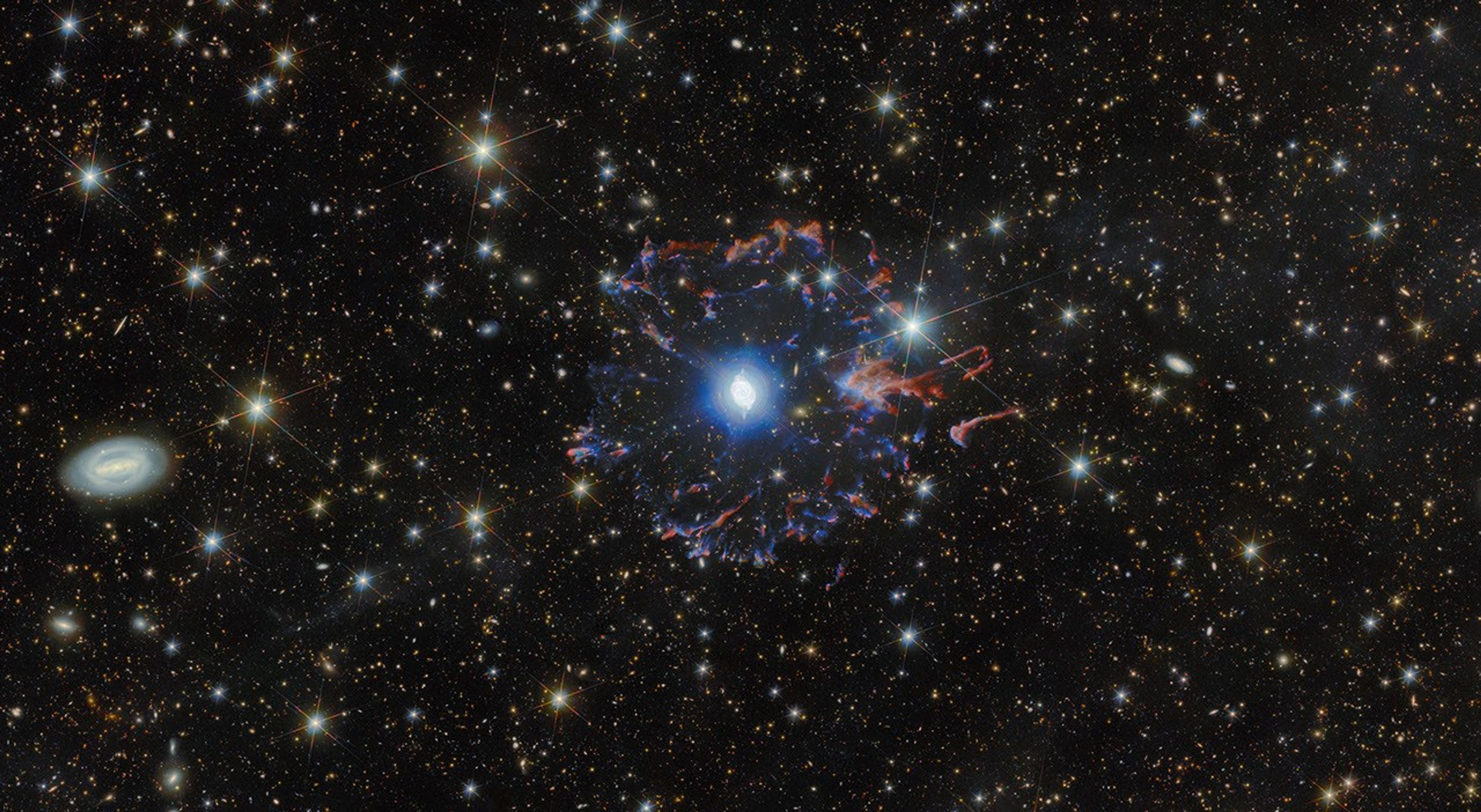
Hubble and Euclid teamed up in this image of the Cat’s Eye Nebula, NGC 6543.
Credits:
ESA/Hubble & NASA, ESA Euclid/Euclid Consortium/NASA/Q1-2025, J.-C. Cuillandre & E. Bertin (CEA Paris-Saclay), Z. Tsvetanov
ESA/Hubble & NASA, ESA Euclid/Euclid Consortium/NASA/Q1-2025, J.-C. Cuillandre & E. Bertin (CEA Paris-Saclay), Z. Tsvetanov
This new NASA/ESA Hubble Space Telescope image features one of the most visually intricate remnants of a dying star: the Cat’s Eye Nebula, also known as NGC 6543. This extraordinary planetary nebula lies in the constellation Draco and has captivated astronomers for decades with its elaborate and multilayered structure. Observations with ESA’s Gaia mission place the nebula at 4,400 light-years away.
Planetary nebulae, so-called because of their round shape, which made them appear to look like planets when viewed through early telescopes, are in fact expanding gas thrown off by stars in their final stages of evolution. It was the Cat’s Eye Nebula itself where this fact was first discovered in 1864 – examining the spectrum of its light reveals the emission from individual molecules that’s characteristic of a gas, distinguishing planetary nebulae from stars and galaxies.
Hubble also revolutionized our understanding of planetary nebulae; its detailed images showed that the simple, circular appearance of a planetary nebula seen from the ground belies a very complex morphology. This was particularly true of the Cat’s Eye Nebula, where Hubble images in 1995 revealed never-before-seen structures that broadened our understanding of how planetary nebulae come to be.
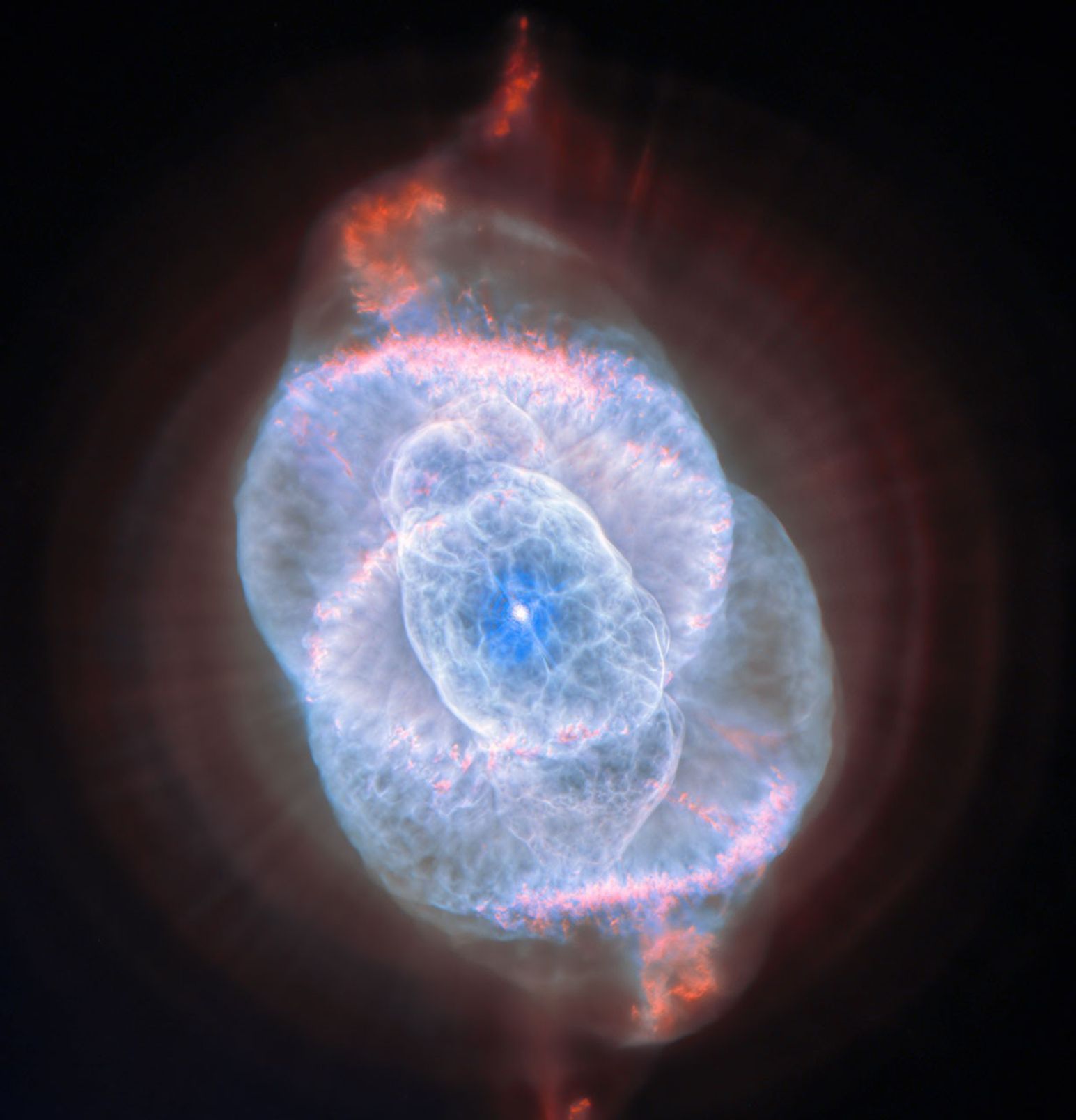
In this new image, Hubble captures the very core of billowing gas with the High Resolution Channel sub-instrument on its Advanced Camera for Surveys (ACS). This instrument is optimized for taking very sharp images of fine details in a small area, such as the complex features at the heart of the Cat’s Eye Nebula. The data reveal a tapestry of concentric shells, jets of high-speed gas and dense knots sculpted by shock interactions, features that appear almost surreal in their intricacy. These structures are believed to record episodic mass loss from the dying star at the nebula’s center, creating a kind of cosmic “fossil record” of its final evolutionary stages. Part of these data were also used in a previous image of the Cat’s Eye Nebula, released in 2004. Previously unused data from ACS is combined with state-of-the-art image processing to create this new image, the sharpest yet taken of this nebula.
ESA/Hubble & NASA, Z. Tsvetanov
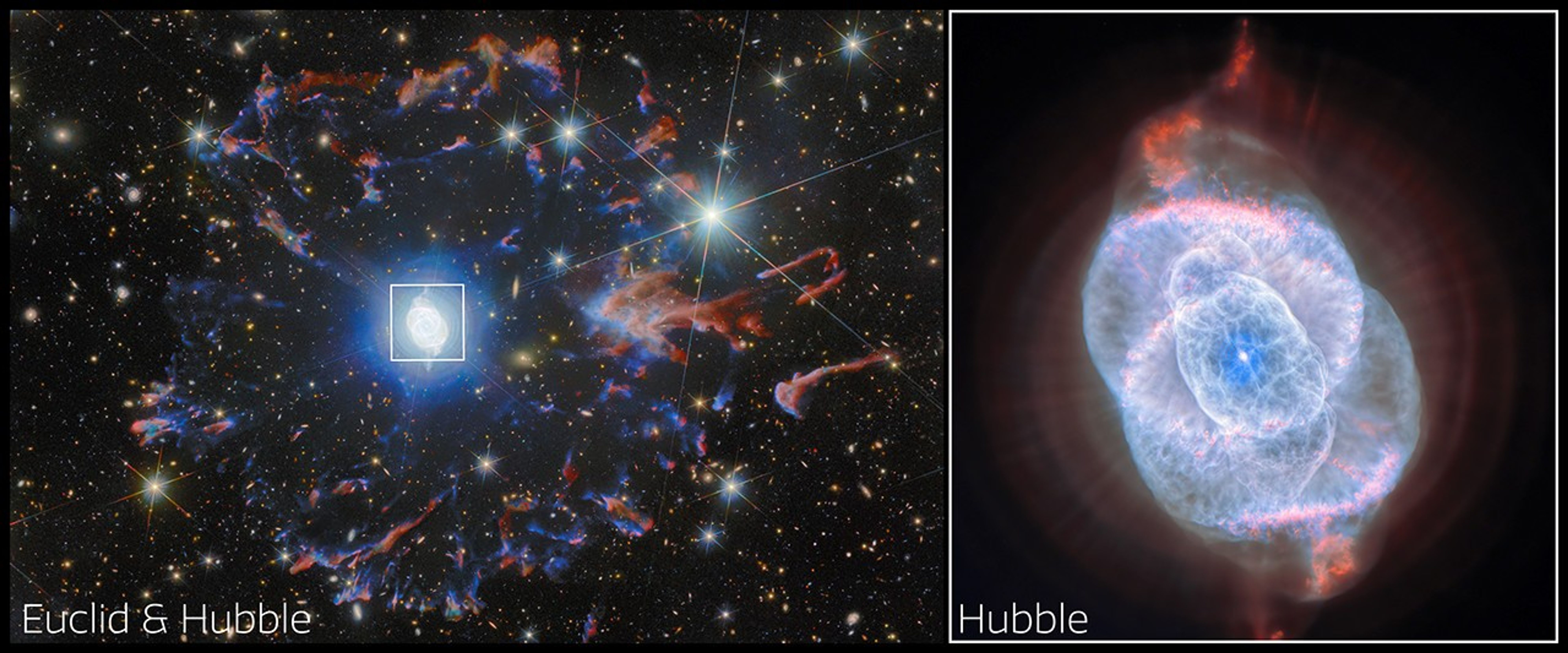
This time, Hubble is joined by ESA’s Euclid space telescope to create a new image of NGC 6543. The combined eyes of Hubble and Euclid reveal the remarkable complexity of stellar death in this object. Though primarily designed to map the distant universe, Euclid captures the Cat’s Eye Nebula as part of its deep imaging surveys. In Euclid’s wide, near-infrared, and visible light view, the arcs and filaments of the nebula’s bright central region are situated within a halo of colorful fragments of gas zooming away from the star. This ring was ejected from the star at an earlier stage, before the main nebula at the center formed. The whole nebula stands out against a backdrop teeming with distant galaxies, demonstrating how local astrophysical beauty and the farthest reaches of the cosmos can be seen together with Euclid.
In Euclid’s wide, near-infrared, and visible light view, the arcs and filaments of the nebula’s bright central region are situated within a halo of colorful fragments of gas zooming away from the star. This ring was ejected from the star at an earlier stage, before the main nebula at the center formed. Hubble captures the very core of the billowing gas with high-resolution visible-light images, adding extra detail in the center of this image. The whole nebula stands out against a backdrop teeming with distant galaxies, demonstrating how local astrophysical beauty and the farthest reaches of the cosmos can be seen together in modern astronomical surveys. Together, these missions provide a rich and complementary view of NGC 6543 – revealing the delicate interplay between stellar end-of-life processes and the vast cosmic tapestry beyond.
ESA/Hubble & NASA, ESA Euclid/Euclid Consortium/NASA/Q1-2025, J.-C. Cuillandre & E. Bertin (CEA Paris-Saclay), Z. Tsvetanov
Within this broad view of the nebula and its surroundings, Hubble captures the very core of the billowing gas with a new high-resolution visible-light image, adding extra detail in the center of this image. The data reveal a tapestry of concentric shells, jets of high-speed gas and dense knots sculpted by shock interactions, features that appear almost surreal in their intricacy. These structures are believed to record episodic mass loss from the dying star at the nebula’s center, creating a kind of cosmic “fossil record” of its final evolutionary stages.
Combining the focused view of Hubble with Euclid’s deep field observations not only highlights the nebula’s exquisite structure but also places it within the broader context of the universe that both space telescopes explore. Together, these missions provide a rich and complementary view of NGC 6543 – revealing the delicate interplay between stellar end-of-life processes and the vast cosmic tapestry beyond.
/Public Release. This material from the originating organization/author(s) might be of the point-in-time nature, and edited for clarity, style and length. Mirage.News does not take institutional positions or sides, and all views, positions, and conclusions expressed herein are solely those of the author(s).View in full here.