
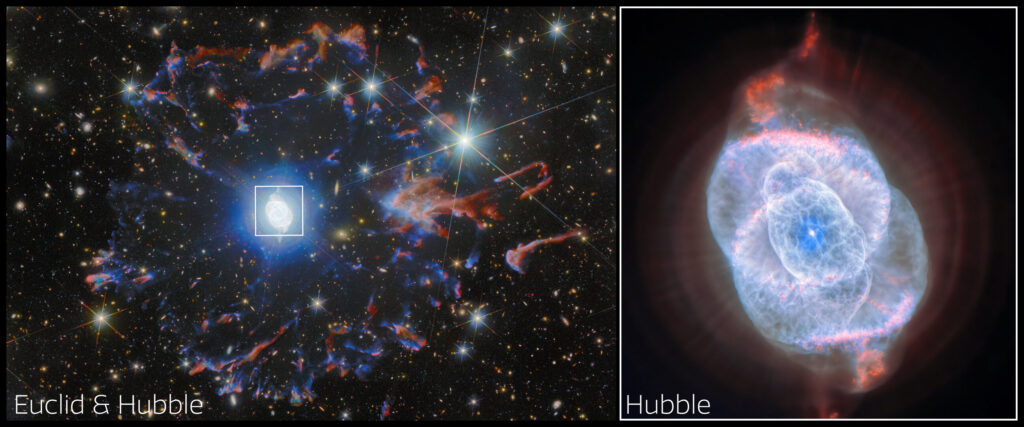
For this month’s ESA/Hubble Picture of the Month, NASA/ESA’s Hubble Space Telescope is joined by ESA’s Euclid to create a new view of the most visually intricate remnants of a dying star: the Cat’s Eye Nebula, also known as NGC 6543.
This extraordinary planetary nebula in the constellation Draco has captivated astronomers for decades with its elaborate and multilayered structure.
Planetary nebulae, so-called because of their round shape when viewed through early telescopes, are in fact expanding gas thrown off by stars in their final stages of evolution. It was the Cat’s Eye Nebula itself where this fact was first discovered in 1864 – examining the spectrum of its light reveals the emission from individual molecules that’s characteristic of a gas, distinguishing planetary nebulae from stars and galaxies.
Here, the nebula is showcased through the combined eyes of the NASA/ESA Hubble Space Telescope and ESA’s Euclid, highlighting the remarkable complexity of stellar death.
[Image Description: Two images of a planetary nebula in space. The image to the left, labelled ‘Euclid & Hubble’, shows the whole nebula and its surroundings. A star in the very centre is surrounded by white bubbles and loops of gas, all shining with a powerful blue light. Farther away a broken ring of red and blue gas clouds surrounds the nebula. The background shows many stars and distant galaxies. A white box indicates the centre of the nebula, and this region is the image to the right, labelled ‘Hubble’. It shows the multi-layered bubbles, pointed jets and circular shells of gas that make up the nebula, as well as the central star, in greater detail.]