
NASA’s Early Image of Interstellar Object 3I/ATLAS No Longer Tells the Full Story
What was once framed as a straightforward hydrogen plume is now eclipsed by evidence of structured motion, symmetry, and complexity that challenges conventional comet science.
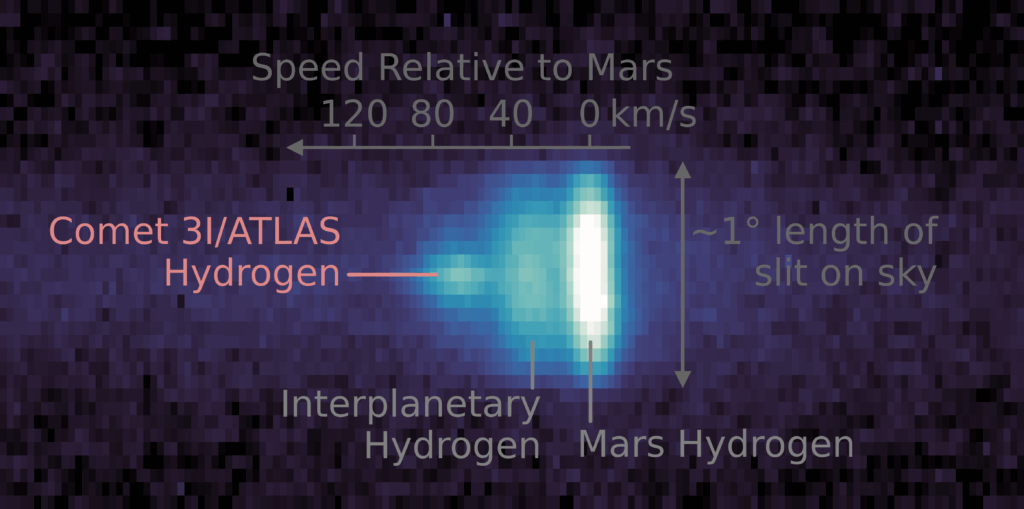
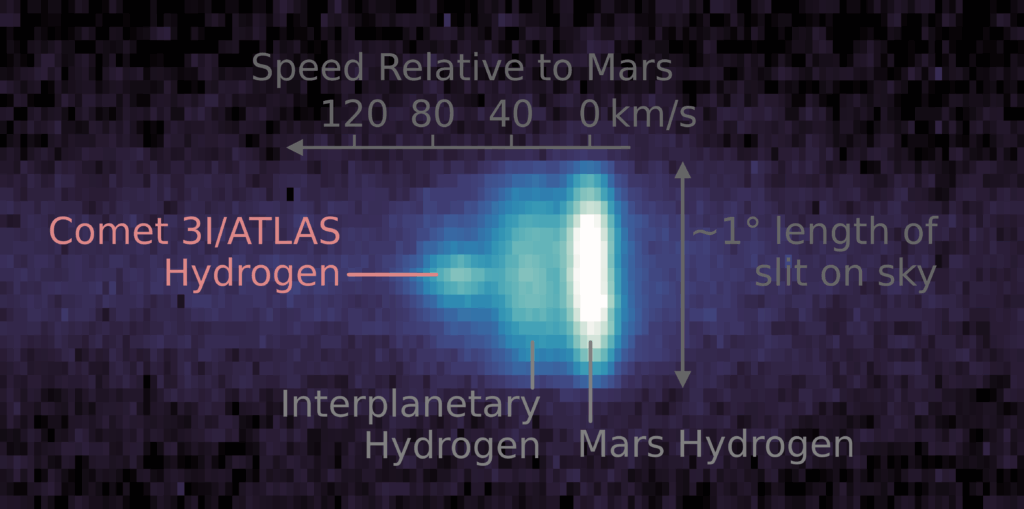
Three months ago, NASA released an image of 3I/ATLAS that appeared to offer clarity.
A hydrogen signal. A velocity map. A familiar story.
But science did not stop moving while the image stood still.
[USA HERALD] – As new observations accumulated and independent analyses accelerated, it became clear that the image — while accurate at the time — no longer reflects what researchers now understand about this object passing through our solar system.
A Snapshot Frozen in an Earlier Assumption
The NASA graphic depicted hydrogen emission associated with 3I/ATLAS, plotted against velocity relative to Mars. The implication was straightforward: hydrogen detected through ultraviolet emission was being released in a manner consistent with water ice sublimation, a hallmark of ordinary comets.
That interpretation fit comfortably within established models. Hydrogen was treated as a secondary byproduct, drifting outward in a largely diffuse and thermally driven cloud. For a brief moment, 3I/ATLAS appeared explainable.
That moment has passed.