
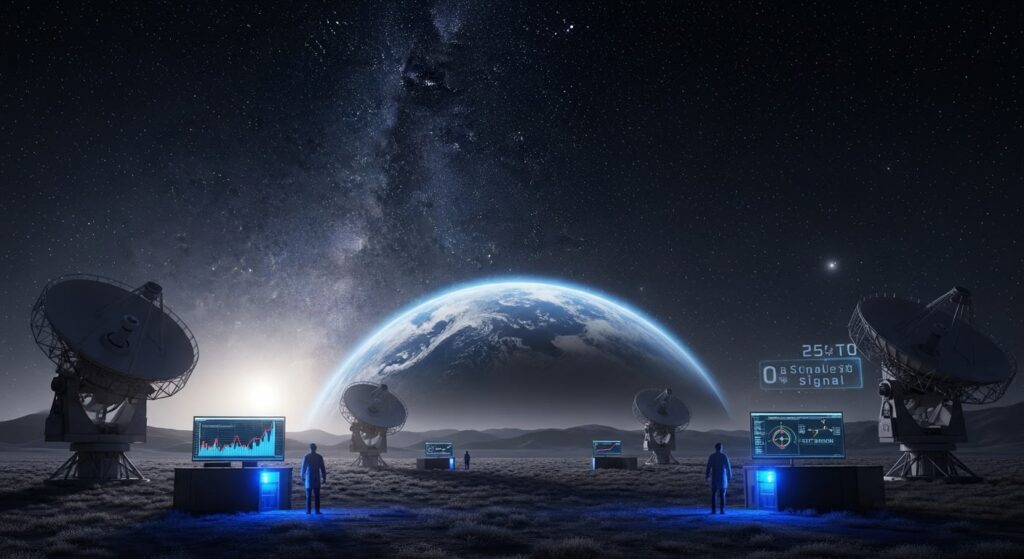
It began without darkness.
The stars still shone.
On a clear Thursday night, children in deserts and cities pointed upward at familiar constellations. Satellites orbited peacefully. Aircraft crossed continents. The sky looked exactly as it had the night before.
But at 02:17 UTC, deep beneath the Atacama Desert, engineers monitoring the European Southern Observatory noticed something impossible.
The universe had stopped speaking.
Every telescope array registered the same anomaly. No gamma radiation. No radio waves. No X-ray bursts. Pulsars that had ticked like cosmic clocks for millennia fell silent. Even the faint whisper of background radiation—the leftover echo of creation itself—flattened into nothing.
The stars were still visible.
But energetically, they were dead.
Within minutes, alerts spread to NASA, the CERN, and the China National Space Administration. Independent observatories confirmed it. Instruments were recalibrated. Software was replaced. Dishes were physically rotated.
Nothing changed.
The cosmos had been muted.
At first, scientists suspected interference. Solar disruption. Equipment failure. A previously unknown physical phenomenon.
But by sunrise, a deeper horror emerged.
Neutrino detectors—designed to catch ghostlike particles streaming from nuclear reactions inside stars—detected zero activity. Not reduced.
Zero.
That meant fusion across the observable universe had ceased.
Yet the stars still shone because of light already in transit. Photons emitted years, centuries, even millions of years ago were still traveling toward Earth. The sky was a delayed broadcast of a show that had already ended.
Humanity was watching the afterimage of a dead universe.
Global markets halted within hours. Religious leaders filled screens. Hashtags trended worldwide: #SilentSky #CosmicBlackout #TheEnd
Dr. Elara Mirov, a theoretical physicist at CERN, delivered the sentence that shifted everything:
“This is not decay. It is coordination.”
The shutdown was uniform. Instantaneous. Across distances so vast that even light would take billions of years to cross them. No natural process could act everywhere at once.
Something had flipped a switch.
Three days passed.
The Sun continued to shine—because its light from eight minutes prior was still arriving. But solar neutrino detectors confirmed what they feared.
The Sun’s core had gone silent too.
Earth had approximately eight minutes of ignorance before sunrise would fail.
Governments prepared emergency broadcasts. Power grids braced for collapse. Space agencies redirected satellites to collect final measurements. The world held its breath.
Then, at 11:42 UTC—
The Sun dimmed.
Not dramatically. Not explosively.
It simply… faded.
Daylight softened into twilight within seconds. Temperatures began dropping almost immediately. Solar panels went dark. Birds fell silent as if obeying a deeper quiet.
The universe was not exploding.
It was shutting down.
But amid the fear, a pattern emerged.
Deep-space radio arrays at the Very Large Array detected a faint, structured fluctuation—not radiation, but absence modulated in rhythm. Like someone tapping on a muted microphone.
Zero. Zero. Zero. Pulse.
Zero. Zero. Zero. Pulse.
Binary.
A message encoded in silence.
Teams worldwide collaborated in real time, translating the rhythm. The signal was simple, repeating, mathematical.
It described a sequence. A countdown.
And at its end, a symbol.
A circle.
Dr. Mirov proposed the unthinkable.
“What if this isn’t destruction? What if it’s containment?”
She theorized that the universe functioned like a computational field—vast, structured, governed by deeper layers of reality. If something within it became unstable, the system might suspend energy processes to prevent further spread.
A cosmic quarantine.
Human consciousness, she argued, had recently crossed thresholds—quantum experiments, artificial intelligence, high-energy collisions. Perhaps Earth had triggered something. Perhaps awareness itself was a variable the universe had not predicted.
The stars weren’t dying.
They were paused.
As days passed, temperatures plummeted. Oceans began forming ice along their edges. Emergency reactors powered cities in rotating grids. Humanity unified with startling speed—not out of hope, but survival.
And then, on the seventh night of darkness, the sky changed.
The stars flickered.
Not randomly—but sequentially.
Like a progress bar restarting.
One by one, distant points of light brightened—not merely visually, but energetically. Telescopes screamed back to life with radiation readings. Pulsars resumed ticking. Neutrinos streamed once more through Earth’s crust.
Fusion reignited across the cosmos.
The Sun returned in a violent bloom of gold over frozen horizons.
The universe had rebooted.
But something was different.
The cosmic background radiation—the oldest light in existence—now carried a subtle asymmetry. A watermark.
Embedded within it was the same circle symbol from the countdown.
And beneath it, translated by global consensus into mathematical certainty, a final message:
“Version 1.1 initialized.”
Humanity had not been erased.
It had been updated.
And somewhere beyond the silent layers of space, something was still watching—monitoring its experiment, waiting to see what the rebooted stars would illuminate next.