
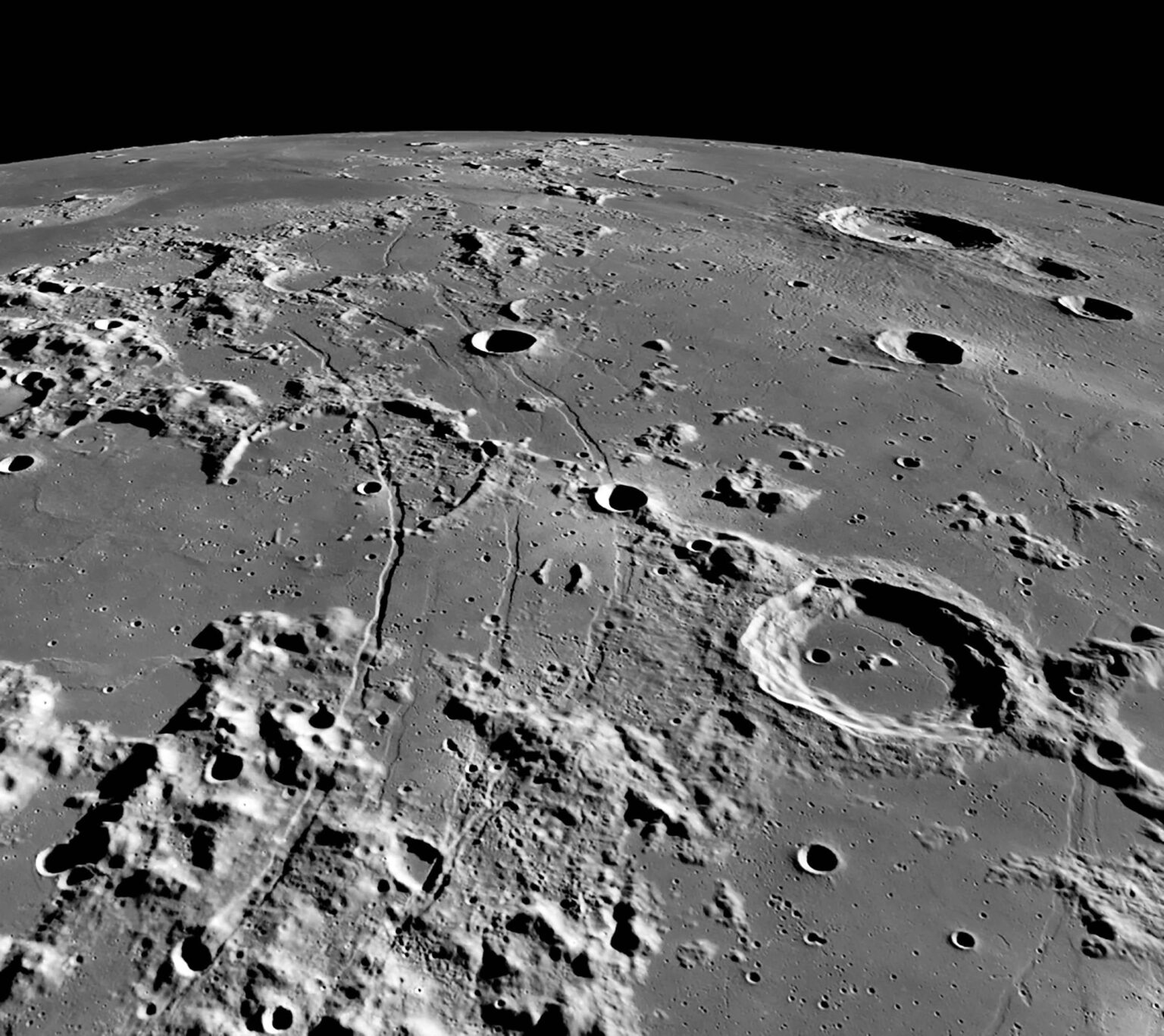
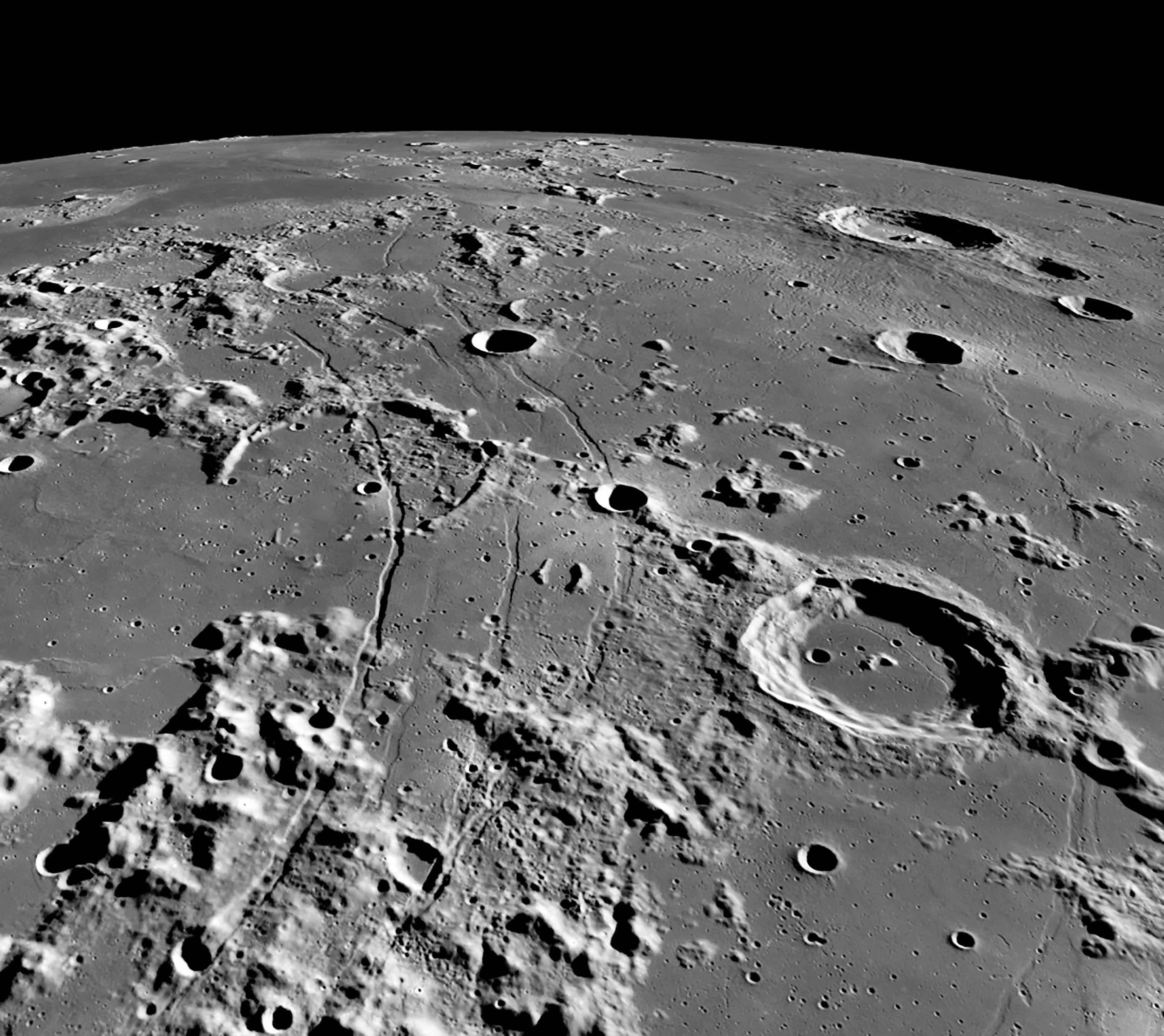
An oblique view of Rimae Hippalus on the Moon, showing the extent of the grabens, which span over 250 kilometers. The image width is roughly 150 kilometers at the bottom, and 500 kilometers on the horizon. The central peak crater Campanus (46-kilometer diameter) is in the right foreground.
by Grahamthicke
2 Comments
Grabens are long valleys that form on the Moon when a block of crust drops between two normal faults as the surface stretches.
A recent detailed [analysis](https://www.mdpi.com/2072-4292/16/1/107) shows that lunar grabens are the largest tensional linear structures on the Moon and that they cluster along the margins of mare basins.
A dedicated mapping campaign using global images from Lunar Reconnaissance Orbiter ([LRO](https://science.nasa.gov/mission/lro/)) identified more than 1800 separate graben segments on the Moon’s nearside alone.
Many of these troughs run for hundreds of kilometers while remaining only a few miles wide, which makes them narrow but powerful markers of ancient stress.
The same analysis of their ages finds that most large grabens formed between about 3.7 and 3.4 billion years ago, with activity peaking near 3.6 billion years ago.
When all of those valleys opened, the [Moon](https://www.earth.com/news/china-discovers-carbon-in-moon-samples-that-could-change-the-history-of-its-origins/)’s radius grew by roughly 400 feet, a tiny change compared with its total size but a clear sign of global extension.
Later, smaller examples added another twist to the story. A high-resolution lunar graben[ ](https://www.sciencedaily.com/releases/2012/02/120220135000.htm)was reported that likely formed less than 50 million years ago, showing that the Moon’s crust did not stop adjusting in deep time.
image taken with an iPhone.