
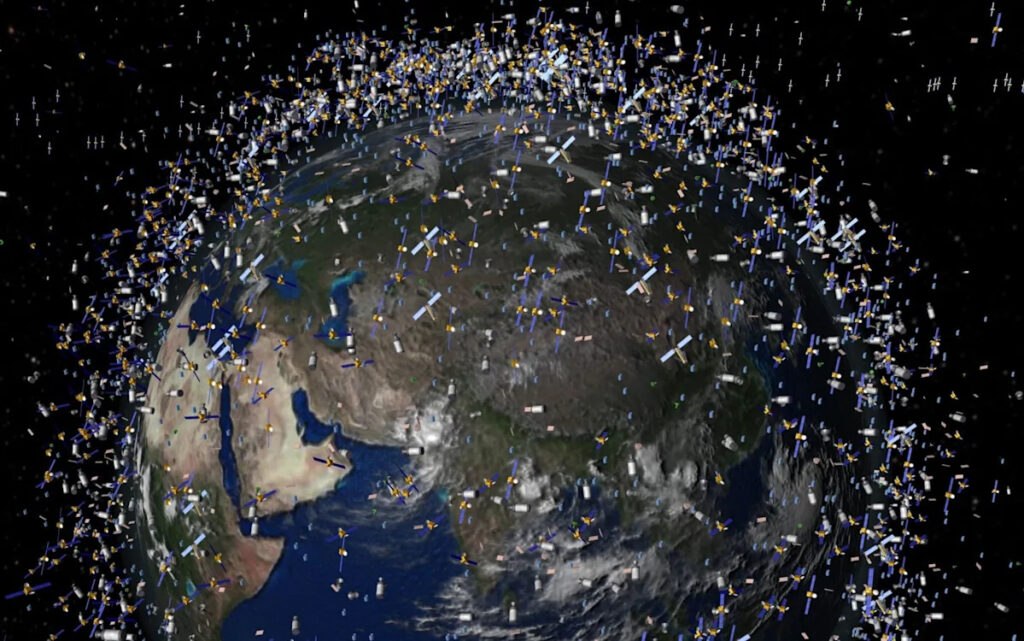
The risk of space junk crashing into the UK “cannot be ignored”, the UK Space Agency has said.
Government scientists are “closely” monitoring space junk after a spate of incidents in the past year in which debris from rockets and satellites has fallen across the world.
With debris having struck Kenya, Poland and Australia during the past year, experts have said that “it’s a question of when” the UK will be hit.
Angus Stewart, joint head of the National Space Operations Centre at the UK Space Agency, said: “Over the past 12 months or so, we’ve seen objects re-entering the Earth’s atmosphere close to the UK, with debris landing in mainland Europe.
“It’s something we’re monitoring closely, because the risks cannot be ignored.”
Mobile networks were asked to check the UK’s emergency alert system in January amid concerns fragments of a Chinese rocket could land in Britain.
The risk of space debris plummeting to Earth has jumped in recent years because of the proliferation of rockets and satellites being launched into orbit.
Andrew Faiola, commercial director of Astroscale, said: “Space debris respects no national borders. We are seeing more and more, so it could just as easily be here as anywhere else. Statistically, it’s probably a question of when” the UK was hit, he added.
Until 2018, humans had launched fewer than 9,000 satellites into space. But with the rise of low-Earth-orbit satellites – those which operate at between 100km and 2,000km above Earth – that number has soared to around 15,000.
Elon Musk’s SpaceX, which owns 60 per cent of all satellites in orbit, plans to launch a mega-constellation of more than one million spacecraft.
China, too, has expanded from fewer than 100 satellites in 2013, to 1,900 today, while the EU and countries such as India are also rapidly scaling up their numbers of space launches.
The influx of satellites in low-Earth orbit has increased congestion, increasing the risk of a high-speed collision.
“There are around a million pieces of material with enough energy to disable a spacecraft currently orbiting the earth,” warned Don Pollacco, a professor of astrophysics at the University of Warwick.
These fragments of old spacecraft fire through space at 25,000mph, 20 times the speed of sound. At these speeds, he said, a piece of debris the size of a human finger has enough energy to take out a satellite. “It’s like a grenade,” he said.
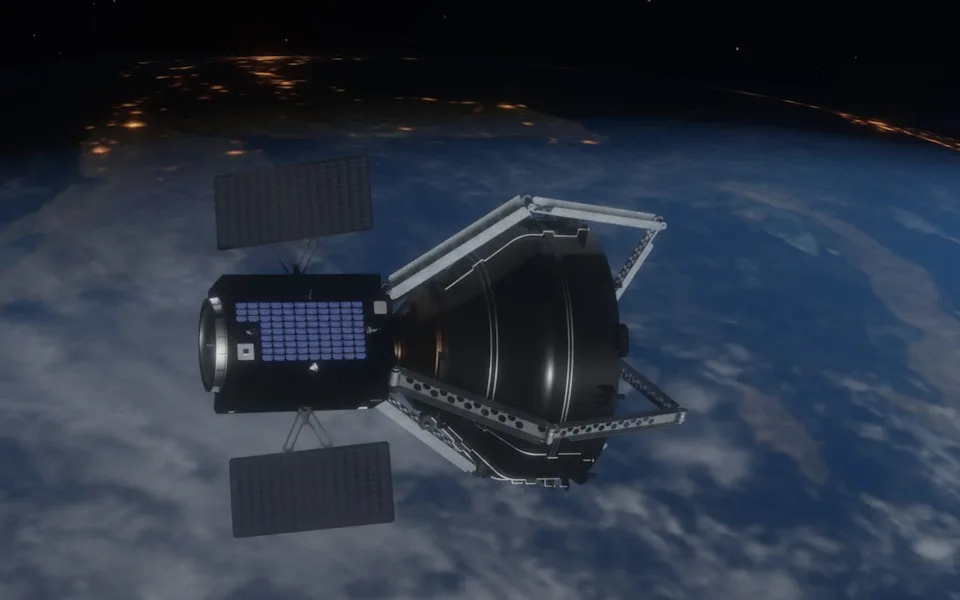
Clearspace-1 is a UK-based European Space Agency mission to remove a used satellite from orbit
Space debris passes by the UK about 70 times a month and, on average, around three large pieces of space debris land on Earth each day. It almost always lands in the sea or disintegrates over sparsely populated areas.
Space junk is also closely monitored by the UK’s emergency preparedness teams for the unlikely possibility that it lands on the UK mainland, where it could cause damage or risk to life.
The risk of small satellites crashing down to earth is small, with most likely to burn up in the Earth’s atmosphere. However, the real danger is when these collide with the bodies of much larger ageing rockets that have been dumped into orbit.
In late January, an 11m-long booster from China’s Zhuque-3 rocket, which had launched on Dec 3, splashed down to Earth about 1,200 miles south-east of New Zealand.
The incident caused Britain’s mobile networks to check their emergency alert systems in case the debris crashed into the UK and a message needed to be sent to people living near the impact site.
On Feb 19, a piece of debris from a SpaceX Falcon 9 rocket crashed in western Poland, damaging property, according to local media.
In Kenya, a 500kg metal ring from an ageing rocket came crashing down in late December. In Australia, smoking fragments of a suspected Chinese rocket barrelled into the western part of the country last October.
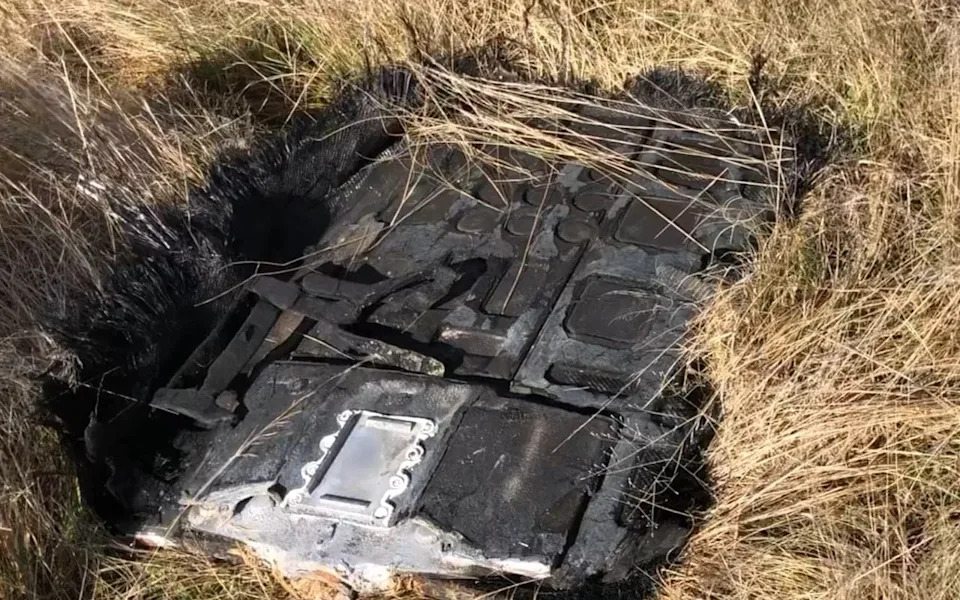
Two Australian farmers discovered debris from a Space X craft on their land in August 2022 – Brad Tucker/Cover Images
Besides warnings of rocket debris raining down on UK cities, experts warn that the increase in space launches is likely to increase the risk of pollution, as many satellites contain rare metals on board.
Most disturbing of all are fears of the Kessler effect, which theorises that if enough debris collides in space, it could create a chain reaction of collisions, eventually rendering parts of the Earth’s orbit inaccessible.
Efforts are under way to deal with the increasing risk of space debris. These include Astroscale, a UK government-backed company building spacecraft to tow ageing satellites out to the so-called “graveyard orbit” – more than 36,000km from Earth, where they no longer pose a threat.
According to Prof Pollacco, another potentially far less expensive solution is to have better systems in place to track the location of satellites in orbit.
Currently, many objects travelling in low Earth orbit can be tracked only to within an area of 10 cubic km, making collisions incredibly difficult to predict accurately.
“If we know where satellites are and have confidence in our predictions, we could be a lot better prepared to do something about it,” Prof Pollacco said.