
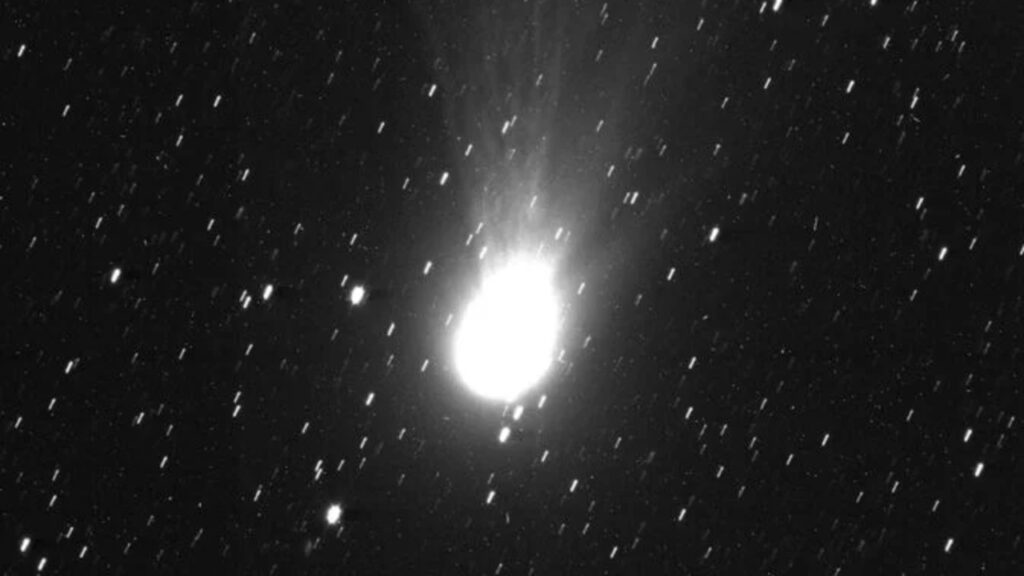
Just seven days after interstellar comet 3I/ATLAS reached perihelion, ESA astronomers were able to capture detailed images of it using the JUICE mission. According to available reports, 120 images of the interstellar comet were taken as it continued on its part of the journey through our solar system.
Another View Of Interstellar Comet 3I/ATLAS Provided By The ESA JUICE Mission
On 14 April 2023, the ESA JUICE (Jupiter Icy Moons Explorer) mission lifted off aboard an Ariane 5 rocket from Europe’s spaceport in Kourou, French Guiana. This mission would be responsible for studying not just Jupiter’s moons, but also the planet’s environment.
The JUICE mission is still en route to Jupiter, where its mission will begin, but it is still able to make some detailed observations of our solar system. One of such observations this mission has made in recent times is that of interstellar comet 3I/ATLAS.
Using the mission’s JANUS camera, ESA astronomers were able to capture 120 images of the interstellar comet just after perihelion. These images were taken on 6 November 2025, and they provide a detailed view of the comet.
From the images, we can see the comet’s nucleus surrounded by a coma with its tail stretching into space. The JANUS camera wasn’t the only instrument aboard the JUICE mission that was directed towards this interstellar comet.
Four other pieces of equipment were also directed towards the comet to help gather more information about this comet. The information gathered is currently being analysed by ESA scientists to expand our understanding of this comet.
Learning More About Interstellar Comet 3I/ATLAS
The 120 images of interstellar comet 3I/ATLAS, as well as the data gathered by the mission’s other instruments, will help expand our understanding of this comet. Over the past few months, more details on this comet have been revealed by similar images and data collected by other missions in space.
The JUICE mission might provide another angle with which we can study this comet to understand its history and origin. Findings from the analysis of the data collected by instruments on the Jupiter-bound spacecraft will be ready later this month.