
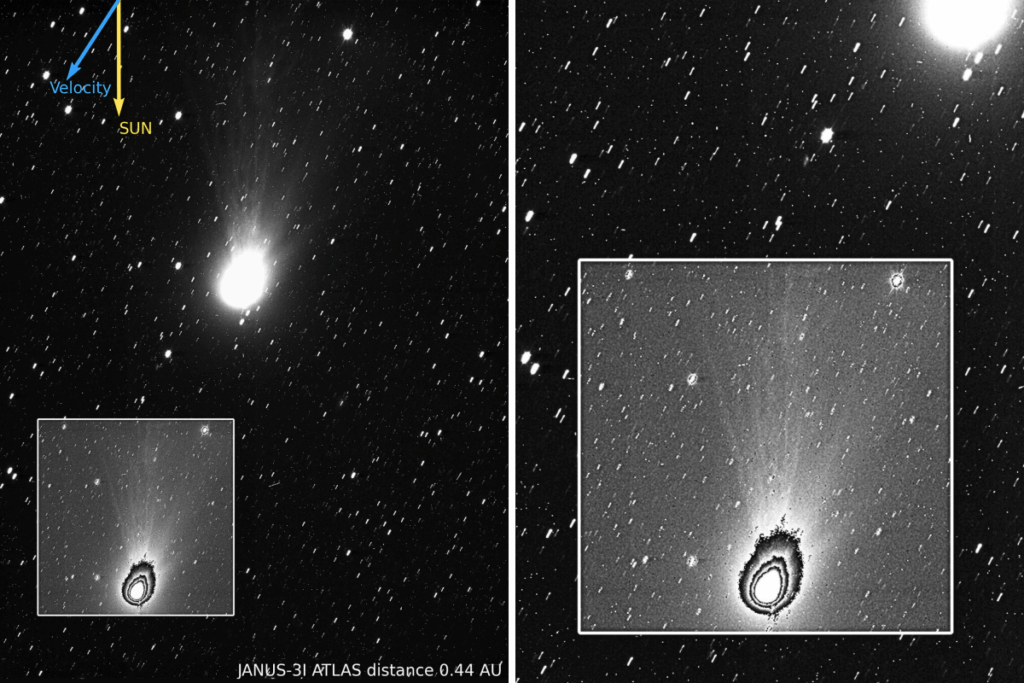
A newly released image from the European Space Agency’s Jupiter Icy Moons Explorer (Juice) has offered a detailed look at interstellar comet 3I/ATLAS, showing the object actively releasing dust and gas as it passed through the inner Solar System.
The image was taken by Juice’s science camera, known as JANUS, on November 6, 2025—just seven days after the comet reached its closest point to the Sun. At the time, the spacecraft was about 66 million kilometers from the comet.
Despite its distant vantage point, the camera captured a clear view of the comet’s surrounding coma, a bright cloud of gas encasing its tiny, unseen nucleus, and a long tail stretching away from the Sun.
The picture also reveals fine structures within the coma, including rays, jets, streams and filament-like features. An inset version of the image uses additional processing to highlight these details.
Arrows included in the image show the comet’s direction of travel and the relative position of the Sun, helping scientists interpret how solar heating is driving the comet’s activity.
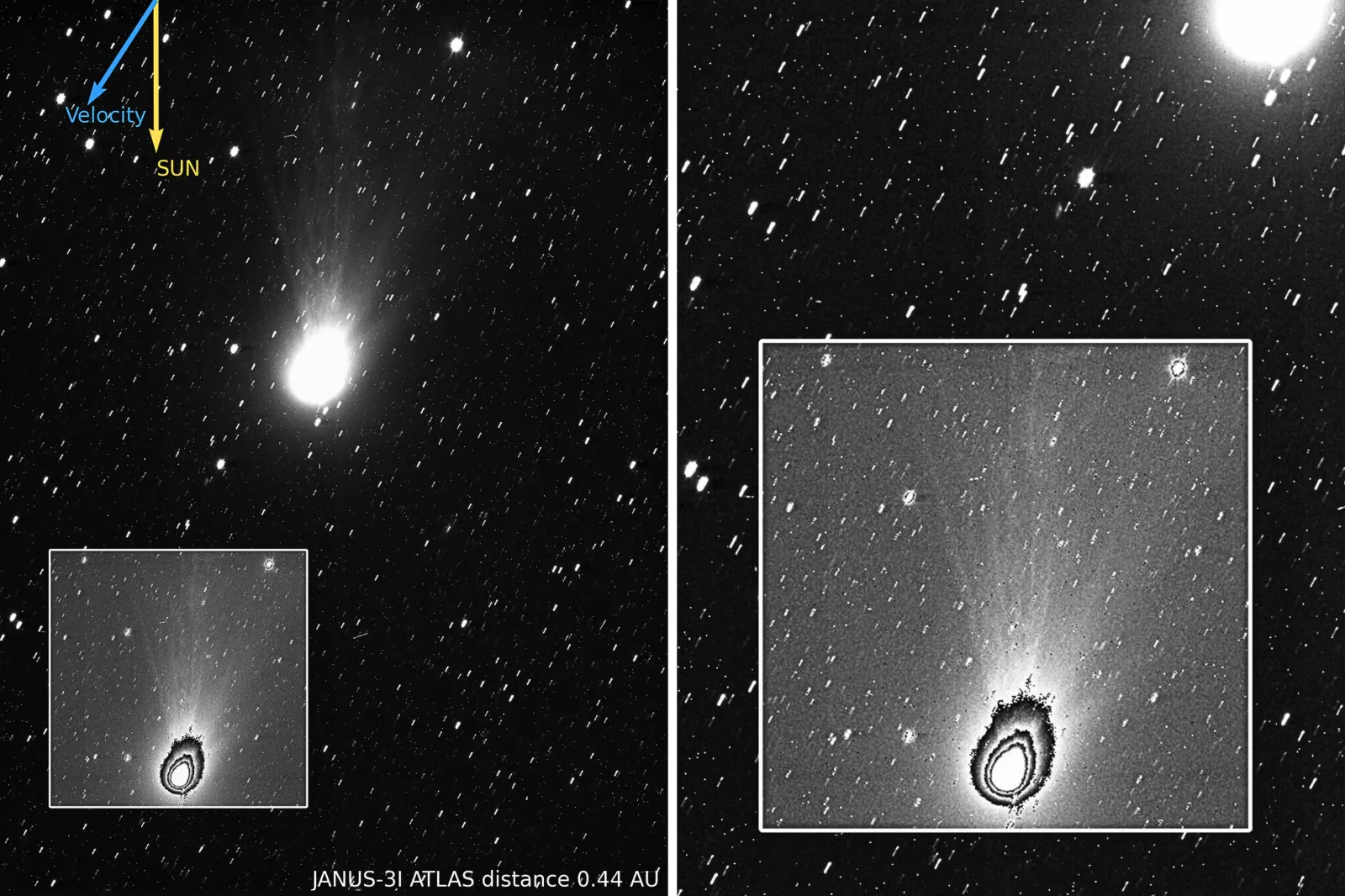
Although 3I/ATLAS originated beyond the Solar System, scientists say that its behavior closely matches that of typical comets made of ice and dust. As the comet warmed during its passage near the Sun, frozen material on its surface vaporized, carrying dust outward and forming the distinctive coma and tail seen in the image.
JANUS was one of five Juice instruments used to observe the comet during November 2025.
The others—MAJIS, SWI, PEP and UVS—collected complementary data aimed at revealing what the comet is made of and how it responded to solar heating. Together, the instruments gathered a broad set of observations that researchers are now beginning to analyze.
In the months after the flyby, Juice was positioned on the opposite side of the Sun from Earth and used its main high‑gain antenna as a heat shield. As a result, the spacecraft relied on a smaller antenna to transmit data at a slower rate. Instrument teams received the full dataset only last week and are now working through the information in detail.
In total, JANUS captured more than 120 images of 3I/ATLAS across a wide range of wavelengths. Scientists are examining the full set to better understand the comet’s structure and activity.
Comet 3I/ATLAS—also known as C/2025 N1 (ATLAS)—was discovered on July 1, 2025, by the NASA‑funded Asteroid Terrestrial‑impact Last Alert System (ATLAS) telescope in Rio Hurtado, Chile.
Do you have a tip on a science story that Newsweek should be covering? Do you have a question about comets? Let us know via science@newsweek.com.