
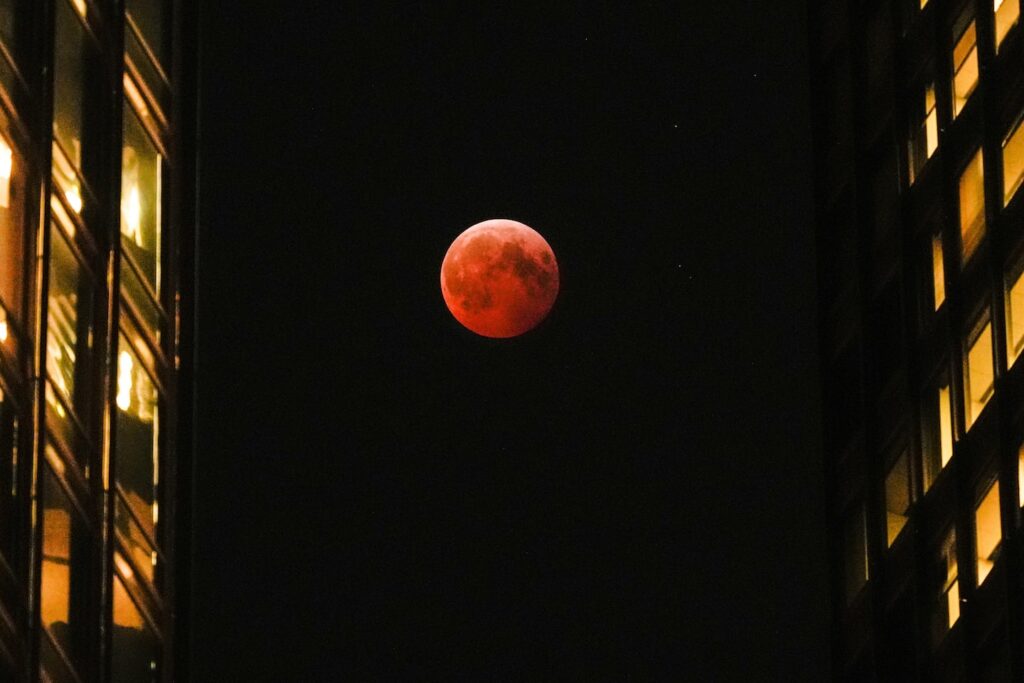
A total lunar eclipse will turn the moon blood red on Tuesday morning, but you’ll have to get up before the sun.
The middle of the eclipse will be during sunrise, around 6:30 a.m., said James D. Lowenthal, an astronomy professor at Smith College. But at that point, the moon will already have set in Massachusetts.
“It will set fully eclipsed. Observers would see a dark moon sitting in a bright sky at that time,“ he said.
The best time to watch would be around 5:30 a.m., Lowenthal said.
“It’s actually pretty neat, because you’ll get that crimson color of the moon and you’ll get it during that predawn silhouette against blue sky,” said Scott MacNeill, staff astronomer at Brown University’s Ladd Observatory. Observers can step out as early as 4:30 in the morning and will be able to spot the red in the moon until a little after 6 a.m., he said.
When people think about a lunar eclipse, they picture the moon being high in the sky. But this lunar eclipse will appear on the horizon.
“We call it the moon illusion which is where the moon appears to be really big on the horizon,” MacNeill said. ”That’s your mind playing tricks on you.”
The best spot to see the eclipse would be anywhere with a wide-open view of the western sky, MacNeill said.
“It is an inspiring natural spectacle that provides awe and wonder and connection with nature, and connection with our ancestors,” Lowenthal said. “To think that our parents and our grandparents, and thousands of generations, have been looking at the same things, and maybe feeling the same things, and the connection with that human history and culture is profound for many people.”
During a total lunar eclipse, Earth moves between the sun and the moon, casting a shadow that covers the moon. The moon looks red because of stray bits of sunlight filtering through Earth’s atmosphere, Lowenthal said.
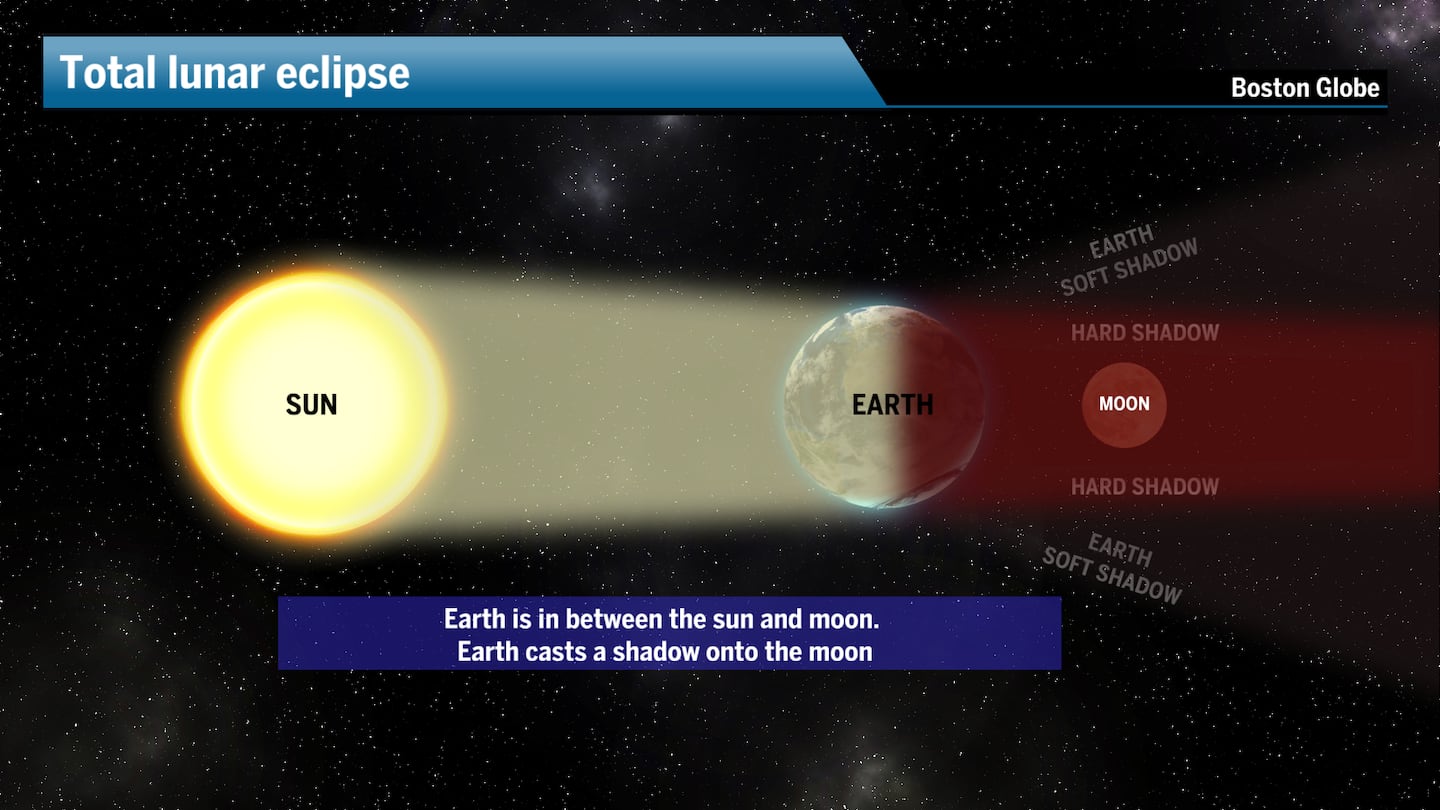 A total lunar eclipse happens when the Earth passes between the sun and the moon with its shadow covering the entire moon.Boston Globe
The moon shines because it’s reflecting sunlight, Lowenthal said.
“If that sunlight gets cut off by the earth, then the moon is dramatically darker and it usually takes on a coppery red hue as well,” he said.
Whether you’ll be able to see the moon turn blood red depends on the weather, of course. In Massachusetts, the National Weather Service forecast suggests it will be cloudy and quite cold.
For those watching, there’s no need for any special equipment to observe.
“If you have binoculars, that’s fantastic,” Lowenthal said. “If you have a telescope, great. But you don’t need either one. You can just look with your naked eye.”
Hannah Goeke can be reached at hannah.goeke@globe.com. Marianne Mizera can be reached at marianne.mizera@globe.com. Follow her @MareMizera.