
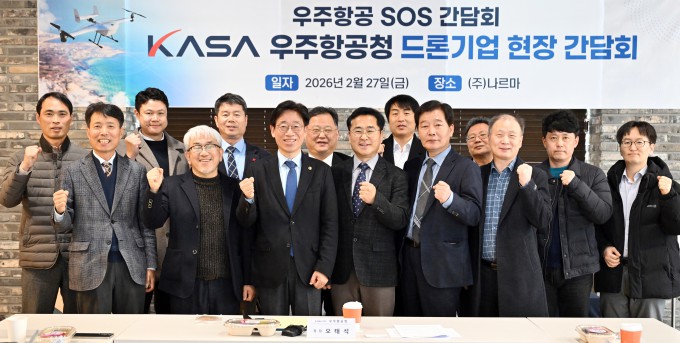
The first aeroSpace On-site Solution (SOS) meeting, held on the topic of the drone industry. Photo provided by KASA.
■ The Korea AeroSpace Administration (KASA) announced on the 27th that it held its first ‘aeroSpace On-site Solution (SOS)’ meeting on the topic of the drone industry at Narma, a small and medium-sized enterprise in Daejeon. The aeroSpace SOS meetings are a field communication brand focused on resolving the difficulties of aerospace companies and gathering on-site opinions for core policy tasks. The topics will include next-generation launch vehicles, low-orbit satellite communication networks, lunar exploration, drones, and international joint development of civil aircraft. KASA plans to visit company sites across the country twice a month.
■ The Korea Institute of Fusion Energy (KFE) announced on the 27th that it held an inquiry-based educational program, ‘FUSION Exploration Team,’ for 20 high school students from across the country. Under the theme ‘SF Future Sketch: Drawing the Era of Fusion and AI,’ the program combined a tour of the Korea Superconducting Tokamak Advanced Research (KSTAR) facility with lectures and team discussions. Participants developed future scenarios on AI tasks for the commercialization of fusion power and presented a ‘Future Exploration Report.’
■ The University of Science and Technology (UST) announced on the 27th that it conducted a preliminary education and held an entrance ceremony for new students for the 2026 spring semester from the 23rd to the 27th. This year, it operated new programs focused on nurturing global researchers with humanistic insight and AI convergence capabilities. Lectures included ‘The Irreplaceable Power of Walking in the Age of AI’ by Suh Myung-sook, Chairwoman of the Jeju Olle Foundation, and ‘Art and Science·Engineering’ by Kim Yang-han, Professor Emeritus at KAIST.
■ The Korea Institute of Science and Technology Information (KISTI) announced on the 27th that it launched the ‘AI SilkNet Center,’ a hub for AI cooperation in Central Asia, with Kazakhstan’s National Academy of Sciences. The center will pursue nine major goals, including education, analysis, research, and technical support, leveraging KISTI’s big data analysis and high-performance computing (HPC) capabilities as core assets. It is expected to become a practical cooperation platform to support Kazakhstan, which is pursuing a transition to high-tech industries, in establishing its AI-based strategies.
■ The National Institute of Toxicological Research (KIT) announced on the 27th that it participated with about 30 domestic bio-companies in a Korea-Japan bio-cooperation event held at Shonan iPARK and Andaz Tokyo hotel in Japan from the 25th to the 26th. The event was held in collaboration with the Osong Medical Innovation Foundation and Chungbuk Technopark, with support from the Ministry of SMEs and Startups. Discussions were held with major Japanese pharmaceutical companies and private corporate venture capitalists (CVCs) on plans for joint research, technology transfer, and investment cooperation.
Copyright ⓒ DongA Science. All rights reserved.