
NASA is adding a new mission to its Artemis program, one that will eventually return American astronauts to the moon for the first time in more than 50 years. This comes as its second launch faces delays and challenges.
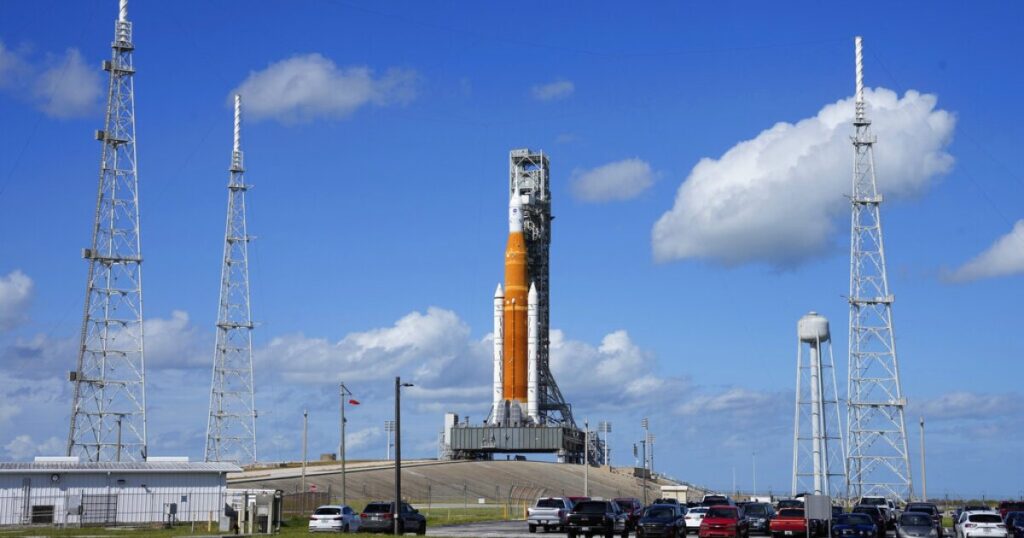
For example, Central Florida Public Media’s Brendan Byrne reported how NASA encountered an issue with the Artemis II rocket’s helium system. They rolled the rocket from its launch site at Kennedy Space Center back into the Vehicle Assembly Building — delaying a mission launching four astronauts around the moon. The next launch opportunity is in April.
The following mission, Artemis III, was supposed to land humans on the moon. But on Friday, NASA announced it’s changing gears.
On “The Florida Roundup,” Byrne explained how Artemis III will be more like Apollo missions, where they go to low Earth orbit and “rendezvous with a potential future landing mission.”
Artemis III’s mission is now set for 2027, while Artemis IV will plan to land on the moon in 2028, according to a NASA release.
“It’s obvious that every single component of this program is over budget and behind schedule. Whether that’s the rocket, the capsule, the landers — all of it.”
Greg Autry, UCF’s Associate Provost for Space Commercialization and Strategy
NASA said the new mission will try to include a rendezvous and docking with one or both commercial landers from Space X and Blue Origin, in-space tests of the docked vehicles, integrated checkout of life support, communications and propulsion systems, as well as testing new Extravehicular Activity (xEVA) suits.
NASA Administrator Jared Isaacman said the agency has to standardize its approach, increase flight rate safely and execute President Donald Trump’s national space policy.
“With credible competition from our greatest geopolitical adversary increasing by the day, we need to move faster, eliminate delays, and achieve our objectives,” Isaacman said in a prepared statement. “Standardizing vehicle configuration, increasing flight rate and progressing through objectives in a logical, phased approach is how we achieved the near-impossible in 1969, and it is how we will do it again.”
ALSO READ: NASA chief blasts Boeing, space agency for failed Starliner astronaut mission
Byrne said Isaacman recognizes things aren’t moving fast enough and when missions are three years apart, like SLS and Artemis, you learn some things and then it can get rusty.
“Think about the Apollo program. It was just in a few years we went from launching to landing. That’s what he wants to do. He wants to speed it up, and that’s going to get us there,” Byrne said.
Artemis program faces ‘systematic challenges’
Greg Autry, the associate provost for space commercialization strategy at UCF, said this overhaul shows how there’s been “systematic challenges” with the program.
He explained how he sat on the NASA agency review team in 2016 as one of the people creating the Trump space policy.

This image provided by NASA shows NASA’s moon rocket sits on the pad at Kennedy Space Center in Florida on Thursday, Feb. 19, 2026. (NASA via AP)
“When he came in for the first administration with a small group of people, we came to the conclusion that going to the moon made sense with the assets NASA had at the time, and made that recommendation to the vice president’s office, and it got support,” Autry told host Tom Hudson. “But we would have assumed we would have been on the moon — footprints on the moon by 2024. We’re not anywhere near there.”
Autry said he was nominated to be the chief financial officer of NASA twice, so he’s been briefed deeply about these projects.
“Frankly, it’s obvious that every single component of this program is over budget and behind schedule. Whether that’s the rocket, the capsule, the landers — all of it. And other spaces,” Autry said.
He added that part of the reason is that there isn’t the same kind of national priority that there was back in the day for the Apollo program.
“The passion that you had during the Apollo program isn’t always there. And that isn’t to say people at NASA and people in this room don’t love space, but it isn’t the national priority that it was at that moment — that sense of urgency. I think Jared Isaacman is bringing in a great sense of urgency,” Autry said.
There are also “huge” manufacturing and supply chain problems in the country, Autry said.
“Because we made a decision back in the ’90s to offshore our entire manufacturing supply chain. And when you don’t have those people going through trade schools and learning to do machining and the things that you need to do space. You can’t have an economy that only builds the F-35 and spacecraft — the whole thing has to work,” Autry said.
Does the space industry have a ‘public perception problem?’
Overall, Byrne said that with people he’s talked to, the space industry has a “public perception problem.”
“People are not excited about it as they used to be. There are efforts to get kids involved in STEAM and STEM and get them along this direction there. But there’s a lot to be done,” Byrne said. “When it comes to the first Artemis I launch, I expected to be stuck in bumper-to-bumper traffic coming home after covering that. And it wasn’t. There wasn’t a lot of people out there for it.”
ALSO READ: NASA returning moon rocket to hangar, delaying astronaut mission at least a month
Byrne said we’ll have to see when Artemis II launches, since there’ll be astronauts aboard, and what the excitement will be.
Autry agreed and said he was surprised by the number of people who don’t know about the Artemis II mission, but that could have been possible in 1968 with Apollo 8. That was the first crew to orbit the moon without landing.
“That said, if you look at the aerospace engineering enrollments in colleges, it’s an amazing uptick,” Autry said. “And mostly they’re excited by what’s happening in commercial space, and the ability to participate in that because they know they can go to a company and make a difference immediately and work on something that’s actually going to fly.”
He said entrepreneurs have found commercial demand for space launch, using Starlink as an example of generating “massive amounts of revenue.”
“Airlines and cruise lines are signing up as fast as they can, and it is transformative for people in remote parts of the world. And that works. The imaging constellations we have are generating data that’s incredibly valuable. And combined with the power of AI to look at all those images and produce actionable business information, there’s real value there. So that is sustainable,” Autry said.
He believes the economic growth from space is going to continue at a much higher rate than the overall Gross Domestic Product (GDP).
But the first dollars into space exploration were American taxpayer dollars and still are today. Autry said, like railroads and the national highway system, “we wouldn’t question the value of any of those things economically.”
“So the return is jobs, businesses, prosperity and a better standard of living,” Autry said.
This story was compiled from interviews conducted by Tom Hudson for “The Florida Roundup.”
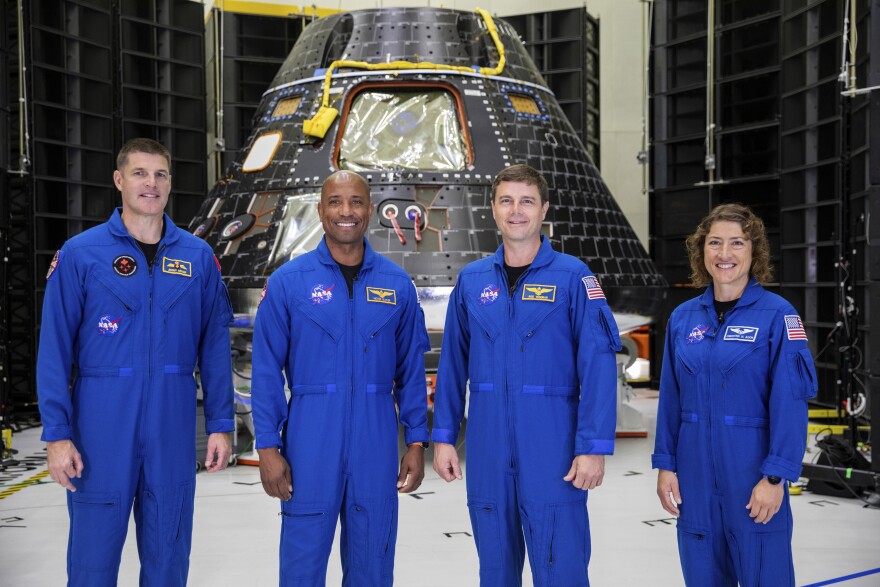
Artemis II crew members, from left, Jeremy Hansen, Victor Glover, Reid Wiseman and Christina Koch, stand together at NASA’s Kennedy Space Center in Florida, in front of an Orion crew module on Tuesday, Aug. 8, 2023.