
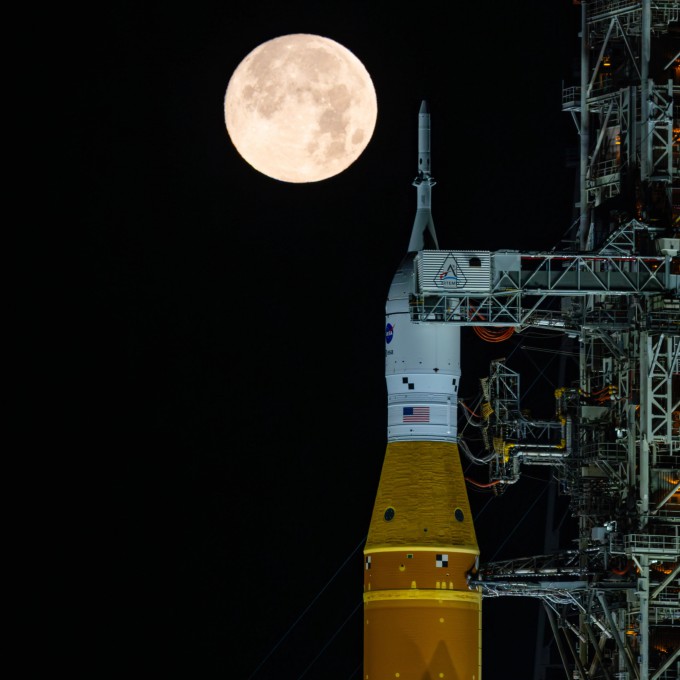
Artemis II is positioned on Launch Pad 39B at NASA’s Kennedy Space Center in Florida, with a full moon in the background. Photo: NASA/Sam Lott
NASA has added a previously unplanned step to its crewed lunar exploration program, Artemis. Instead of heading straight to the Moon, a rehearsal will first be conducted in low-Earth orbit (LEO) in 2027.
On the 27th of last month (local time), NASA announced that it had changed its plans to conduct a comprehensive test flight in low-Earth orbit before the crewed lunar landing.
The original plan was for Artemis II, scheduled for April, to perform a lunar flyby, followed by Artemis III attempting a Moon landing in 2028. Under the revised plan, Artemis III will not go to the Moon. It will be replaced by a mission in 2027 where the crew will practice docking with the lunar lander in low-Earth orbit.
NASA maintains that there is no schedule delay. The goal remains one or two Moon landings in 2028, which are slated to be the Artemis IV and V missions.
Jared Isaacman, NASA Director, said at a press briefing that day, “We didn’t want the gap between launches to become too long, so we added a step to the program.” He added, “It is much better for the astronauts to first check the integrated system of the lander and the Orion crew spacecraft in low-Earth orbit than to test it at the Moon.”
He explained, “The spacesuits can also be tested in low-Earth orbit before going to the lunar surface, which helps reduce the risk of the subsequent Moon landing.”
Artemis II was originally targeted for a March launch, but the schedule was pushed back after a helium leak was discovered in NASA’s primary rocket, the Space Launch System (SLS). The rocket has been moved to the Vehicle Assembly Building at the Kennedy Space Center in Florida and is currently undergoing repairs. If repairs are completed smoothly, a launch could be attempted as early as April 1-6.
The lunar lander issue remains a challenge. Elon Musk’s SpaceX has a contract to develop the lander and is preparing for a launch using its Starship rocket, but due to development delays, NASA has requested a more simplified new plan. Jeff Bezos’s Blue Origin has also been asked to submit a proposal to accelerate its lander development.
The backdrop for the urgency to return to the Moon is the competition with China. China is making steady progress toward its goal of a lunar landing in 2030. With both the United States and China planning to land on the lunar south pole, competition over the optimal location for a future lunar base is intensifying.
Copyright ⓒ DongA Science. All rights reserved.