
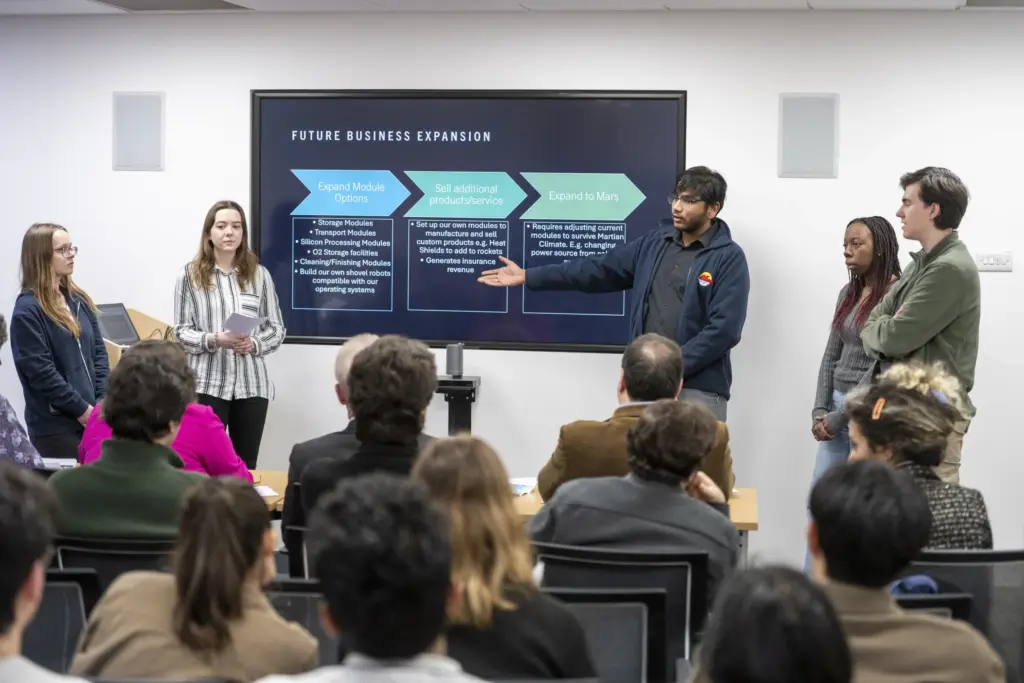
The UK heat of the ActInSpace program, held at Surrey Research Park, has named the University College London (UCL) team IRONSTAR winners with their early-stage debris risk-pricing concept for operators and insurers to better qualify their exposures.
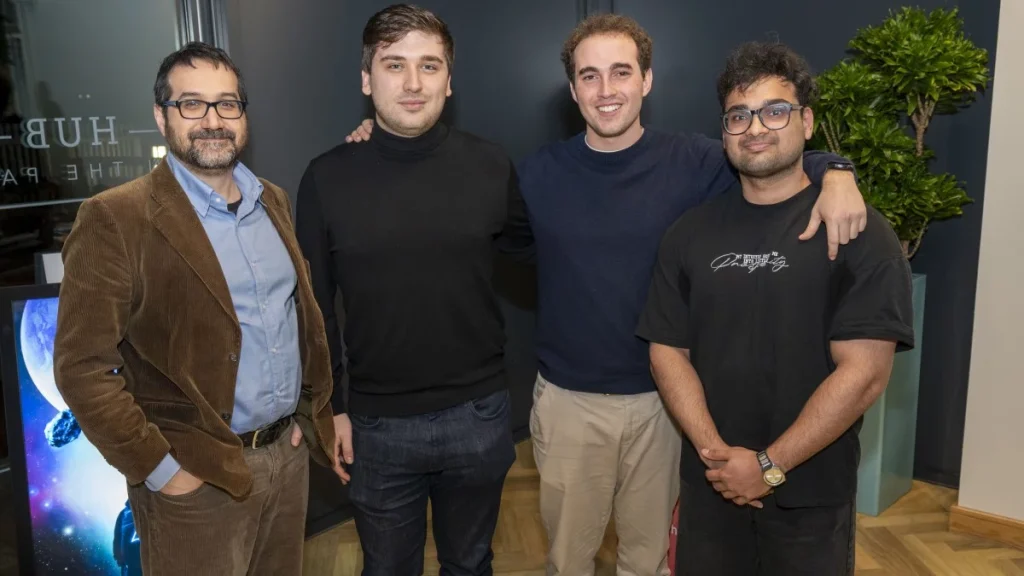 The winning team IRONSTAR with ActInSpace Judge Professor Adam Amara (left), Chief Scientist for the UK Space Agency and Director of Surrey Space Institute
“Insurers need better statistics on losses to inform setting their risk premiums, but the difficulty of accurately diagnosing failures in space makes this difficult,” Professor Keith Ryden, Professor of Space Engineering (Space Environment and Protection) and Director, Surrey Space Centre, told Orbital Today. “Governments need the most assurances given the importance of basic infrastructure like navigation services and security services – they need to procure satellites and systems with suitable protection.”
Launched in 2014, ActInSpace is a program developed by the Centre national d’études spatiales (CNES), the French space agency, and the European Space Agency (ESA), which takes place every two years to develop innovative new space technology. This year’s UK heat brought together 75 participants, spanning local industry, national agencies, and leading universities.
The winning formula
IRONSTAR was devised by UCL Masters Students of Space Science and Engineering, Sundash Sundaragopal, Pietro De Rigo Piter, and Vasil Pachedzhiev. Their proposal aimed to protect space assets through a new methodology for quantifying risk exposures for stakeholders.
“It was great trying to develop a business idea in such an amazing atmosphere, having people together, bridging ideas and finding solutions that are needed in today’s world,” Sundaragopal said in a statement. “It was exciting to compete with other teams, too, and it also helped with racing to find an idea.”
The event was supported by Surrey’s STEM ecosystem, spanning engineers, consultants, and experts from the UK Space South Central cluster.
Judges of the contest brought special attention to a number of additional teams with follow-on opportunities:
Design in Defence were granted delegate packages to attend SpaceComm in London in March, courtesy of Space South Central, to connect their proposals to industryEvent Horizon was awarded a tour of the legendary offices of Surrey Satellite Technology Ltd (SSTL) to grant them hands-on experience with Earth observation programmes.Team TBD received an opportunity to visit the national space facilities at Harwell Space Cluster in Oxfordshire to be walked through the advanced space testing equipment available there.Open Orbit Labs, led by PhD Researcher Milad Albagul, won a six-month membership at the Surrey Research Park start-up incubator to further develop their real-time observation and warning system for space debris.
“These young people only had 24 hours to work on a problem, and what you see is a lot of energy, a lot of excitement, and a huge diversity of ideas coming through,” Professor. Adam Amara, Chief Scientist at the UK Space Agency and Director of the Surrey Space Institute, said of the event, within which he served as one of the judges. “Everything from insurance solutions for space debris to trying to tackle malaria.”
ActInSpace takes place every two years and is now conducting its 6th iteration. In 2024, the globe-spanning project assembled 1,800 participants working in 410 teams across over 50 sites hosted in 35 countries. 40 distinct startups were forged as a result of this competition.
The second stage of ActInSpace 2026 will be its International Event, held in Bordeaux on 1-2 April, assembling the winners of local hackathons to compete in the semi-finals and the finals themselves.
New thinking for old problems
The hackathon demonstrates Europe’s rekindled interest in serving critical roles in the space industry. As giants like the US and China forge ahead, regulatory, sustainability, and legal issues persist, problems historically championed in Europe and the UK.
“Debris is a growing concern in certain low-altitude orbits, and so regulations to manage it are being developed, but the key challenge is to ensure all countries adhere to them in future – this is a geopolitical challenge rather like climate change,” Professor Ryden told Orbital Today. “The current key challenge is that the US is advancing so fast with commercial space – Europe needs to speed up and enable a more pluralist and dynamic space economy rather than just a government top-down approach, which tends to be slow and cumbersome. Some more regulations are needed, but in themselves they don’t create growth.”
 Published by Laurence Russell
Laurence Russell is a space and satellite journalist of 5-years having worked at Satellite Evolution Group and Connectivity Business News, as well as contributing to Via Satellite, Payload, Kaspersky Secure Futures, and DatacenterDynamics. Situated in North London, Laurence Russell is a Postgraduate of Southampton University, a fellow of the Royal Astronomical Society, and a community activist.