
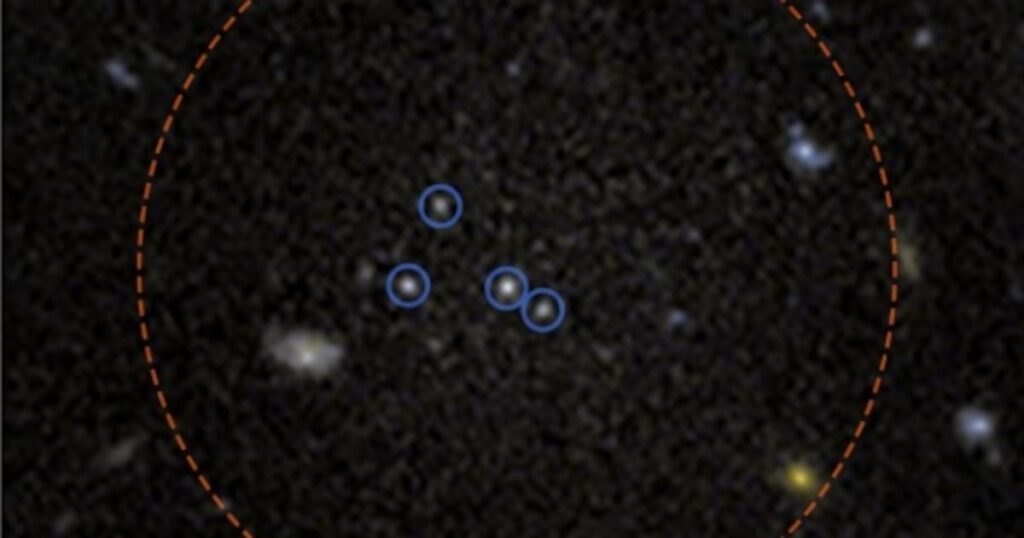
How do you uncover something deep in space that can’t really be seen? A Canadian-led team has not only done that – they’ve identified an entire galaxy that’s almost completely invisible and a reminder that there’s a lot about the universe astronomers still don’t understand.
It’s called a “dark galaxy.” It lies roughly 250 million light-years away and is thought to be mostly made up of mysterious dark matter, meaning it emits nearly no light. Just a scattering of stars can be seen in what appears to be a faint smudge deep the night sky.
“Yeah it’s pretty much invisible,” said David Li, the University of Toronto post-doctoral fellow who’s been fielding lots of interview requests about his team’s discovery that’s also been nicknamed a “ghost galaxy.”
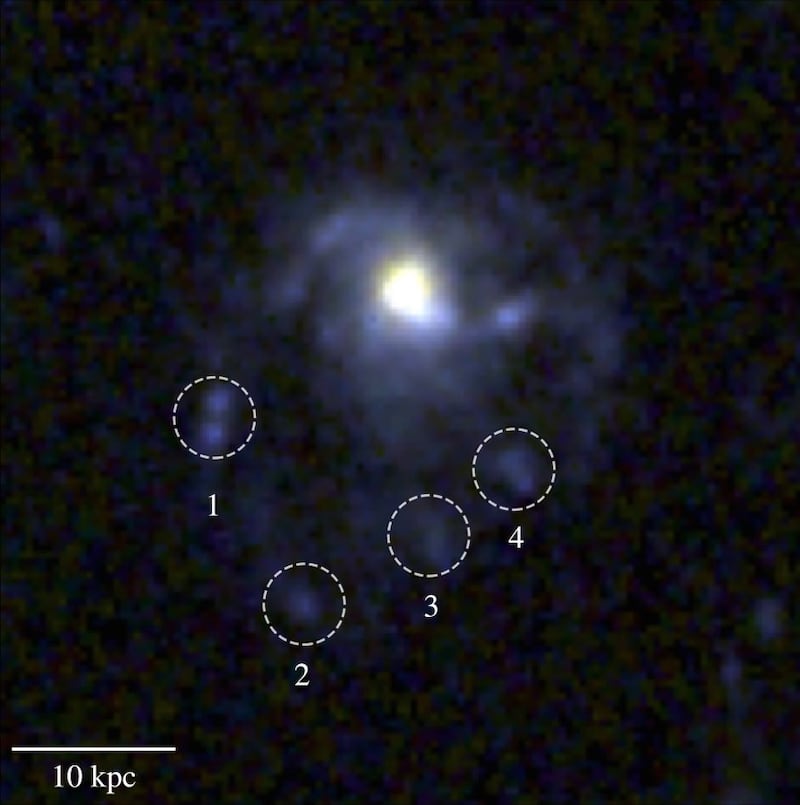
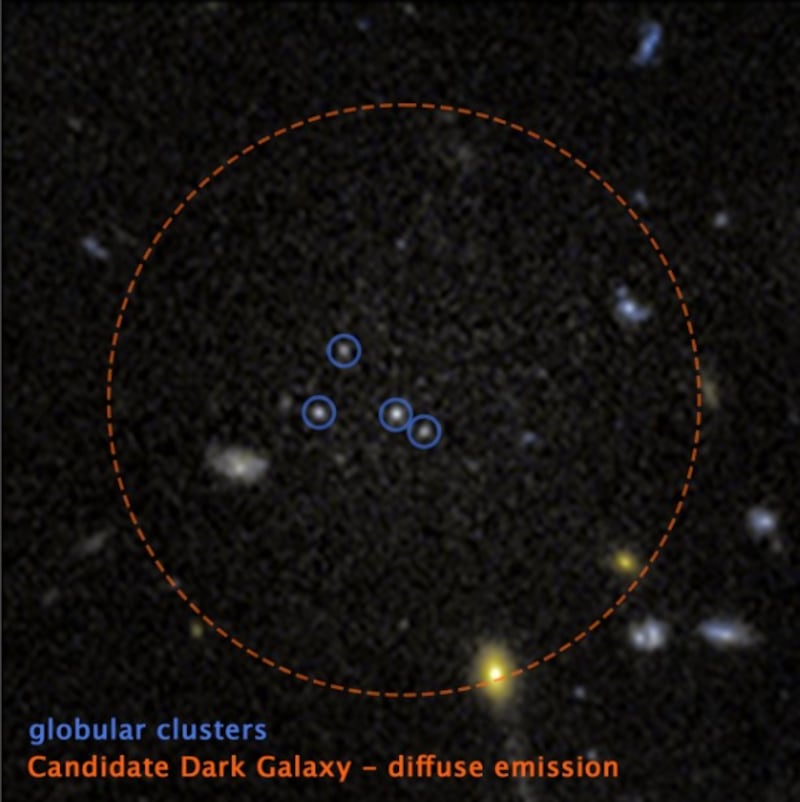 Dark matter in the universe Four globular clusters of stars can been around a suspected dark galaxy. (SOURCE: NASA, ESA , D. Li (UToronto) Image Processing : J. DePasquale (STScl))
“I think it’s cool. Because they’re essentially extremely dark and they’re very special,” said Li. “It’s very hard to find them.”
NASA recently promoted the research along with the Hubble Space Telescope which was used to help find CDG-2, short for Candidate Dark Galaxy-2.
“This thing is too extreme,” said Li, referring to the possibility that it is 99.9 per cent made up of dark matter.
Since dark galaxies are so difficult to see, researchers had to come up with an indirect way to find them. They instead searched for globular clusters – tightly packed groups of very old stars that typically orbit a galaxy.
They noticed four of them in a small patch of space that appeared to be empty and realized something must be holding them together – something massive and almost completely invisible. That hidden force is believed to be CDG‑2.
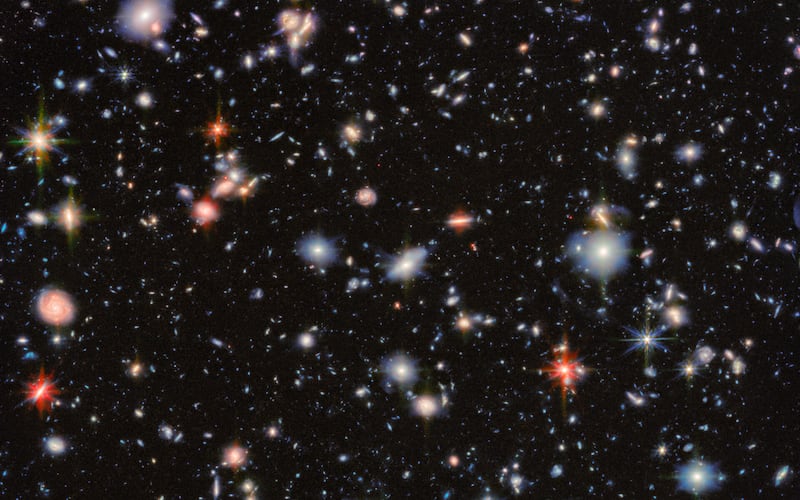 James Webb telescope image This image from the James Webb Space Telescope shows just some of the billions of galaxies in the universe. Estimates vary from 100 billion to 2 trillion.
To reach their conclusion the team, including collaborators at McMaster, the University of Waterloo and international scientists combined data and imagery from three of astronomy’s most powerful instruments: NASA’s Hubble Space Telescope, the European Space Agency’s Euclid space telescope and the ground‑based Subaru Telescope in Hawaii.
They detected a very faint glow and diffuse structure around the clusters – clear signs that a hidden galaxy may be there. The researchers say CDG-2 only has the brightness of about 5 million stars, a tiny number compared to the 100 to 400 billion in our own Milky Way.
“They’re very different from what we know about normal galaxies,” said Li.
The researchers think long‑ago encounters with larger neighbouring galaxies tore away the material CDG‑2 needed to make stars, leaving it almost entirely dark.
“That’s why I’d call it a ghost,” Li said. “Only a skeleton of what it once was remains.”
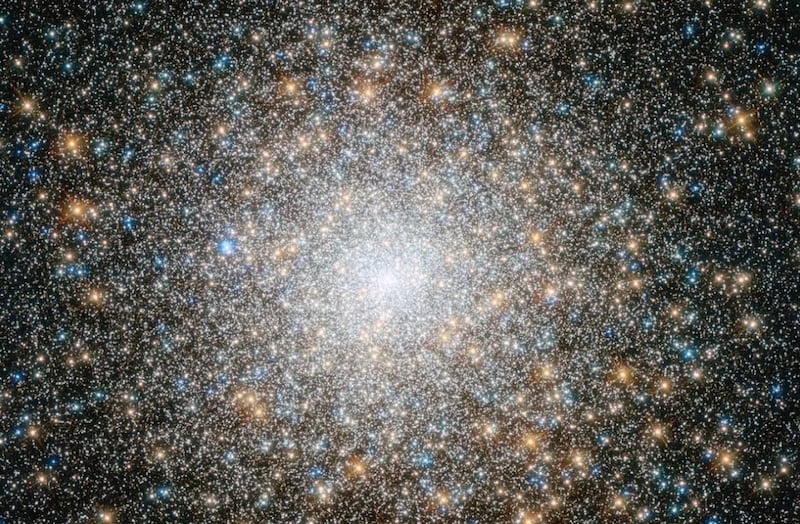 Dark matter in the universe M15 is a globular cluster in the Milky Way’s halo that contains more than 100,000 stars (SOURCE: ESA, NASA)
Li is part of the growing field of astrostatistics, which uses statistical tools to comb through the massive flood of data from today’s telescopes and uncover hidden patterns.
Scientists have been trying to unravel the mystery of dark matter for a century – ever since it was first proposed in 1933. NASA calls it the invisible glue that holds the universe together, a substance that neither reflects, emits or absorbs light.
It’s believed 80 per cent of all matter in the universe is dark matter. Scientists think it exists because it appears to be having a gravitational influence on visible matter.
“We can observe its effect,” says Li.
It’s already been a busy year for Canadian astronomers studying galaxies. Earlier this month, astrophysicists from the University of Waterloo observed the most distant “jellyfish galaxy” ever imaged – a galaxy trailing long tails of gas that resemble jellyfish tentacles.
 Jellyfish galaxy Distant jellyfish galaxy discovered by University of Waterloo astronomers. (SOURCE: JWST, I. Roberts (UWaterloo)
In January, researchers primarily from Dalhousie University and UBC also found something surprising: a cluster of galaxies with scorching hot gas that existed just 1.4 billion years after the Big Bang, far earlier and hotter than current models had predicted.
As for Li’s discovery, he’s been surprised by all of the global attention he’s been getting.
“It’s been a little bit crazy,” Li said. “But it feels great that people actually care about science and astronomy in particular.”
He hopes to find more dark galaxies because he believes they could unlock new clues about the nature of dark matter.
“Maybe thousands, or tens of thousands of them, could show up in the future.”