
Sign up to see the future, today
Can’t-miss innovations from the bleeding edge of science and tech
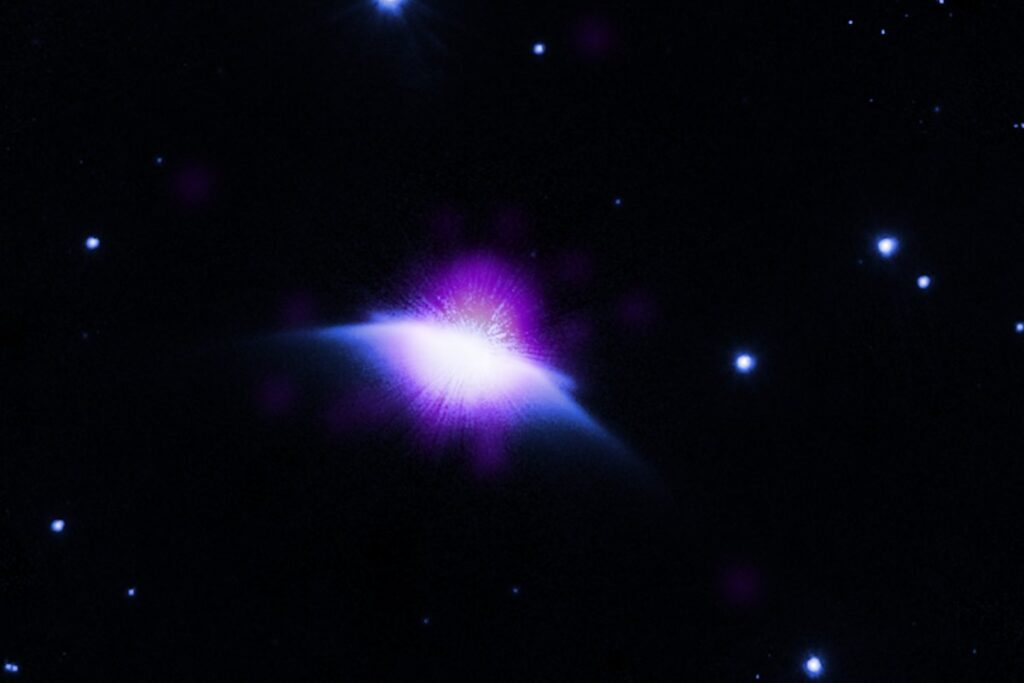
Astronomers using NASA’s Chandra X-ray Observatory have spotted a young star just 120 light years away engaging in what is an aptly childish pastime: blowing a bubble.
The bubble, of course, is not the product of a soapy solution but hot gasses being pushed outward by the star’s powerful stellar winds. This astrosphere, as it’s known, swallows the entire star, and could be a glimpse of how our star system formed its own protective bubble, called the heliosphere, billions of years ago.
At roughly the same mass and temperature as the Sun, the star — technically designated as HD 61005 — is also considered a G-type yellow dwarf, but at a much younger 100 millions years of age, compared to the Sun’s five billion years. That makes this detection, described in a new study set to be published in The Astrophysical Journal, the first time an astrosphere has been spotted around a Sun-like star anywhere in the cosmos.
“We have been studying our Sun’s astrosphere for decades, but we can’t see it from the outside,” lead author Carey Lisse, an astronomer at Johns Hopkins University in Baltimore, said in a statement about the work. “This new Chandra result about a similar star’s astrosphere teaches us about the shape of the Sun’s, and how it has changed over billions of years as the Sun evolves and moves through the galaxy.”
HD 61005 is not shy about flexing its youthful vigor. It boasts a powerful stellar wind that travels about three times faster than the Sun’s, on top of being 25 times denser, the researchers found. Stellar winds are formed by the constant stream of energetic particles emitted by a star, playing a significant role in how the star system is shaped, including shielding it from wayward emissions from deep space.
The star system has been nicknamed the “Moth” because of its wing-like disk, visible in infrared observations, of leftover dust from the star’s formation that stretches outside the astrosphere. These seeming wings are swept back as the star flies through space.
But while the dust disk buckles, the star’s bubble remains decidedly spherical. Evidently, the stellar wind is strong enough to prevent the astrosphere from deforming, even as it plows through a heavy dust cloud. The astrosphere stretches 200 astronomical units in diameter, or 200 times the distance between the Earth and the Sun, despite its dense surroundings. Astronomers believe that the Sun also blew through a region of dense gas and dust in its past, making HD 61005 an all the more intriguing Doppelgänger for uncovering our star’s evolution.
“It is amazing to think that our protective heliosphere would only extend out to the orbit of Saturn if we were in the part of the galaxy where the Moth is located, or, conversely, that the Moth would have an astrosphere 10 times wider than the Sun’s if it were located here,” Lisse said.
More on space: Scientists Intrigued as Prominent Star Suddenly Winks Out of Existence