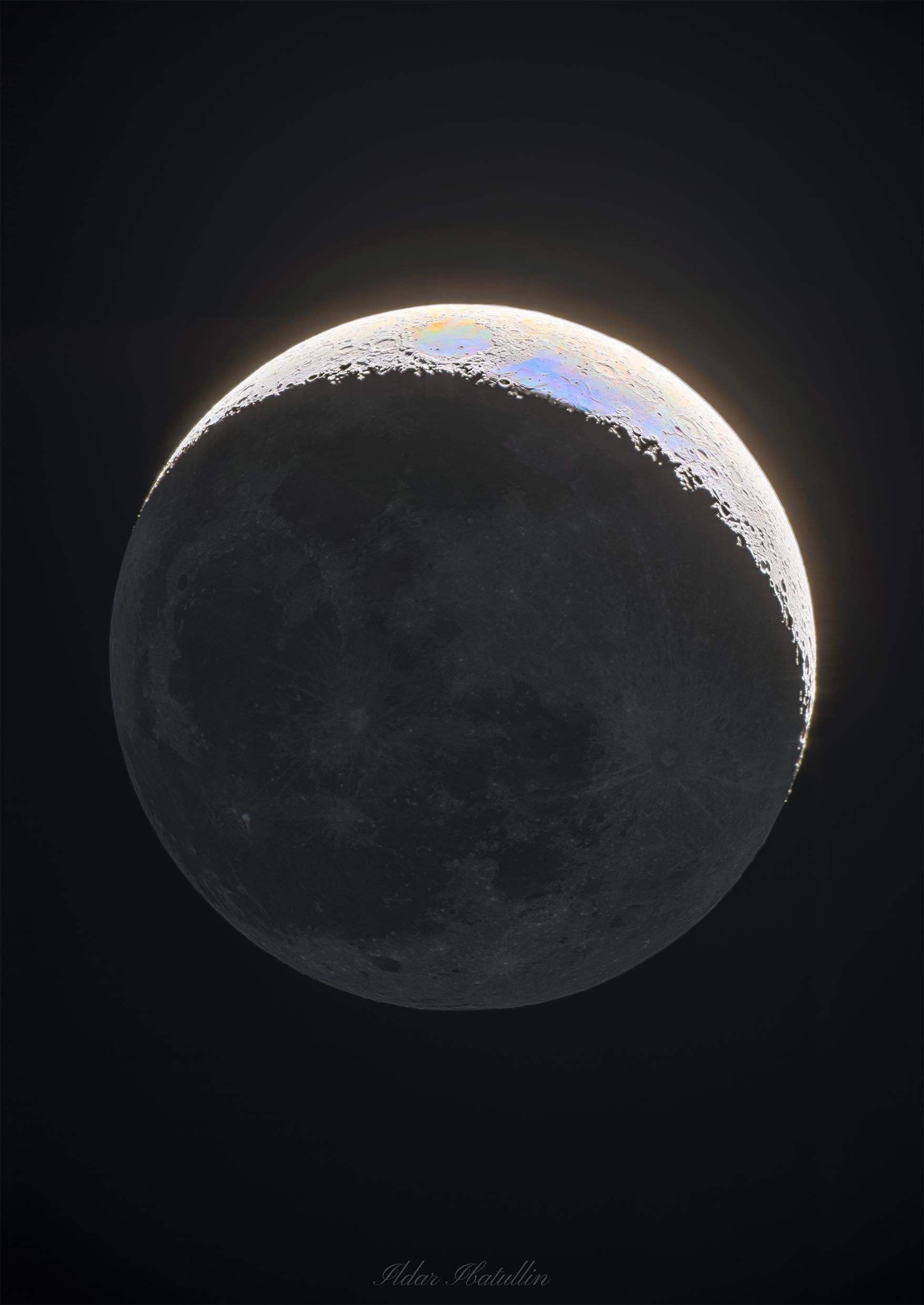
Mineral Сrescent Moon (11% phase) photographed in HDR on February 20, 2026.
The main challenge of this shoot was the extremely low position of the moon above the horizon. In such conditions, dense layers of the atmosphere act as a low-quality lens, mercilessly blurring details and distorting color reproduction.
Nevertheless, after complex processing, it was possible to reveal the mineral colors of the surface. It is important to understand that this is not an artistic filter, but the result of extreme enhancement of natural saturation. Such visualization allows us to literally see the geological composition of the satellite. Orange and brown hues indicate a high iron oxide content, while blue and light blue areas are rich in titanium oxide.
Equipment: Canon 550D, Sony a7sii, Baader UV-IR cut, SVBony IR-pass 685nm, Barlow 2x lens, GSO 150/750, Arsenal EQ5.

![Capturing the Crescent Moon through thick layers of atmosphere. One of my most challenging mineral HDR shots yet. [OC]](https://www.ufofeed.com/wp-content/uploads/2026/03/irgw8ui9nfmg1-1088x1536.jpeg "Capturing the Crescent Moon through thick layers of atmosphere. One of my most challenging mineral HDR shots yet. [OC]")
1 Comment
Mineral Сrescent Moon (11% phase) photographed in HDR on February 20, 2026.
The main challenge of this shoot was the extremely low position of the moon above the horizon. In such conditions, dense layers of the atmosphere act as a low-quality lens, mercilessly blurring details and distorting color reproduction.
Nevertheless, after complex processing, it was possible to reveal the mineral colors of the surface. It is important to understand that this is not an artistic filter, but the result of extreme enhancement of natural saturation. Such visualization allows us to literally see the geological composition of the satellite. Orange and brown hues indicate a high iron oxide content, while blue and light blue areas are rich in titanium oxide.
Equipment: Canon 550D, Sony a7sii, Baader UV-IR cut, SVBony IR-pass 685nm, Barlow 2x lens, GSO 150/750, Arsenal EQ5.