
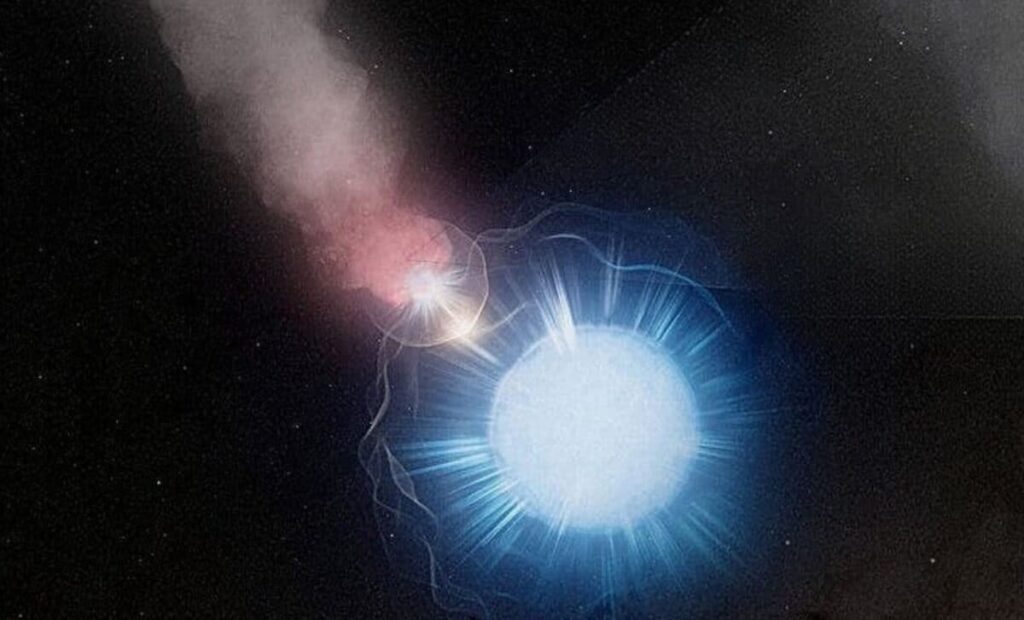
A rare pair of massive stars is producing some of the smallest solid particles ever observed around such objects. By combining data from the James Webb Space Telescope and ALMA, researchers found that the binary system WR 112 sheds carbon dust grains only a few nanometers across.
The discovery, published in The Astrophysical Journal, highlights an unexpected contrast between the scale of dying massive stars and the minuscule particles they release into space. According to the study’s lead author, Yale juniorDonglin Wu, the size difference between the star and the dust it produces approaches a quintillion to one.
Wu conducted the research as part of a summer undergraduate program at the California Institute of Technology, working with Héctor Arce and Daisuke Nagai. The system under investigation, WR 112, contains a rare and short-lived Wolf-Rayet star, known for its unusual spectra and extreme stellar winds.
A Rare Wolf–Rayet System Under Scrutiny
WR 112 is not an ordinary binary. It hosts an intensely hot, dying Wolf-Rayet star orbiting a stellar companion. Such stars are both massive and short-lived, and they expel powerful winds that shape their surroundings.
Findings published inThe Astrophysical Journal, the colliding winds in WR 112 generate dense, cooling zones. In these regions, carbon-rich dust condenses and is later scattered into space by intense starlight. Mid-infrared images from the James Webb Space Telescope had already revealed bright spiral arcs of dust encircling the system, suggesting sustained and structured dust production.
One rarity in astronomy, as Wu noted in remarks reported with the study, is encountering such systems at all.
“Astronomy and astrophysics connect to something very romantic. You look up at the night sky and think about how immense it is. There are so many things that are still unknown—things that are difficult to observe, things that are rare.”
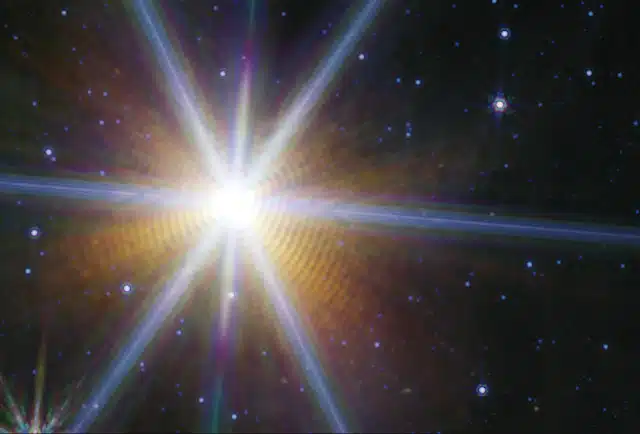 Infrared image of the Wolf-Rayet star WR 112 captured by the James Webb Space Telescope. Credit: NASA
When Powerful Telescopes Reveal An Absence
To better understand the dust in WR 112, the team compared observations from JWST with millimeter data from the Atacama Large Millimeter/submillimeter Array. The contrast was striking.
While JWST clearly detected the extended spiral structures in mid-infrared light, ALMA detected no dust emission at millimeter wavelengths. The scientists found that, ALMA is one of the most powerful millimeter telescopes on Earth, capable of detecting larger dust grains with high sensitivity.
The absence of a millimeter signal led to a key inference. Only warm, very small dust grains could remain invisible to ALMA under these conditions. Larger grains would have produced detectable emission.
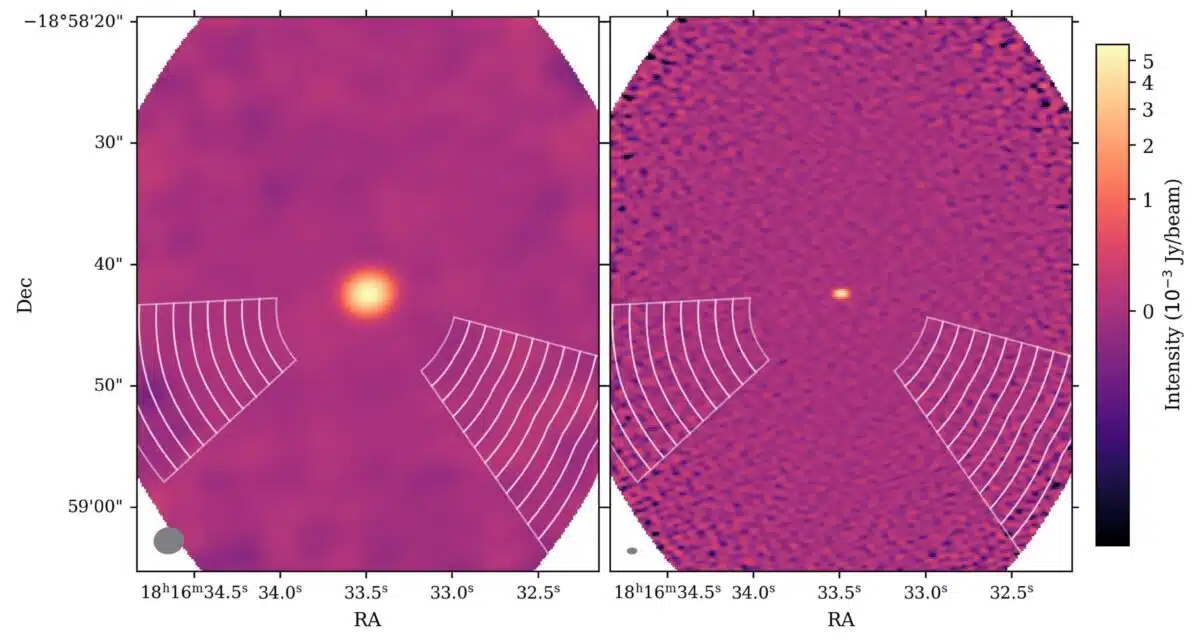 Comparison of observations of the binary system WR 112. Credit: The Astrophysical Journal
Two Distinct Populations Of Tiny Grains
Researchers concluded that most dust grains in WR 112’s spirals are smaller than one micrometer. As explained in the study:
“our results also suggest that the majority of grains in the system have radii below one micrometer, and the extended dust structures are dominated by nanometer-sized grains.”
The team identified two distinct grain populations within this distribution: a dominant group of nanometer-scale particles and a smaller population around 0.1 micrometer in size. This distinction helps resolve decades of conflicting measurements in similar binary systems, which had alternately pointed to either extremely small grains or relatively larger ones.
The researchers also examined physical processes capable of fragmenting or evaporating dust in the intense radiation field near the stars. They found that certain mechanisms preferentially destroy intermediate-sized grains under specific conditions, providing a physical explanation for the observed size distribution.