
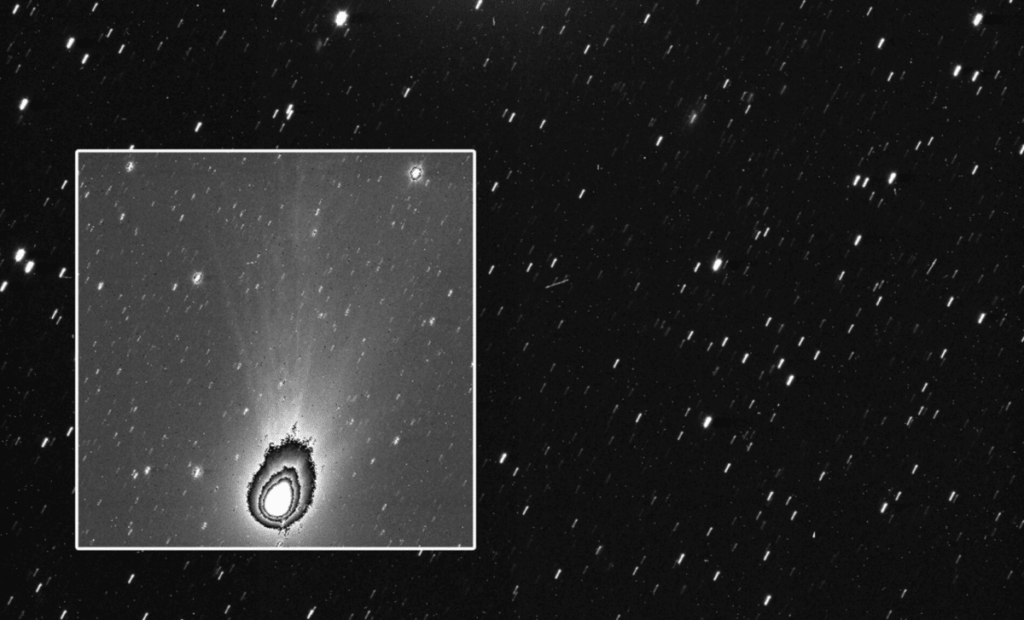
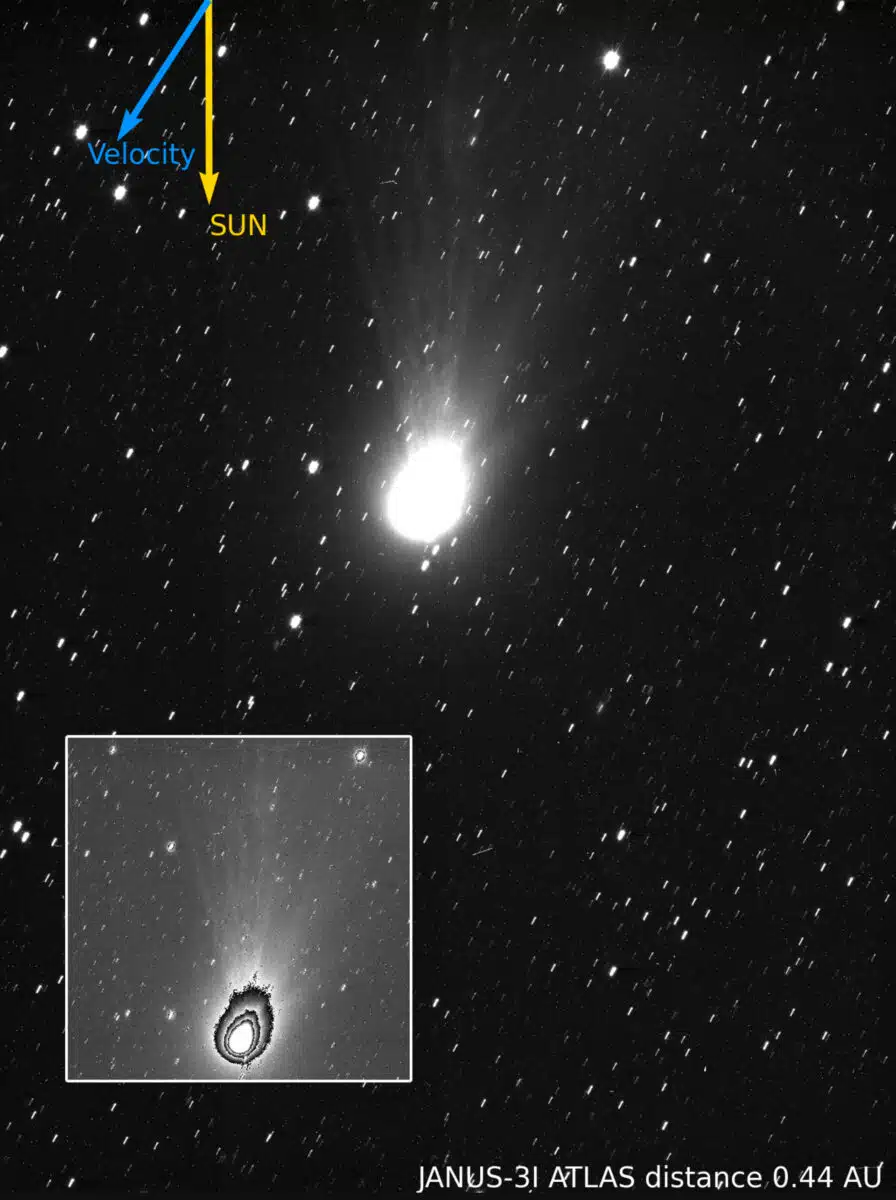
For the first time, scientists have captured a detailed image of an interstellar comet passing through our solar system. The European Space Agency’s (ESA) Jupiter Icy Moons Explorer (JUICE) spacecraft has provided an extraordinary view of 3I/ATLAS, a comet that originated far beyond our solar system. This rare visitor, which made its closest approach to the Sun in late 2025, is offering researchers an unprecedented opportunity to study how objects from interstellar space behave as they interact with the solar system. The striking image taken by JUICE’s JANUS camera reveals the comet’s halo of gas and dust, providing new clues about its composition and journey.
The Discovery of 3I/ATLAS: A Celestial Visitor Like No Other
The comet 3I/ATLAS, a first-of-its-kind interstellar comet, made its closest approach to the Sun in late 2025. Unlike typical Solar System comets, this one is a rare visitor, having traveled from outside the solar system. Its discovery is a monumental event in space exploration, providing a never-before-seen look at an object originating from interstellar space. While its exact origins remain a mystery, its journey through our solar system is helping scientists unravel the secrets of such celestial bodies and their behavior as they interact with the Sun’s radiation and gravitational forces. The image from the JUICE spacecraft’s JANUS camera is the first of its kind, capturing not just the comet’s tail but also its coma, a cloud of gas that surrounds the nucleus of the comet.
The Role of ESA’s JUICE Mission in Observing 3I/ATLAS
ESA’s Jupiter Icy Moons Explorer (JUICE) mission has been tasked with studying the gas giants and their moons. However, the mission’s unexpected encounter with 3I/ATLAS has provided an unexpected bonus for scientists. With its advanced suite of scientific instruments, including the JANUS camera, JUICE captured invaluable data on this interstellar visitor. The spacecraft, orbiting approximately 66 million kilometers from 3I/ATLAS, was able to photograph and study the comet’s structure and behavior. Over the course of several months, five of JUICE’s instruments worked together to analyze the comet in detail, providing an in-depth look at the physical characteristics and chemical composition of the object. This collaboration is part of ESA’s ongoing effort to study celestial bodies from beyond our solar system.
How 3I/ATLAS Was Captured by JUICE’s JANUS Camera
The capture of 3I/ATLAS by the JANUS camera on November 6, 2025, was a significant milestone. This high-resolution, multi-color optical camera is designed to capture detailed images of distant celestial objects, such as Jupiter’s moons. The team behind JANUS processed the images to reveal the structure of the comet’s coma, making it visible to researchers and providing key information about its size and composition. The unique combination of gases, dust, and particles around the comet tells scientists a great deal about its material makeup and its journey through interstellar space.
What We Can Learn from 3I/ATLAS
The study of 3I/ATLAS offers insight into the nature of comets that are not native to our solar system. Unlike comets that form from materials within the solar system, 3I/ATLAS brings with it material from another part of the galaxy, possibly holding information about the formation of other solar systems. Researchers are particularly interested in the tail and coma of the comet, as these regions of gas and dust provide clues about the object’s interactions with the solar wind and its age. The study of such objects could unlock secrets about the early days of our own solar system and the conditions that led to the formation of planets and moons.
The Role of Spectrometry in Understanding the Comet’s Composition
One of the critical aspects of studying comet 3I/ATLAS is its composition. ESA’s MAJIS and UVS instruments are focusing on analyzing the spectrometry data collected from the comet. By studying the light emitted and absorbed by the comet, scientists can determine its chemical makeup. The data gathered will provide valuable information on the types of gases and molecules that exist in the comet, which may not be found on Earth or in other parts of the solar system. Understanding this composition is crucial not just for studying the comet itself but for understanding how similar objects could have played a role in the formation of our solar system.
The Wait for Data: A Slow Yet Rewarding Process
The process of analyzing data from JUICE’s instruments has not been quick, as it takes time to decode and interpret the complex signals from 3I/ATLAS. After JUICE crossed to the opposite side of the Sun from Earth, communication slowed down, requiring the team to use smaller antennas to send back information at a reduced rate. However, this slow pace of data transmission has not deterred the scientific teams, who are diligently working through the data. The analysis of over 120 images and numerous spectrometric data sets is ongoing, and researchers are eagerly anticipating the full results of their study, expected to be discussed later this year.