
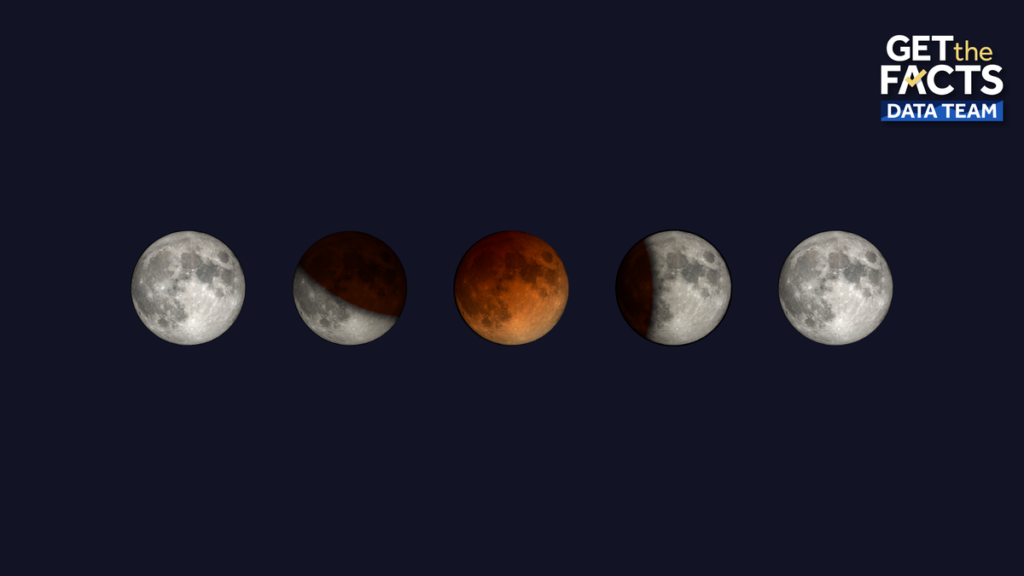
A total lunar eclipse will be visible across most of the United States in the early hours of Tuesday. A total lunar eclipse occurs when Earth moves between the sun and the moon. It creates a dark red and orange shade across the moon.Before and after the total lunar eclipse, the moon also goes through a partial eclipse, where Earth’s shadow begins to move across the full moon. It looks like a growing bite is being taken out of the moon. The next total lunar eclipse won’t be visible from the Americas until 2029, according to NASA. As the moon moves through the phases of a lunar eclipse, so does the visibility region.The first two phases — the penumbral and partial eclipse — will be completely visible across all of the U.S. During the penumbral phase, the moon is in Earth’s outer shadow. It has a very subtle dim.The viewing zone along the East Coast will reach the moon’s setting during the totality phase. Moving west across the U.S., more of the lunar eclipse becomes visible in its entirety.When to watch the lunar eclipse?Totality will occur at 6:04 a.m. Eastern Time or 3:04 a.m. Pacific Time, according to NASA. Use our tool below to see what time the moon will be at each phase during the lunar eclipse in your time zone. Because of the viewing differences across the country, make sure to check the map above to avoid missing a specific phase.For example, on parts of the East Coast, the moon will set during totality — limiting the time window for seeing the lunar eclipse.
A total lunar eclipse will be visible across most of the United States in the early hours of Tuesday.
A total lunar eclipse occurs when Earth moves between the sun and the moon. It creates a dark red and orange shade across the moon.
Before and after the total lunar eclipse, the moon also goes through a partial eclipse, where Earth’s shadow begins to move across the full moon. It looks like a growing bite is being taken out of the moon.
The next total lunar eclipse won’t be visible from the Americas until 2029, according to NASA.
As the moon moves through the phases of a lunar eclipse, so does the visibility region.
The first two phases — the penumbral and partial eclipse — will be completely visible across all of the U.S.
During the penumbral phase, the moon is in Earth’s outer shadow. It has a very subtle dim.
The viewing zone along the East Coast will reach the moon’s setting during the totality phase.
Moving west across the U.S., more of the lunar eclipse becomes visible in its entirety.
When to watch the lunar eclipse?
Totality will occur at 6:04 a.m. Eastern Time or 3:04 a.m. Pacific Time, according to NASA.
Use our tool below to see what time the moon will be at each phase during the lunar eclipse in your time zone. Because of the viewing differences across the country, make sure to check the map above to avoid missing a specific phase.
For example, on parts of the East Coast, the moon will set during totality — limiting the time window for seeing the lunar eclipse.