
Imagine trying to reconstruct the history of a city by studying only its oldest surviving buildings. You can’t watch it being built, you can’t interview the architects, all you have are the structures themselves, their materials, their arrangement, the subtle clues locked into their very fabric. That is essentially what astronomers do when they study the formation of our Galaxy, and a new study has just given them their biggest collection of clues yet.
The key lies in a type of star called an RR Lyrae variable. These ancient, pulsating stars swell and shrink over the course of just a few hours, brightening and dimming like a slow heartbeat. What makes them extraordinary is that they are almost eerily predictable. Because astronomers know precisely how bright they truly are, they can calculate exactly how far away they are just by measuring how bright they appear in the sky. They are, in the truest sense, cosmic lighthouses.
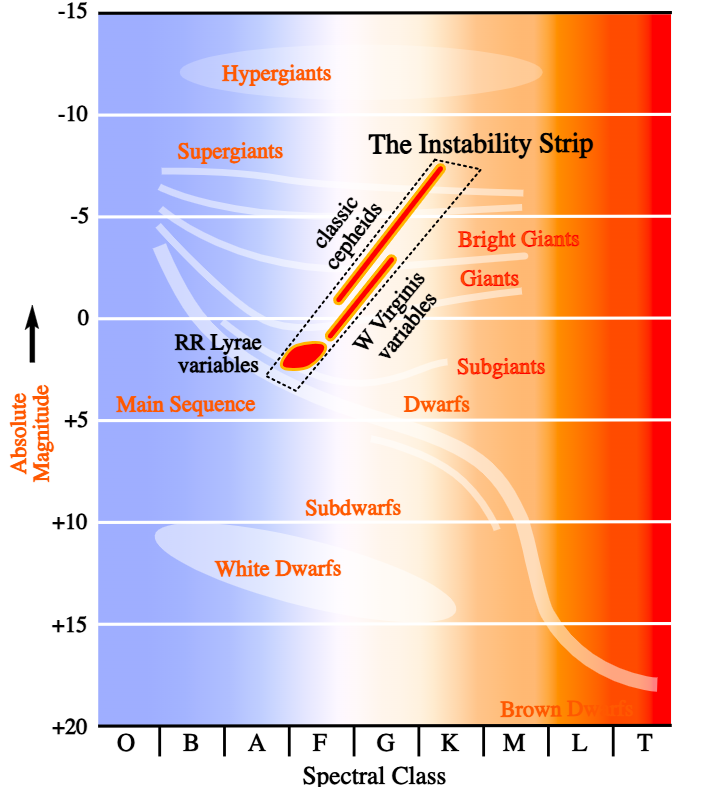 The RR Lyrae variable stars fall in a particular area on a Hertzsprung–Russell diagram of colour versus brightness (Credit : Rursus)
Crucially, RR Lyrae stars are old and we’re not talking millions of years, we’re talking more than ten billion. These stars were forming when the Milky Way itself was still taking shape, in the chaotic early universe shortly after the Big Bang. That makes them living relics, fossils of a Galaxy in the process of becoming itself.
A large international team assembled the biggest ever catalogue of these stellar fossils, thousands of them combining precise distance measurements with data from the European Space Agency’s Gaia satellite, which has mapped the positions and movements of over a billion stars with extraordinary accuracy. Together, this gave astronomers a picture of where these ancient stars are, how fast they’re moving, and in which direction, essentially, a 3D map of the early Milky Way that can be rewound like a film.
What they found challenges a long held assumption that the Milky Way’s different structural layers we see edge on in the night sky were long thought to have formed at different times. The new results suggest that they all appear to have formed remarkably quickly and at roughly the same epoch. The main difference between them isn’t age, it’s chemistry: stars in the halo contain less iron than those in the thick disk, which in turn contain less than the thin disk. Each successive layer was enriched by the deaths of previous stellar generations, a kind of celestial inheritance passed down through supernovae.
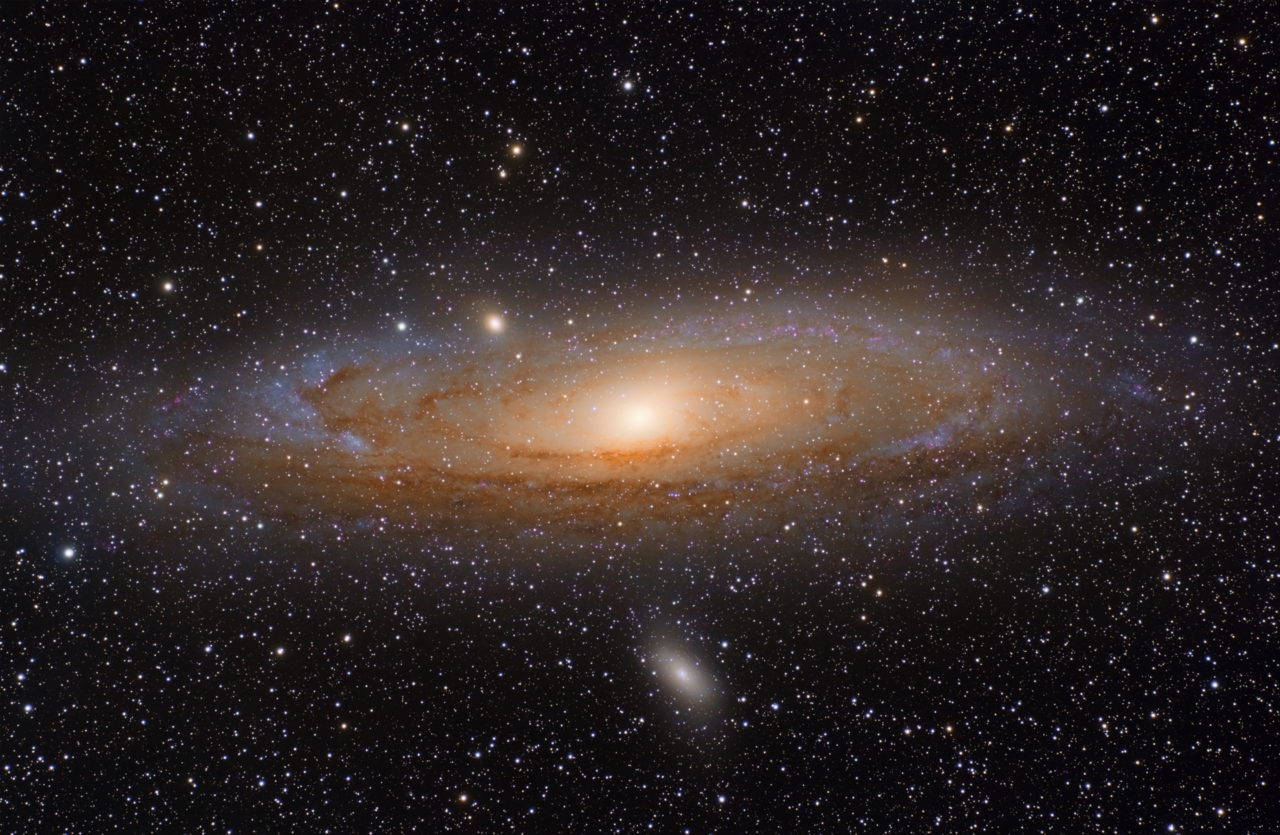 The Andromeda Galaxy is home to a number of RR Lyrae variable stars (Credit : Brody Wesner)
Perhaps the most striking finding involves our galactic neighbour, Andromeda. When the team compared the chemical fingerprints of old stars across the Milky Way with those in M31, they found strikingly similar patterns, despite the two galaxies being very different in size and having quite different histories of merging with smaller galaxies. Whatever process drove the earliest phase of galaxy formation, it seems to have operated in the same way across both.
Source : RR Lyrae Variables as Beacons to Investigate the Early Formation of the Milky Way