
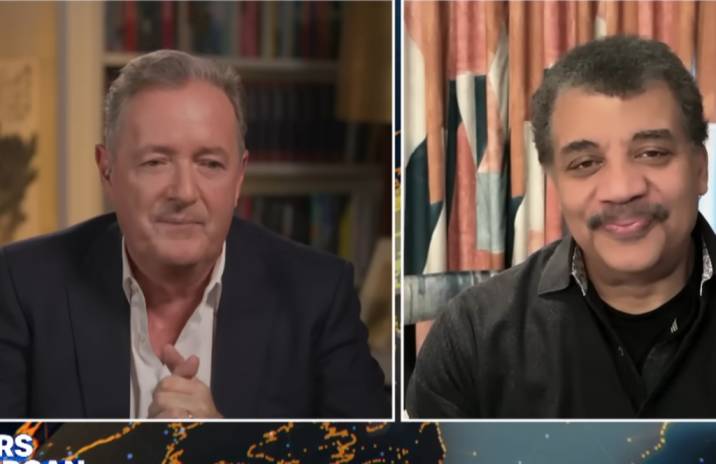
By the time I was 11, if you asked me that annoying question that adults always ask kids, “What do you want to be when you grow up?” my answer was astrophysicist. So looking up that long, that frequently, for so much of my life, you end up seeing things that you’ve never seen before. And then you look it up and you find out, oh, there’s a weather phenomenon. It’s lightning. It’s the clouds. It’s a different kind of cloud. And so you become highly fluent at all the things that might otherwise trick someone without that background into thinking it’s extraterrestrial.
There’s a case where, for example, the planet Venus — which is white cloud-shrouded, and it’s the nearest planet to Earth — is bright not only because it’s near, but because it’s white, reflects sunlight, and it’s near the sun on each side, in the morning or in the evening. If you ever hear of the “evening star” or the “morning star,” they’re referring to Venus. So there was a time when there was a police car that was tracking a UFO, calling it in, and they were saying, “The UFO’s darting left and right and we’re tracking it.” And it turns out they were tracking Venus on a road that itself was curving. And they were not conscious of the fact that they were the ones swerving. They were thinking the UFO — Venus to them, because it’s a UFO to them, they don’t know what they were looking at — that that’s what it was doing.
So there are these reports of things people see where if you knew better, you would be able to explain it, and then you wouldn’t call the police department. That still leaves behind cases that are not explained by natural causes or known phenomena. So it could be phenomena yet to be discovered. Frontier. I’m good with that. A new sky phenomenon. Let’s investigate it. Let’s get more data. Go for it.
But just because you don’t know what it is and it’s doing things that are mysterious to you, and you use the “U” for Unidentified Flying Object — or as you know, the United States rebranded that as UAP, Unidentified Anomalous Phenomena. Who are they kidding? They’re talking about the same thing, of course. So you rebrand it, but you can’t look at something that’s anomalous, say you don’t know what it is, and then declare that you know what it is. That doesn’t comport. You just say, “I don’t know what it is. Let’s investigate it further.” Which I’m all for.
Roswell, Area 51, and Government Secrets
PIERS MORGAN: A lot of the speculation, I guess, in the last hundred years was fueled by Roswell in the 50s, by this fabled Area 51 at the US Air Force facility in Southern Nevada, and so on. I imagine you’ve either been there or know people who have. You’ve looked at all this. What is the truth about Roswell, Area 51?
NEIL DEGRASSE TYSON: I’m not authorized to come in for — just kidding.
PIERS MORGAN: You’re pleading the Extraterrestrial Fifth.
NEIL DEGRASSE TYSON: So, just to back up for a moment. What I explore in Take Me to Your Leader is all the ways aliens might visit us, could visit us, may have visited us, and just unpack what might be alien science, alien technology, even alien powers — powers they might wield that we don’t biologically. And so you can approach that question with guardrails on the conclusions you might jump to. And the guardrails, because the laws of physics as we experience them here on Earth, it turns out, apply across the universe and across time. It’s not an assumption, it’s a measurement that we have made, so we get to constrain what’s going on here.
And so now getting more directly to your question. I’ve been to Roswell, never been to Area 51. I can say that if the government is stockpiling — let’s assume the government is stockpiling aliens. Let’s ask a whole other set of questions. Let’s just do this. You ready? Come with me on this.
If they’re doing that, let’s say at Area 51 or anywhere, no one is leaking that information. So many people who are sure that the US government is a big, bloated, inefficient bureaucracy simultaneously will declare that it’s masterminding a major cover-up when thousands of people are in on it and keeping a secret. And all I can think of is Benjamin Franklin’s edict from his almanac where he said, back in the early 1800s, he wrote: “Three people can keep a secret if two of them are dead.” This is just a blunt understanding of human nature.
And by the way, the kinds of secrets we’re talking about are the tasty secrets, the really juicy secrets. The government, of course, keeps secrets that no one even cares about. So it’s the ones that you really care about. And how about the janitor that could have just slipped an iPhone photo of the alien and then immediately posted it? Yes, the janitor would lose his job the next day, but it would be the most famous, richest janitor there ever was. Because that would go viral faster than cat videos go viral.
So we can ask the question, because every one of us has a smartphone on our hip capable of high resolution photos and videos. And we upload 4 or 5 billion photos a day to the Internet, plus a million hours of video a day to the Internet. None of them have detailed images of aliens. So either the aliens are only coming to Earth to visit our military installations and the US government — I mean, maybe they just care about our military. That’s possible, I suppose. But if we were under alien invasion, it seems to me that would get crowdsourced because everybody would take pictures of it and you wouldn’t need hearings. No one would have to swear they’re telling the truth. Could you just bring forth the alien?
What Did Obama Really Mean About Aliens?
PIERS MORGAN: Well, there are two things I would say to that, which I think are interesting. So Marco Rubio and others implied in the Age of Disclosure documentary that some information is hidden from even the President of the United States, which I suspect may be true. But then we have the extraordinary situation of President Obama, who was president for eight years, just casually asked at the end of an interview last week with Brian Tyler Cohen about whether aliens are real. And he says this.
VIDEO CLIP BEGINS:
BARACK OBAMA: Are aliens real? They’re real, but I haven’t seen them. And they’re not being kept in — what is it, Area 51. There’s no underground facility unless there’s this enormous conspiracy and they hid it from the President of the United States.
VIDEO CLIP ENDS:
PIERS MORGAN: And Obama replied, yeah, he thinks they’re real. Now, when the President of the United States, who’s been in that job for eight years, when one of those guys says he thinks aliens are real — notwithstanding, he backtracked a bit afterwards — but in that moment, everyone goes, “Whoa, whoa, what? Obama thinks aliens are real. What’s he seeing?”
Should We Trust Politicians on Scientific Discoveries?
NEIL DEGRASSE TYSON: Yeah, I don’t see why people credit politicians with having deep insights into scientific discoveries of the universe. That’s odd to me as a scientist, because anyone who is going to discover an alien, it’s going to be a scientist looking up with our thousands of telescopes that we have around the Earth.
PIERS MORGAN: But wouldn’t you — okay, but on that point though, Neil, wouldn’t you then feel compelled as a scientist to immediately inform the president?
NEIL DEGRASSE TYSON: So that’s the whole point. The title of my book is Take Me to Your Leader. So the alien comes down and says, “Take me to your leader.” Who do you take it to? Do you take it to the elected official who doesn’t know science, or do you take it to a science agency where you have cryptographers and biologists and chemists? Or the alien, having eavesdropped on our signals, might think the actual leaders are Taylor Swift or some other pop culture figure.
So the point is, it’s an interesting dilemma you might have. I would simply say that if an alien came up to me and told me to take it to its leader, I would take it to the nearest science conference and we would engage in conversation and later on inform the government. That’s totally how I would do that.
And could it be — wait, wait, wait. In that interview with Obama, he says, “Yeah, aliens are real.” I didn’t interpret that as “we are stockpiling aliens.” He’s scientifically literate enough to know that in the universe there are likely aliens. And that’s how I interpreted that first sentence. I didn’t view that as him leaking secrets or anything.
The Alien Cover-Up Debate and Government Credibility
PIERS MORGAN: That was just, hang on, hang on, hang on. You are a super brain. You know the difference. And he’s a lawyer, by the way, who even more knows the difference between how you phrase things. The difference between saying, look, it’s likely in the whole universe, there’s other stuff, right? And him actually responding directly to are aliens real? With a yes.
NEIL DEGRASSE TYSON: Okay, I, since no one in government has presented an alien, I did not immediately think the government has aliens.
By the way, by the way, the notion that there’s some kind of a cover up. How can you continue to think that when in the film, in the documentary Disclosure. I don’t want to confuse the documentary with the Steven Spielberg movie that’s about to come out. The Spielberg movie is called Disclosure Day. And so Age of Disclosure. In that documentary, there’s a no end train of people talking about aliens. In the locked box in the shed.
And so if they’re talking about it and they’re insiders and they’re whistleblowers, then who cares what the President says? These people are on the inside. So they’re the ones who I’m going to listen to, not the President. Especially since the President, if there is a cover up, is going to be in on the cover up and someone who’s sneaking information out is not.
And so the fact that people listen to what presidents say as though it is the truth, I’ve never understood that at all. They’re just someone we elect.
Could Aliens Already Be Among Us?
PIERS MORGAN: Could it be that aliens, could it be that aliens are coming to our planet and identifying as humans? I mean, could Elon Musk, who joked about being an alien, could he actually be an alien, double bluffing us? He’s got a super brain, he does extraordinary things in many ways. He doesn’t come across as particularly human. Could it be that if you were a superior alien force, would you send a bunch of Elon Musks along and just, you know, blend in and then slowly take over?
NEIL DEGRASSE TYSON: Okay, there’s a way to test for that. And that is you line up everybody who’s a little suspicious looking. Okay? This is kind of like in the film Men in Black. You’d be on the list in their headquarters. They were tracking all of the aliens on Earth and there were people who were in pop culture. And they look a little different — like Michael Jackson was one of them. I remember in one of the frames.
And so the way to do that is get the most alien likely imposter you can find. Let it be Elon Musk. Just bring him into the lab and take a blood sample. If the heart is in the wrong place, if he’s got green blood instead of — that would mean it’s based on copper instead of iron. Not a weird exotic thought there. And so you could do that.
So now if they are human physiologically and the alien is just duping us, then you just kind of — there’s no way to tell. If the alien made a perfect human, then as far as we’re concerned, they’re human, of alien manufacture. But there’s no way for you to know because you constructed the example to be such that there’s no way to know, so that you can continue to believe that aliens are among us.
This is Conspiracy Thinking 101, where you invent an account that allows you to continue to think what you’d like, even if the direct evidence isn’t there. Or if there’s a gap in the evidence, you gap it yourself so that you can continue to believe. So I came to conclude that it’s almost a belief system because no one is — like I said, if you bring forth the alien, I don’t need your testimony. We got the alien.
Are All Alien Theories Conspiracy Theories?
PIERS MORGAN: I would argue that given we know nothing about aliens from what you’re saying, then all theories about them, potentially are conspiracy theories. Right. I mean, we can say as you’ve done and Obama stated when the fury blew up about his comments, well, it makes sense that there would be other stuff out there — that in itself is a conspiracy theory. It may not be. You’re just supposing that it’s highly unlikely. And I would agree with you, I would buy into this theory that it’s just very unlikely that in the universe we’re the only living entities. Right. So, but everything by definition would be a conspiracy theory until there’s any factual evidence.
NEIL DEGRASSE TYSON: No, no, not really. Because the difference is — okay, so what you’re asking, I think you’re asking is whether the fact that scientists who have done the calculation have pretty high confidence that there are aliens out there. So, okay, that’s one thing.
And by the way we are looking, we have major observing programs, helped in large measure by the James Webb Space Telescope, to look for evidence of aliens. And by the way, to the scientist, an alien is any kind of biota or it could be microbial. So we’d be happy if we found anything, not just, you know, the kind that would come here in a spaceship.
So I have a hard time accepting that, looking at the statistics on that. And now we’re motivated to search — that somehow that’s a conspiracy theory because we’re testing our conclusions. Okay. The conclusions are not a given. We’re presuming there’s life out there. Now let’s go find it.
The UFO people are declaring, we’ve been visited. That’s a declaration. But they don’t have the evidence, or it’s hidden or it’s a conspiracy, or it’s covered up. And so they arrive at their conclusion, gapping the absence of evidence. And so that’s to me, different.
Alien Etiquette: How Should We Behave If We Meet One?
PIERS MORGAN: You talk in the book, which is a fascinating read, but you talk about the etiquette we should consider if we ever do meet an alien. Just give me a little bit of that.
NEIL DEGRASSE TYSON: Yeah. I mean, we have so many assumptions that we just take for granted. Because one of the chapters, the first chapter is called Alien to Us. And I explore all the ways we’ve imagined aliens in our pop culture, in our films, in our books. And so this gives us a range of our creativity. And then we can then ask, well, what would we look like to them? And how much thought have we put into that?
For example, the alien comes down and wants to hang out with you, and you say, “Excuse me, I need to spend the next one third of Earth’s rotation in a semi comatose state. I’ll be back to you in eight hours.” That’s gotta come across kind of just — and then the whole world is just semi comatose, not even sort of awake. They’re just — you can poke them and nothing happens.
Things you’re urged to want to shake their hand, like that’s worth it. Not all humans do that. In China, it’s more of a bow where you hold your own hand. So that’s not even all around the Earth. But if they happen to have some appendage sticking forward, you don’t just grab it and shake it. You don’t know what part of that alien you just grabbed. And so just leave your assumptions at home and go there with no assumptions at all.
And the alien — making this up, of course — suppose the alien had a little bit of dog in it. Just however that — all right, it probably doesn’t have DNA, but if it had some dog behavior and it lands, the first thing it might do is go around and wonder. And we see dogs do that. That’s just normal for dogs. All right, if an alien did that, you say, “Wait, what?” But maybe that’s normal for aliens. So I spent a whole chapter exploring how we are alien to aliens, because I don’t think people gave that enough thought.
PIERS MORGAN: No, I gave it no thought until I read that. It’s fascinating and actually it makes perfect sense. Perfect sense.
NEIL DEGRASSE TYSON: You know what else I would do? I would leave behind everyone who thinks Earth is flat or does not recognize that science is a path to objective truth. Because we want to leave a good impression on the aliens. And if they see members of your species that are totally out of it, that could leave a bad impression. Because I don’t want the alien to phone home and say, “There is no sign of intelligent life on Earth.” I want to give him the best chance that they can say nice things about us in the report.
AI as Our Own Alien Creation: Should We Be Afraid?
PIERS MORGAN: Are we building our own alien force through AI and robots? And do you fear that? I mean, a lot of very bright people are getting very concerned that AI will ultimately learn to self design. And that when it does, it may well take a view that humans are pretty useless. They spend eight hours a day in comatose conditions, for example. We drink, we fornicate, we take drugs, we fight and so on. And they might, if they get smart — which they’re getting very smart very quickly — just go, “Well, let’s get rid of them.” But I mean, on a serious point, do you worry about that?
NEIL DEGRASSE TYSON: I get it, I get it. So let me take one step back and then two steps forward to that question.
So one step back is we measure how great AI is by how well it imitates our intelligence, hence artificial intelligence. And by the way, who said humans are intelligent? Humans did. Okay, so is that the measure of intelligence? Because we call ourselves intelligent. If an alien came, would it judge us to be intelligent? If it built a spaceship across the galaxy, chances are we got nothing on these aliens. And they’ll look at our attempts to make a computer program that can imitate us or be a little smarter than us, and they’ll just laugh, because human intelligence is a low bar.
If you have a computer beating human intelligence and an alien is looking at that, it’s like, “What? We can program that in an afternoon. Little alien junior in our basement is programming that.”
So I don’t necessarily see human intelligence as the measure of things, just for those reasons. Just step back and ask — a quick example here is: our closest genetic relative is the chimp and we’re like 2% different in DNA. And the smartest chimps there ever were can stack boxes and reach a banana and might do some rudimentary sign language. They’re only 2% different from us.
Well, then we’re prone to say what a difference that is. We have philosophy and art and civilization and the James Webb telescope and all they can do is stack boxes. Well, imagine a life form that’s 2% vector beyond us, that we are beyond the chimp. What would we look like to them? The smartest among us would match their toddlers. Stephen Hawking to them — “Oh, that’s cute. He knows astrophysics. He can do it in his head like little alien Timmy Zork Jr. over here who’s just home from preschool.”
So I don’t view AI with humans as the metric as something that is cosmically significant.
Now more directly to answer you — yeah, AI, once it has its own agency, that’s the scary part. Then what would it think of humans? Might it make us their pet, for example? And then I thought about that — we kind of don’t want that, of course, but look at how we treat our pets. We know humans will step over homeless other humans in the street to go home and cuddle with their pet dog, their pet cat. So maybe being the pet of an alien is not so bad, if our behavior towards pets is any indication.
If they otherwise see us the way the agents in The Matrix — that we are a virus on Earth that we need to get rid of — that could be bad. So maybe we should start behaving better in anticipation of that day.
PIERS MORGAN: But do you think AI is capable of self designing? Do you think it can get to that stage? I’ve seen opinions split on that.
The Threat of Malicious AI
NEIL DEGRASSE TYSON: Yeah, yeah. I don’t. In my life, I’ve written maybe 50,000 lines of code, but that was long ago. But I was in it and I felt it. And the computer is this thing, you know, you’re talking to it and you design it to talk back to you and help you and give you data that you couldn’t have calculated. And so its powers are only growing exponentially. If it could design itself, that’s a game changer right there.
And the question, but here’s what I would ask AI is like in a computer. Yes. There’s all these robots that people are designing. By the way, the human form is the last thing you want to imitate. You know, it’s the human form really. Okay. With two feet easily get knocked over. You need at least three. Okay. Insects know this. Insects have six legs. Three legs are on the ground at any given moment. And so it’s stable the whole way. That’s why they can scurry so quickly and why most mammals can outrun us. Okay, so our form is not a thing that should be emulated.
But regardless, the AI is in a computer sitting there on a shelf. Okay? I as a human still get to go to the beach, go to a party, meet people I’ve never met before, find a shell, a mollusk on the shore that maybe it’s a new mollusk that’s not cataloged yet. I can make discoveries because I am mobile and I can get around. A piece of silicon is not. Now maybe you just make mobile AI. Is it going to hang out at the beach and watch a sunset and compose a poem on that? I don’t see that in line as what’s going to come. And so we have to train it to have that bit of sort of humanity and humility about its own knowledge and its own place in our world.
PIERS MORGAN: You know, it’s interesting you mentioned Stephen Hawking. I’ve said this many times, but I did, as you did, one of the last interviews with him before he sadly died. He was an amazing guy. But I did ask him what’s the biggest threat to mankind? And he said, “When AI learns to self design, that’s it.” So I just hope he didn’t give a caveat as to whether it was going to self design. He just said that would be the moment.
Ray Bradbury, Terminator, and the Guardrails of AI
NEIL DEGRASSE TYSON: Yeah. One of my favorite quotes is from this sci-fi writer, Ray Bradbury. And I met him only once and I confirmed with him that it’s a legit quote. Apparently a woman once came up to him and said, “Mr. Bradbury, why do you write these stories about apocalyptic futures? Is that where you see humanity headed?” And he says, “No, I write those stories so you know to avoid them.”
And when you look at the number of alien movies we have drawn from the creativity of our most creative storytellers, so many of them have bad endings. Take Terminator, really out of the box on that one. I think the first one was 1984. It’s 1985. So we have been warned by our own media, our own movies, we have been warned. So we’re in a position to say we know what to look for. Here are the guardrails to prevent that from happening.
And even Isaac Asimov with his famous three laws of robotics. The first law is, if you’re designing a robot, the robot must never harm humans. The second law is the robot must never allow harm to happen to humans if their intervention could prevent it. The third law is the robot must look after its own existence, provided doing so does not violate the first or second laws.
I’m reciting these for you only to tell you that Isaac Asimov, as early as the 1950s, knew that you have to put guardrails on your creation. And to the extent that there are no guardrails, I love the title of this book that came out recently. It said, “If anyone builds it, everyone dies.” Okay, that kind of checks. And so we just — the guardrail part is what’s important.
PIERS MORGAN: Yeah, it’s fascinating to see where it all goes. What I’ll talk just quickly about —
AI and Geopolitics: A New Cold War?
NEIL DEGRASSE TYSON: Let’s just think about briefly geopolitically. We’re old enough. We’re about the same age. We remember the Cold War. And the tensions surrounding the buildup of nuclear weaponry that could destroy each other and the world multiple times over. Once the realization that there are no winners in an all out nuclear exchange, then people came to the table and started reducing the stockpiles.
So if we tell the world, if anyone builds this super intelligent AI, this AGI — Advanced General Intelligence AI — if anyone builds it, that’s the end of us all. Then maybe we can come together with world wisdom, the wisdom of the ages, that tells us no one should have in their hands something that can destroy the world. So who knows, maybe the prospect of inventing that will bring peace to the world. Have you thought of that?
PIERS MORGAN: It could. I mean, I would say that the thing I’d be wary about would be a nefarious person or group who managed to get the most brilliant AI scientists in the world and get them into a dungeon somewhere and have genuinely malicious, nefarious intent on ending the world.
NEIL DEGRASSE TYSON: Could the rest of the world —
PIERS MORGAN: — stop them?
NEIL DEGRASSE TYSON: That’s a problem. So it’s not just the malicious intent. If you get someone who doesn’t care if they die, then there’s nothing they’re protecting. And that’s — you’re right, these people exist among us in our species. So yeah, I don’t have a good answer for that.
PIERS MORGAN: No, I was hoping you did.
NEIL DEGRASSE TYSON: Sorry. Maybe the alien will have a good answer.
NASA’s Artemis 2 and the Return to the Moon
PIERS MORGAN: It could be the alien. That would be ironic. I love talking to — I could talk to you for hours, but we’re running a bit out of time. I just want to talk to you quickly about NASA and Artemis 2. So my understanding of this is they’ve got this mission going up, I think in a couple of weeks. It’s a 10 day crewed test flight around the moon scheduled for 6th of March. It will take astronauts further into space than anyone’s been before. And it aims to set the stage for an eventual human landing again on the lunar surface for the first time since the 60s and 70s.
What do you feel about this? I mean, it seems extraordinary that we haven’t been back to the moon in so many decades. Is it important that we do get back to the moon? Is Artemis, do you think, going to be the way that we do that?
NEIL DEGRASSE TYSON: Well, let’s remember why we went to the moon in the first place. It wasn’t because, “Oh, we’re Americans, it’s in our DNA. It’s the next thing.” We were scared witless by the godless communist who had already put up a satellite — Sputnik — who put up the first non-human animal. Remember, that was Laika the dog. They were beating us in access to space, yet we were supposed to be what we wanted the world to emulate. And if we’re lagging behind our adversary, that doesn’t bode well geopolitically.
So Kennedy speaks in front of Congress in a joint session of Congress six weeks after Yuri Gagarin came out of orbit and says, “If the events of recent weeks are any indication of this impact of this adventure on the minds of men everywhere, we need to show the world the path of freedom over the path of tyranny.” It was a battle cry against communism.
So when we finally got to the moon, we leapfrogged the Russians, got to the moon, looked over our shoulder, the Russians weren’t there. They weren’t even planning to go to the moon. So we say we win, but then the race is over. And that’s why the program stopped. It’s not because Nixon lacked charisma. Even if he did lack charisma, that’s not why we stopped going to the moon. The geopolitical forcing of that decision evaporated. So why didn’t we stay on the moon? No reason to. Geopolitically. Science was never the driver. You know how many scientists went to the moon? One. Do you know which moon mission that was? The last. Okay, enough said.
So why don’t we go back to the moon? 1980, 1990, 2000, 2010 — no geopolitical forcing to enable it. Let’s go to the mid-2010s. China says they’re going to put Taikonauts, their version of an astronaut, on the moon. Then all of a sudden we say, “Oh, why don’t we go back to the moon? That sounds like the right thing to do.” And we don’t mention the geopolitical forcing because that looks crass. We just paint it as we’re explorers.
And so Trump won in 2016, he brings in Artemis, which, by the way, is a really woke name for the space program, because Artemis was the female twin sister of Apollo. Now that’s good. Okay, so Artemis begins. And because NASA transcends politics in the sense that there are 10 NASA centers scattered into eight states, and you go general election to general election, they go four red, four blue. It’s a mixture of the political spectrum. So that if someone says, “I don’t want to go into space,” you cannot deduce whether they are Republican or Democrat with that answer. So what that means is NASA’s presence in the American culture actually transcends politics.
So Trump says, “We’re going to go back to the moon,” and then Biden comes in and says, “We’re keeping this Trump program.” Everybody likes to hate Trump when you’re on the left, unless we’re going back into space to show the world who and what we are relative to everybody else. So that program has been in place since the mid-2010s, and we’re continuing it back into Trump’s second term. No one will admit that. But part the curtains and you read history. There you have it.
So where are we going? The South Pole. Why is it the farthest? Because the moon’s orbit is not a perfect circle around the Earth. So if you go to the moon while it’s a little farther than average and you make a big loop orbit around it, when you’re on the other side of that figure eight, then you’re the farthest. It’s an incremental record that’s being set. I like the fact that we’re going back to the moon more than I care that they’re setting a distance record, personally.
But they’re going to the South Pole because that’s where there might be water left over from comet impacts. And you go there, you have to surface mine it, then you have water, you can drink it, you can make rocket fuel, you can pitch tent. And so it’s the beginnings of a colony on the moon so that other countries don’t do that before we do.
One Trip Anywhere in the Universe
PIERS MORGAN: Fascinating. Just finally, if I had the unlimited power to let you do any exploration anywhere in the universe, but you can only have one trip, what would you do?
NEIL DEGRASSE TYSON: One trip?
PIERS MORGAN: One trip anywhere in the universe. You get unlimited power to give you one trip.
NEIL DEGRASSE TYSON: Okay. I’d like to move through time and be witness to the formation of the moon, when a Mars-sized protoplanet slammed into Earth, creating a ring system around Earth like Saturn, that would coalesce and form. I want to be able to move through time. That would just be an amazing thing to watch. Popcorn right on the front row.
But in terms of inventions, if I had unlimited resources, I’d want to invent wormholes. That would be a game changer. We know how to make wormholes, by the way. We’re just missing the substance that would allow it. We need a substance that has negative gravity, because gravity brings things together into one place. A wormhole has to pry it apart. So you need a negative gravity substance. We don’t know if it exists in this universe or any other. If it did, we can make wormholes, pry open the fabric of space and time, step through.
Unlike what they show in the movies where it’s like a water slide ride — that’s not it. You would just step through. Like Rick and Morty. You step through. Or who’s the guy in the movie that does this? Dr. Strange. You just step through and get to another destination. That would be a game changer. And if you have wormholes, you don’t need roads.
PIERS MORGAN: Right?
NEIL DEGRASSE TYSON: You just step through. And you can connect the back of your refrigerator to the grocery, and the grocer can peek and say, “Oh, you need some more eggs.” They just pop it in, close back the wormhole. And so for me, if I had unlimited resources and unlimited access to unlimited laws of physics, the wormhole would be at the top of my list.
Closing Remarks
PIERS MORGAN: Fascinating. Neil, brilliant to talk to you. It’s a great book. I encourage everyone to go give it one last plug.
NEIL DEGRASSE TYSON: Oh, I’m uncomfortable doing it, but okay. If you really want to know how to think about aliens, it’s a primer for that first alien encounter so you won’t be taken by surprise.
PIERS MORGAN: Just Visiting: Take Me to Your Leader, out in May. I believe it’s a cracking read, Neil. Thank you very much.
NEIL DEGRASSE TYSON: Thank you very much, too.
PIERS MORGAN: Piers Morgan Uncensored is privately independent. The only boss around here is me. If you enjoy our show, we ask for only one simple thing. Hit subscribe on YouTube and follow Piers Morgan Uncensored on Spotify and Apple Podcasts. And in return, we will continue our mission to inform, irritate, and entertain. And we’ll do it all for free. Independent, uncensored media has never been more critical, and we couldn’t do it without you.
Related Posts