
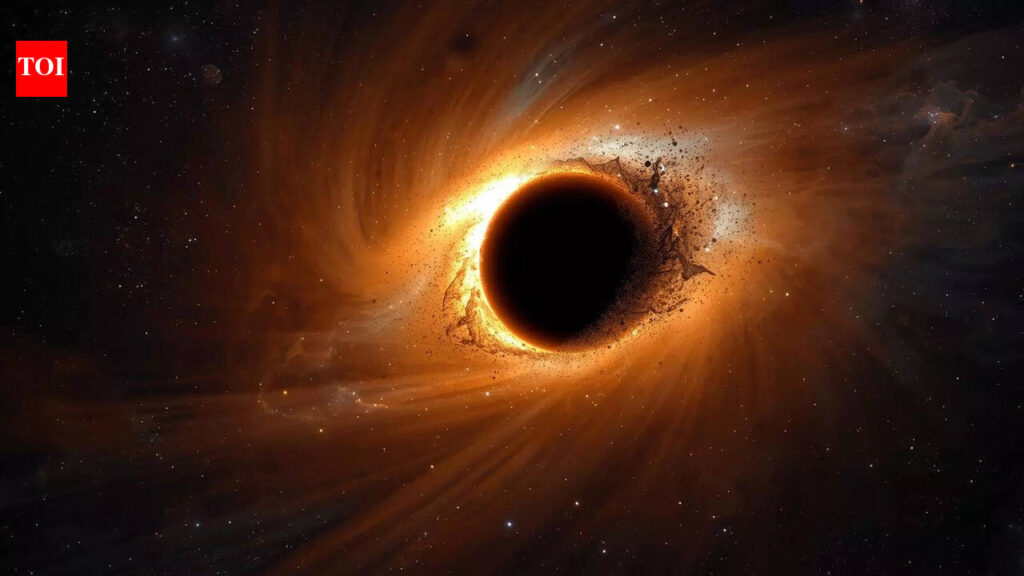
 Caught on camera: Black hole seen tearing a star apart for the first time (AI-generated) Astronomers have reported an unusually high-energy event that may represent a rare form of black hole feeding. The transient, named EP250702a, was first detected in July 2025 by the Einstein Probe mission and later observed by several other space telescopes. Its brightness rose quickly in X-rays, produced strong gamma ray flares, and then declined far more rapidly than most known tidal disruption events. Researchers suggest the signal is consistent with a white dwarf being torn apart by an intermediate mass black hole. Such events have been predicted for years, but not clearly confirmed. The observations include rapid variability, extreme luminosity, and later spectral softening that does not match previously catalogued transients. The findings offer possible evidence for a long-suspected class of black holes.
Fast X-ray transient points to white dwarf disruption by intermediate-mass black hole
The first signs of activity appeared in X-ray data, with emission emerging about a day before the strongest gamma ray bursts were recorded. The Einstein Probe identified the source, and follow-up detections came from the Fermi Gamma-ray Space Telescope and other monitors.The peak X ray brightness lasted roughly a day. After that, the signal fell sharply over the next couple of weeks. In total, the drop in flux spanned several orders of magnitude in a short time. Most tidal disruption events involving normal stars fade over months or years. This one did not.The energy output was also striking. Gamma ray flares lasted hundreds of seconds and suggested that material was being expelled at extremely high speeds.
White dwarf disruption explains the short timescale
Researchers argue that the fast evolution points to the destruction of a white dwarf rather than a typical star. A white dwarf is the compact core left behind after a low or medium mass star exhausts its fuel. It is dense and relatively small, closer in size to Earth than to the Sun.Because of that density, only certain black holes can disrupt it. If the black hole is too massive, the white dwarf would disappear beyond the event horizon before being torn apart. Models show that intermediate-mass black holes are the right size to produce this kind of flare.This class of black hole sits between stellar mass black holes and the supermassive black holes found at galactic centres. Evidence for them has been limited. Events like EP250702a may offer one of the clearer routes to identifying them.
The relativistic jet adds to the evidence
In the study “A fast powerful X-ray transient from possible tidal disruption of a white dwarf”, data indicate that a relativistic jet was launched during the event. That means some of the disrupted material was accelerated outward at close to the speed of light. The hard X-ray and gamma-ray emissions fit this picture.Later, the X-ray spectrum became softer. This is consistent with the formation of an accretion disk, where remaining debris circles the black hole and radiates heat. The sequence, from hard energetic flares to softer thermal emission, aligns with theoretical expectations for a white dwarf tidal disruption. Other explanations were considered. Scenarios involving smaller black holes or unusual stellar interactions did not fully reproduce the timing, brightness, and spectral changes.
Event may help locate elusive black holes
If the interpretation holds, EP250702a would represent the first clear jetted tidal disruption of a white dwarf by an intermediate mass black hole. That would carry implications beyond this single flare. Intermediate mass black holes are thought to play a role in the growth of supermassive black holes. Yet they remain difficult to detect. Transients like this may serve as signposts.There is also interest in gravitational waves. A white dwarf being torn apart could produce both electromagnetic radiation and ripples in spacetime detectable by future instruments. For now, the event stands as an outlier. Bright, brief, and hard to classify at first glance. It may turn out to be a missing piece in the larger story of how black holes feed and grow.