
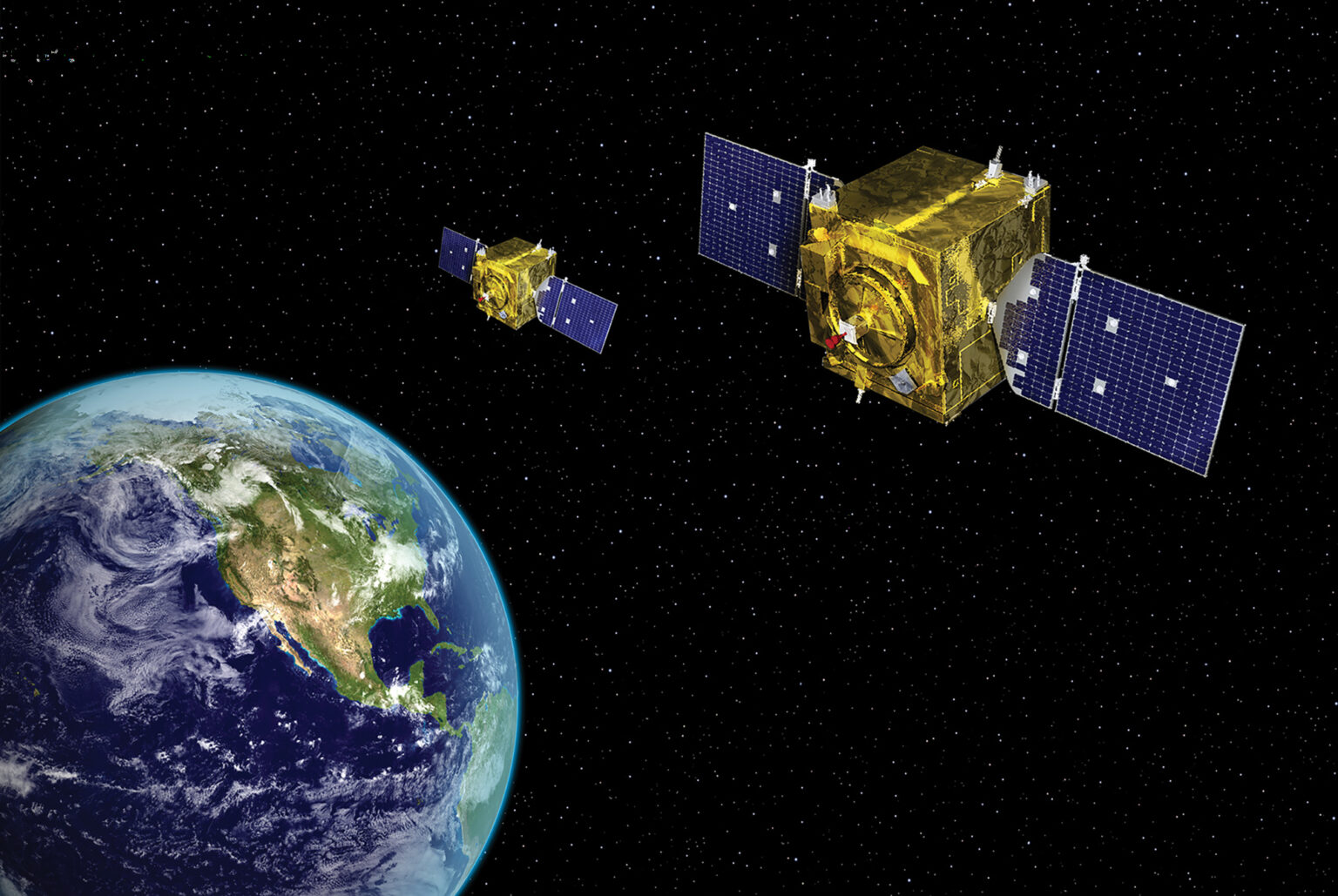
AURORA, Colo.—Guardians in the Space Force’s orbital warfare unit, Mission Delta 9, just got a significant upgrade to their training capabilities in the form of a live satellite, which they’ll use to practice precise, advanced offensive and defensive maneuvers for space warfighting.
The satellite was launched Feb. 12 on the the Space Force’s USSF-87 mission, which also featured a pair of spacecraft for another program the delta operates—the Geosynchronous Space Situational Awareness Program. Lt. Gen. Gregory Gagnon, commander of Combat Forces Command, said operators will be flying the satellite in ways specific to the orbital warfare mission that weren’t possible with previous on-orbit training assets. He compared the experience to that of a pilot transitioning from flying a commercial airframe to a military aircraft.
“They’re going to work on driving that spacecraft in a way that we couldn’t drive spacecraft before,” Gagnon told reporters Feb. 25 at AFA’s Warfare Symposium. “In the past, we’ve kind of had like a 737 and we practiced with that. Now, we’re getting a military-grade aircraft to practice with.”
That practice will help inform the Space Force’s tactics, techniques, and procedures for space maneuvers, Gagnon said, improving the service’s “acumen in orbital warfare.” He highlighted last year’s X-37B spaceplane mission as another key training opportunity. During that mission, the Space Force demonstrated a novel technique called aerobraking, which allows a spacecraft to quickly change orbits using minimal amounts of fuel.
“It’s pretty advanced, changing orbits and aerobraking into different orbits,” Gagnon said.
The Space Force’s greater focus on advanced maneuver comes in response to calls from U.S. Space Command for more mobile satellites that can rapidly change orbits, a concept called dynamic space operations. Officials have said that as propulsion technologies advance, future satellites—those built in the next 10 to 15 years—will likely have advanced maneuver capabilities built in. But for now, satellite mobility is limited by the amount of fuel they carry, which is typically just enough to avoid drifting out of orbit.
While the service is exploring near-term options like on-orbit servicing and refueling that could allow existing satellites to move toward Space Command’s vision, it hasn’t settled on a strategy. Lt. Gen. Philip Garrant, commander of Space Systems Command, said several upcoming demonstrations will help shape the way ahead.
“What a lot of these demos are looking at is how do we get after the near-term problem of maneuvering with different satellites and then making sure that the strategic assets, the protect and defend mission, can be done while we wait for the propulsion technology to truly enable maneuver without regret or dynamic space operations,” he told reporters Feb. 24.
On the training side, SSC is investing in capabilities like the satellite it launched earlier this month to help Guardians prepare for those orbital warfare operations. Gagnon said the maneuver spacecraft that Mission Delta 9 is using is a demonstration satellite and will inform acquisition plans for more training assets and other operational systems.
Col. Corey Klopstein, who leads SSC’s System Delta 81 and is the program executive officer for Operational Test and Training Infrastructure, told reporters in December that his team is exploring options to deliver more on-orbit training satellites for orbital warfare and other missions.
“We’re simultaneously building purpose-built, on-orbit assets to provide the right type of capability that we know we need based on the requirements that we have,” Klopstein said. “In addition, we have partnered with other organizations to either find ways to acquire more assets based on the ones that they’re acquiring or potentially leverage their contracts.”
SYD 81 is also developing synthetic and virtual environments for advanced maneuver training, Klopstein said, including a trainer called Paragon that it has fielded to Mission Delta 9. The system replicates rendezvous and proximity operations, allowing Guardians to get the “reps and sets” they need to perform their mission, he said.