
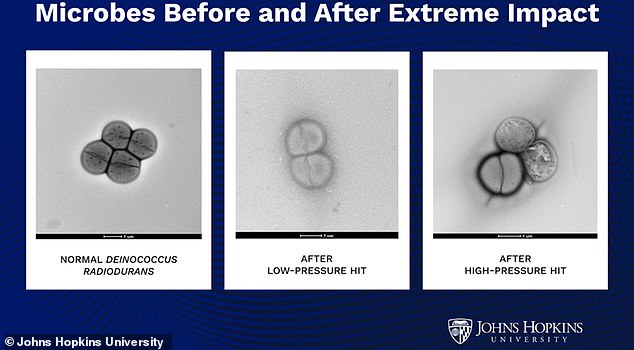
While aliens in science fiction hop between planets on vast spaceships, scientists say real–life extraterrestrials might take a far less glamorous means of transport.
When an asteroid slams into a planet’s surface, it catapults a spray of rocky debris with so much force that pieces can land on distant worlds.
Scientists already know that rocks from Mars have travelled all the way to Earth after an asteroid strike.
Now, researchers from Johns Hopkins University believe that microscopic organisms could have hitched a lift.
According to a new study, certain hardy bacteria can survive the immense pressures of an asteroid impact and the harsh conditions of the journey through space.
Tucked safely inside the ejected debris, bacteria from Mars could have made it all the way to Earth – and potentially even started life on our planet.
Lead author Dr Lily Zhao told the Daily Mail: ‘We found that life is more likely to survive an asteroid impact, so it’s definitely still a real possibility that life on Earth could have come from Mars.
‘Maybe we’re Martians!’
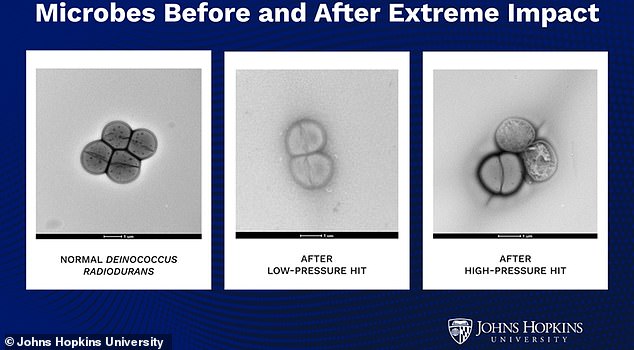
Scientists have found that microbes can survive the extreme forces of an asteroid impact, suggesting that alien life could be catapulted from planet to planet on rocks
The idea that life could have spread through the solar system or even the universe on rocks is known as the lithopanspermia hypothesis.
Senior author Professor Kalita Ramesh told the Daily Mail: ‘It’s an idea that’s more than a century old, but we’ve discounted it for years because the conditions that the life would have to survive were so extreme.’
The seeds of life not only need to withstand freezing cold and intense radiation on their journey through space, but also withstand the enormous forces of an asteroid impact.
Asteroids large enough to eject debris into orbit release energy on the scale of nuclear weapons, and scientists didn’t think anything could survive this.
Previous studies into whether bacteria might handle these forces have consistently proved inconclusive, casting further doubt on the lithopanspermia hypothesis.
However, as the researchers point out, these studies made the mistake of focusing on the kinds of life that are found on Earth.
Instead, the researchers looked at a type of bacteria that is much closer to the kinds of life that could be found on Mars.
They selected Deinococcus radiodurans, a desert bacterium found in the high deserts of Chile, notorious for its ability to survive the most inhospitable, space–like conditions.
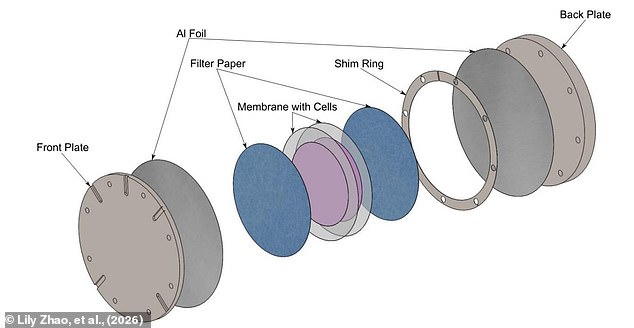
To simulate the forces of an asteroid impact, samples of tough bacteria were loaded between two metal plates and shot with a projectile moving at 300 miles per hour (482 km/h)
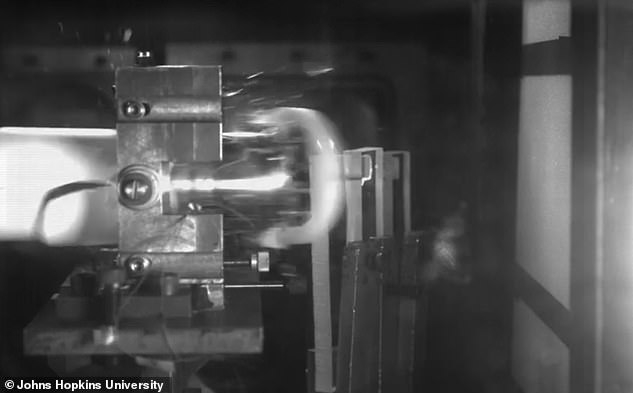
The impact (pictured) created pressures 24 times greater than those found in the Mariana Trench, but the bacteria sill survived 60 per cent of the time
‘The surface of Mars is very cold, very dry, and exposed to much more radiation than the surface of the Earth,’ says Professor Ramesh.
‘Deinococcus radiodurans is able to handle high radiation, extreme cold, and desiccation, and so it is a good model for what a potential Martian bacterium might be like.’
The scientists then put these bacteria through a series of tests designed to simulate an asteroid impact.
The bacteria were sandwiched between two metal plates and shot with a heavy projectile moving at 300 miles per hour (482 km/h), producing pressures between one and three gigapascals.
For comparison, the pressure at the Mariana Trench, the deepest point in the ocean, is just one tenth of a gigapascal.
Despite these incredible forces, the bacteria proved remarkably difficult to kill.
At 1.4 gigapascals of pressure, 100 per cent of the bacteria survived with no signs of damage whatsoever.
Likewise, 60 per cent of the bacteria survived at 2.4 gigapascals with only some signs of ruptured membranes and internal damage.
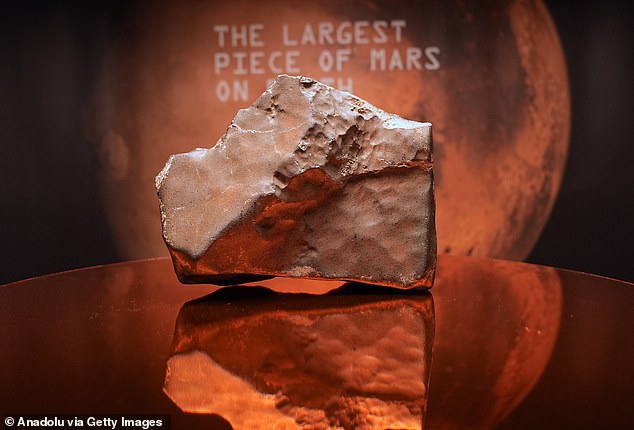
Chunks of Martian rock blasted by impacts do land on Earth, such as this enormous piece that went on auction last year. Scientists say that bacteria could have hitched a lift through space on a similar asteroid
In fact, the steel structure holding the plates together fell apart long before the scientists could kill all the bacteria.
Asteroid impacts produce a range of pressures, with some reaching up to five gigapascals, but this shows that tough bacteria could survive the initial impact.
That means the lithopanspermia theory is a lot more plausible than scientists had previously thought.
That has big consequences for how we think about the origins of life in the solar system, and where we look for life elsewhere.
Professor Ramesh says: ‘The existence of life on one planet now means that life could have moved to other planets or moons over the aeons.
‘For example, Martian life – if it ever existed – could potentially have found its way to the Martian moon Phobos, where it could survive buried beneath the surface.’
Mars is the fourth planet from the sun, with a ‘near-dead’ dusty, cold, desert world with a very thin atmosphere.
Mars is also a dynamic planet with seasons, polar ice caps, canyons, extinct volcanoes, and evidence that it was even more active in the past.
It is one of the most explored planets in the solar system and the only planet humans have sent rovers to explore.
One day on Mars takes a little over 24 hours and a year is 687 Earth days.
Facts and Figures
Orbital period: 687 days
Surface area: 55.91 million mi²
Distance from Sun: 145 million miles
Gravity: 3.721 m/s²
Radius: 2,106 miles
Moons: Phobos, Deimos