
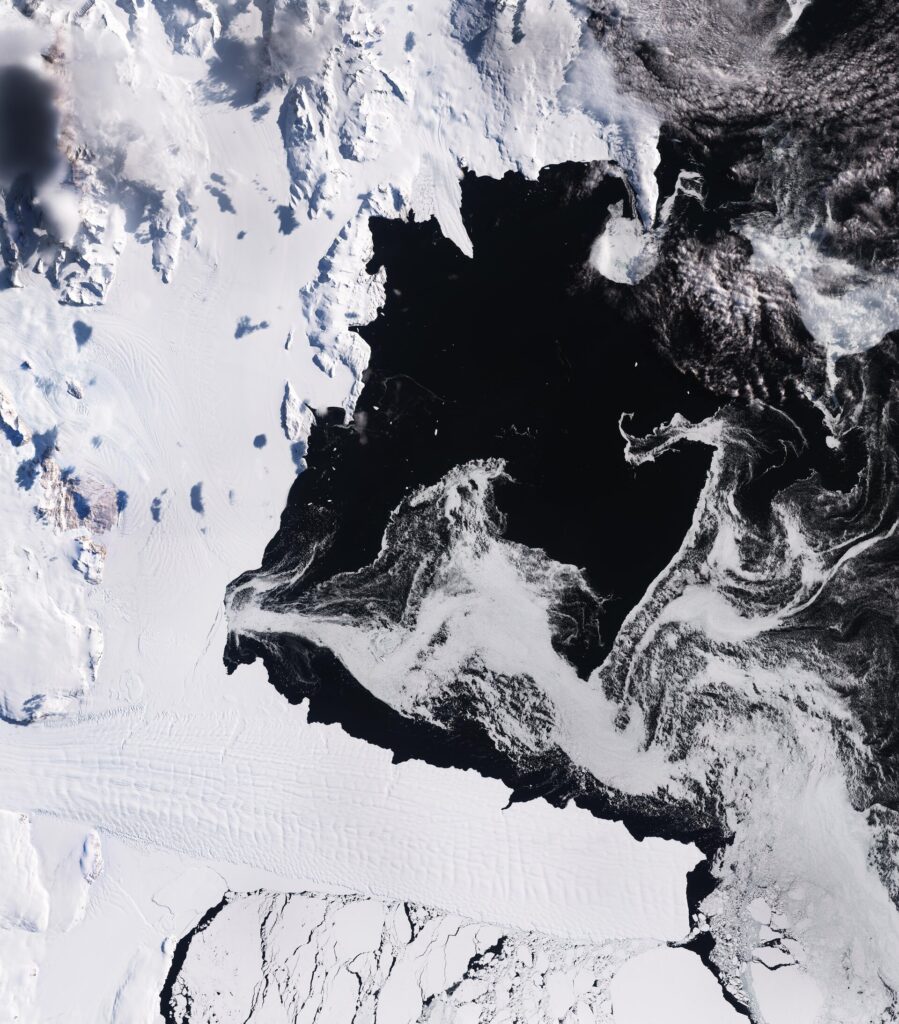
The Copernicus Sentinel-2 mission captures the icy landscape of Terra Nova Bay in East Antarctica.
Zoom in or click on the circles to explore this image at its full 10 m resolution.
The bay is on the coast of Victoria Land on the Ross Sea – an extension of the Southern Ocean – and is delimited by the promontory of Cape Washington to the north and the Drygalski Ice Tongue to the south.
This image from 14 February, which is late summer in the southern hemisphere, shows minimum seasonal sea-ice conditions with large areas of open water which appears black. White sea ice at varying stages floats in the water: from thin, newly-formed crusts to thicker floes. These countless pieces of ice trace out the ocean currents beneath, resulting in large swirling shapes.
Larger blocks of sea ice and icebergs can be seen in the lower part of the image, at the seaward end of Drygalski and below it. This long, narrow sheet of glacial ice stretches for 70 km into the sea, as an extension of the land-based David Glacier.
North of Drygalski, we can see the white expanse of the Nansen Ice Sheet, fed by several outlet glaciers, including the Larsen Glacier to the southwest, the Reeves Glacier to the west and the Priestley Glacier to the north. Flow lines are visible on the surface indicating the direction in which the ice is moving towards the sea.
On its east side, the Nansen Ice Sheet encompasses the Northern Foothills, a line of coastal hills separated by the Browning Pass from the Deep Freeze Range to the north. Here, on the southern headland along the larger inlet, lies the seasonal Italian Zucchelli Station, which has been operating in the area since the mid-80s. Zooming in, the straight lines of one of the runways serving the station can be spotted a few kilometres south of the main structure.
Other research stations are located further north on the same inlet: the German Gondwana Station and the Jang Bogo Station of South Korea. Both stations sit next to the mouth of Campbell Glacier, whose tongue extends southward into the bay. South of the Northern Foothills lies the small Inexpressible Island, which hosts the Chinese Qinling Station on its southern edge.
Stretches of Inexpressible Island and of the coast of Victoria Land are unusually rich in wildlife and have been designated Important Bird Areas by BirdLife International for colonies of Adelie penguins as well as south polar skuas.