
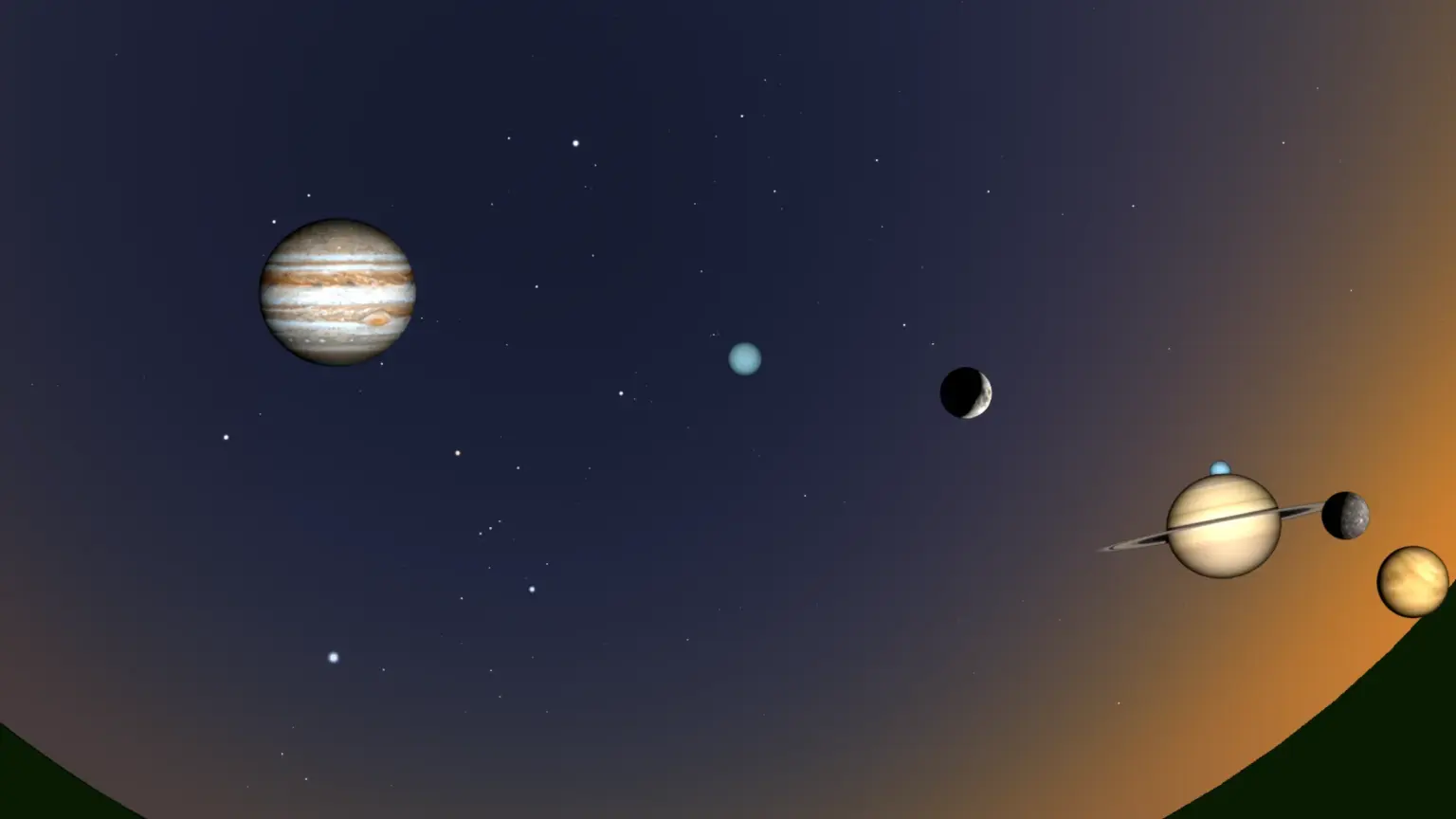
At the end of February, the sky will treat us to a unique astronomical phenomenon — a “parade of planets.” Six planets in the Solar System will line up in a row relative to Earth, creating a spectacle that is not to be missed. According to NASA forecasts, the best evening for viewing will be February 28, although the event will be visible for several days before and after that date.
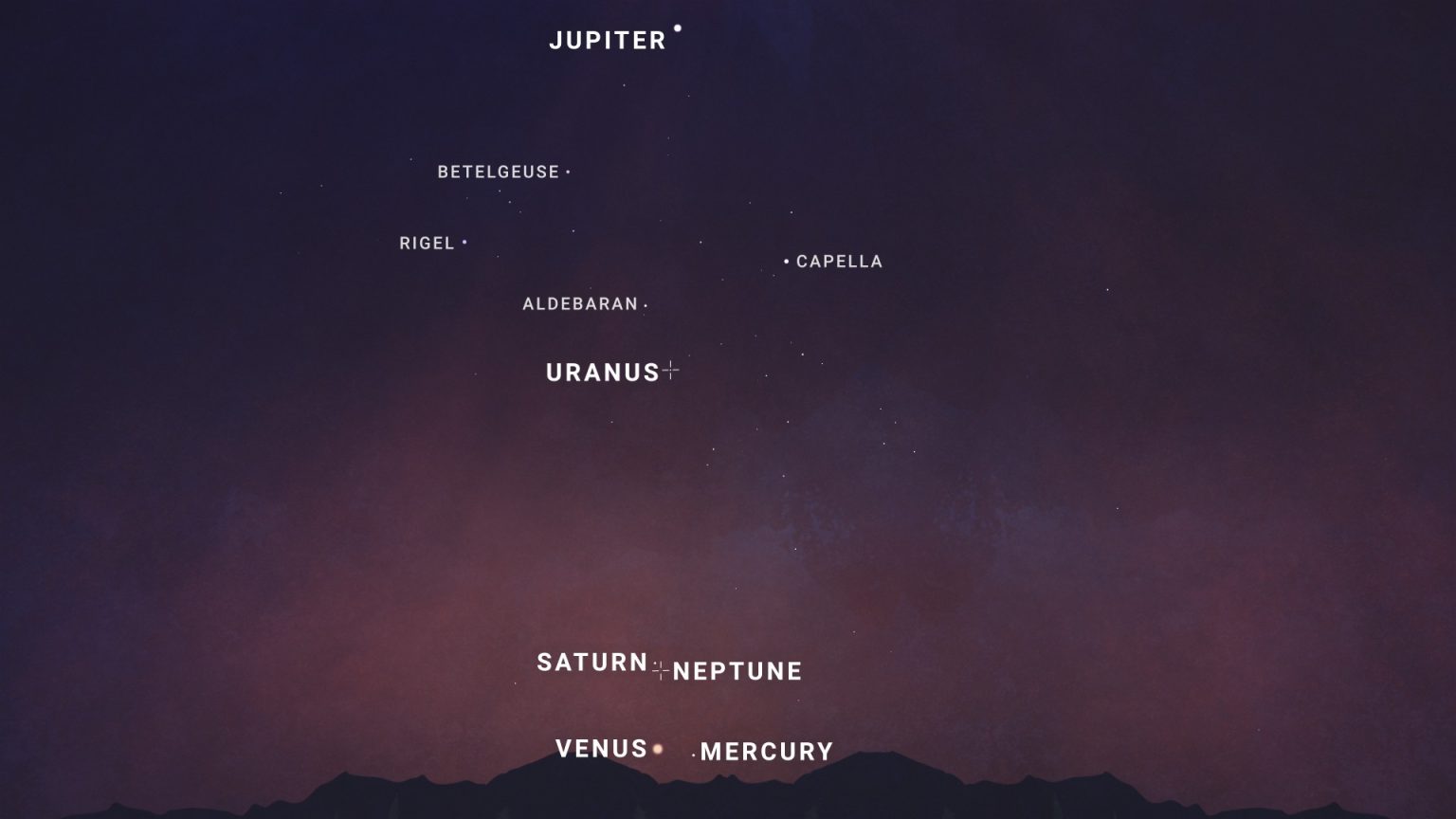 The position of the planets in the night sky on February 28. Source: NASA/JPL-Caltech
For most viewers, the main characters of the show will be four planets that shine so brightly that they will be visible without any optics: Mercury, Venus, Jupiter, and Saturn. They form a peculiar semicircle above the western horizon.
But to see the full lineup of “participants” — the icy giants Uranus and Neptune — you’ll need binoculars or a telescope. Unlike their bright neighbors, they are too dim to be seen with the naked eye. On February 28, there will also be an almost full moon in its growing phase in the sky. Its bright light will create additional illumination, making it even more difficult to see dim Uranus and Neptune. However, this will not prevent you from enjoying the view of Venus or Jupiter.
When and where to watch?
It is worth preparing for observations in advance. Astronomers advise going outside approximately 30–60 minutes after sunset. During this time, twilight ends, and the planets have not yet disappeared behind the horizon.
Look for the cosmic procession in the western or southwestern part of the sky, low above the horizon. The alignment will not last long: as soon as the Sun finally sets, the planets will begin to disappear from view one by one, sinking behind the sun.
After February 28, Venus, Saturn, and Jupiter will continue to delight the eye for a long time, changing their positions. However, Mercury, being closest to the Sun, will quickly disappear into the evening twilight.
Why are the planets lined up in a row?
Don’t think that the planets suddenly decided to line up perfectly in space. This phenomenon is purely an optical illusion caused by our location on Earth. All planets orbit the Sun in roughly the same plane (the ecliptic), but at different speeds. Sometimes their orbits align in such a way that from our planet it appears as if they have gathered in a tight cluster in the sky.
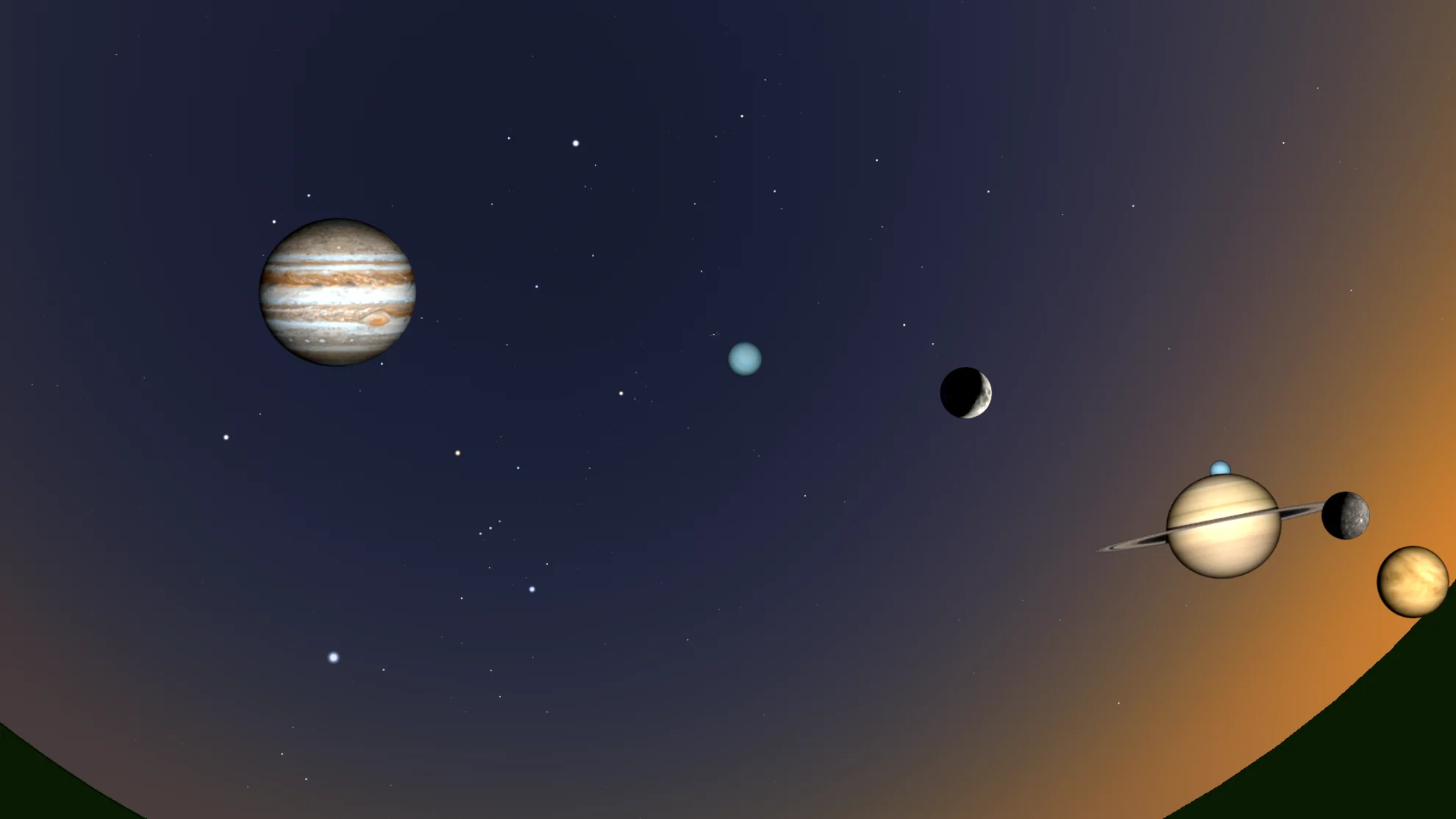 Parade of planets on February 28, 2026. Source: theweathernetwork.com
Seeing two or three bright planets in the night sky is a common occurrence. Four or five is already a rarity, but six at the same time is a real gift for astronomy enthusiasts.
How can we distinguish a planet from a star?
There is one trick that will help you avoid getting confused. Due to atmospheric turbulence, stars usually twinkle as if they were shimmering with colors. But the planets shine with an even, steady light. If you notice a bright “dot” that does not blink, know that you are looking at one of the participants in the parade.
Will there be something similar in 2026?
The February parade is not the only opportunity to admire the planets this year. New encounters await us in spring and summer:
In March, Venus will shine in the evening sky as an incredibly bright “star,” outshining even Jupiter.
Mars will appear in the morning sky at the end of March.
And on June 9, Venus and Jupiter will come together in a close embrace in the evening sky, and Mercury will be visible just below them.
So if the weather disappoints you on February 28, don’t despair — the Universe will invite you on another date.
Earlier, we showed the best photos from the last planetary parade.
According to NASA