
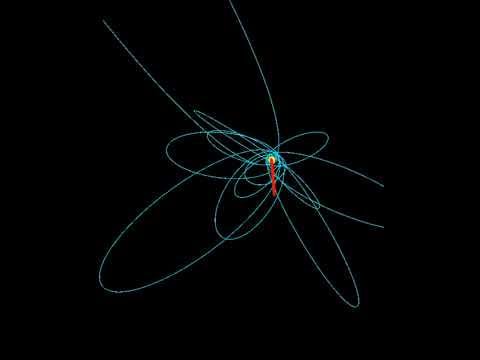
N-body simulation with a perihelion of 1 AU and a mass of 7 Earth masses showed orbital stability for over 1 million years with sharp short peaks and troughs in Milankovitch cycles. This explains climate anomalies such as the Younger Dryas, the Piora oscillation, the Roman optimum, and the Heinrich events, indicating a period of approximately 3,600 years, consistent with the mythological aspect. A probable perihelion passage in 60 BC (the Roman optimum) is confirmed by Roman and Chinese sources as observations of a comet lasting six months.
At the beginning of the Piora oscillation around 3,600 BC, Or there are also descriptions of apocalyptic comets in Sumer and Egypt (Marduk, Seth/Typhon). Orbital characteristics, which are constrained by the TNO clustering mechanism, descriptions of the celestial path from ancient sources, and climatic anomalies, point to an aphelion direction in the search area for planet 9 near the constellation Gemini. Presumably, the capture occurred in the asteroid belt, then the perihelion migrated through Mars' orbit, distorting its eccentricity and approaching Earth's orbit, causing the mid-Pleistocene transition and more severe ice ages.
Is this: 1) pseudoscientific? 2) speculative? 3) contrary to generally accepted opinion.
by pavlokandyba
2 Comments
It would help if you cited sources and explained a bit more your intentions
Fool paper [https://doi.org/10.5281/zenodo.18791756](https://doi.org/10.5281/zenodo.18791756)