
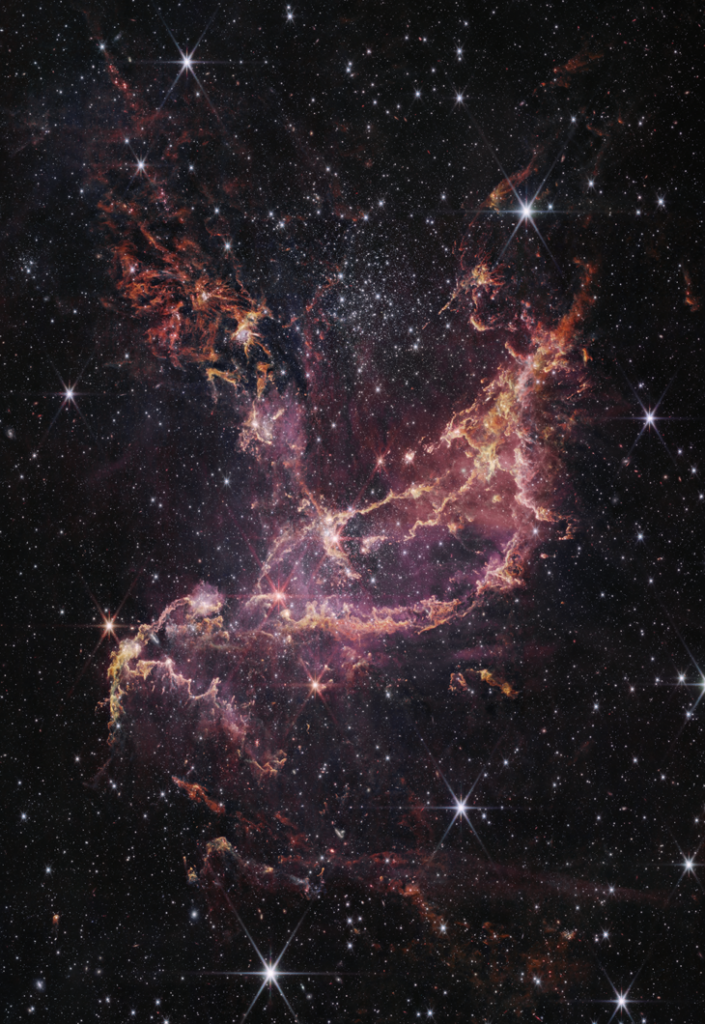
The origins of the universe are veiled in dust. Space is filled with tiny particles ranging in size from a few molecules to micrometers. That’s 1 millionth of a meter or 1 hundred thousandth of an inch max! From the early universe to today, huge clouds of gas and dust have accumulated and collapsed, creating stars and galaxies. Studying these particles provides scientists with insight into what happened in the early universe. However, dust also obscures many interstellar objects from telescopes, limiting what scientists can learn about deep space.
Astronomers are particularly interested in a class of deep-space objects known as dusty star-forming galaxies or DSFGs, which produce new stars at exceptionally high rates. These ancient and distant galaxies create over 100 stars per year, almost 10 times as many as the Milky Way produces, but dust completely obscures them from visible light. Astronomers use a technique to interpret high-resolution data, called resolving, to find the properties of these DSFGs. It’s like looking at detailed pictures in HD or 4K on a screen, but the image is of space! Yet, no equipment was able to resolve DSFGs until JWST.
An international team of astronomers recently resolved 22 DSFGs using JWST’s near-Infrared Camera, known as NIRCam. NIRCAM can observe galaxies at wavelengths of 0.6 to 5 micrometers, which is around 5 millionths of a meter or 2 thousandths of an inch. Astronomers can use these high-resolution observations to bypass the dust enshrouding DSFGs.
The team used 7 different filters on NIRCam to block certain wavelengths or colors of light for each galaxy. Each filter traces different physical properties of the galaxy, such as the galaxy’s size, shape, clumpiness, mass, and star-forming rate. No single filter can resolve all of these properties at once. Astronomers also adjust the filters based on the distance between the galaxy and the Earth. The universe is expanding, which means old, distant galaxies like DSFGs are moving away from our own. This expansion stretches the light waves we receive from them, a phenomenon called redshift.
The team used their high-resolution data to classify the DSFGs into 3 types, based on their visual properties. Type I galaxies form stars throughout their entirety. Type II galaxies only create stars within their center, or core. Lastly, Type III galaxies only create stars outside their core, in an area called the disk. Astronomers studying the history of the universe look for regions where no stars form, a trait known as quenching, to recognize Type II and Type III galaxies. The researchers found that the DSFGs they studied consisted of 10 Type I galaxies, 5 Type II galaxies, and 7 Type III galaxies.
The team then examined the internal properties of each galaxy to create general trends within each category. To estimate their masses and the rate at which they create stars, the astronomers applied a model that used patterns in the light emitted by the DSFGs. They found that the galaxy sizes ranged from 30 billion to 300 billion times the mass of the sun, meaning that the most massive DSFG was smaller than the Milky Way, and formed 25 to 500 stars per year. They also found that these galaxies were between 10 billion light-years and 18 billion light-years from Earth. That’s bigger than a trillion, trillion meters or inches!
The researchers also described trends in the shapes of these galaxies. One was that the farther and older a galaxy was, the more fragmented its shape. The astronomers interpreted this fragmented shape to mean that high-redshift DSFGs are in the process of forming a tightly packed group of stars in the center, known as a bulge. The team suggested that the galaxies forming bulges will eventually quench in their cores, becoming Type III galaxies. In addition, the scientists discovered a previously hidden feature of most of the galaxies, which is that they are lopsided. This lopsidedness signals to astronomers that, at some point in time, these galaxies might have merged with other galaxies.
The team concluded that high-resolution data from JWST can be used to discern hidden characteristics of DSFGs, which can help astronomers determine what occurred to them in the past and predict what will happen to them in the future. They suggested future researchers use JWST data to test theories on why these galaxies are lopsided and how they evolved over time.
Post Views: 72