
Are you excited for the planet alignment visible in late February 2026? Have you seen any of the planets already?
How about listening to the planets instead? It’s possible, following NASA’s release of ‘sonifications’ of three of the planets: Jupiter, Saturn and Uranus.
A total of six planets are visible in the sky at the same time late February 2026, leading to a somewhat uncommon six-planet alignment, or planet parade.
For advice on seeing it, read our guide to the planet alignment, February 2026, and check out a pro astronomer’s top tips for the planet alignment 2026.
But if you want to listen to the planet alignment, read on!
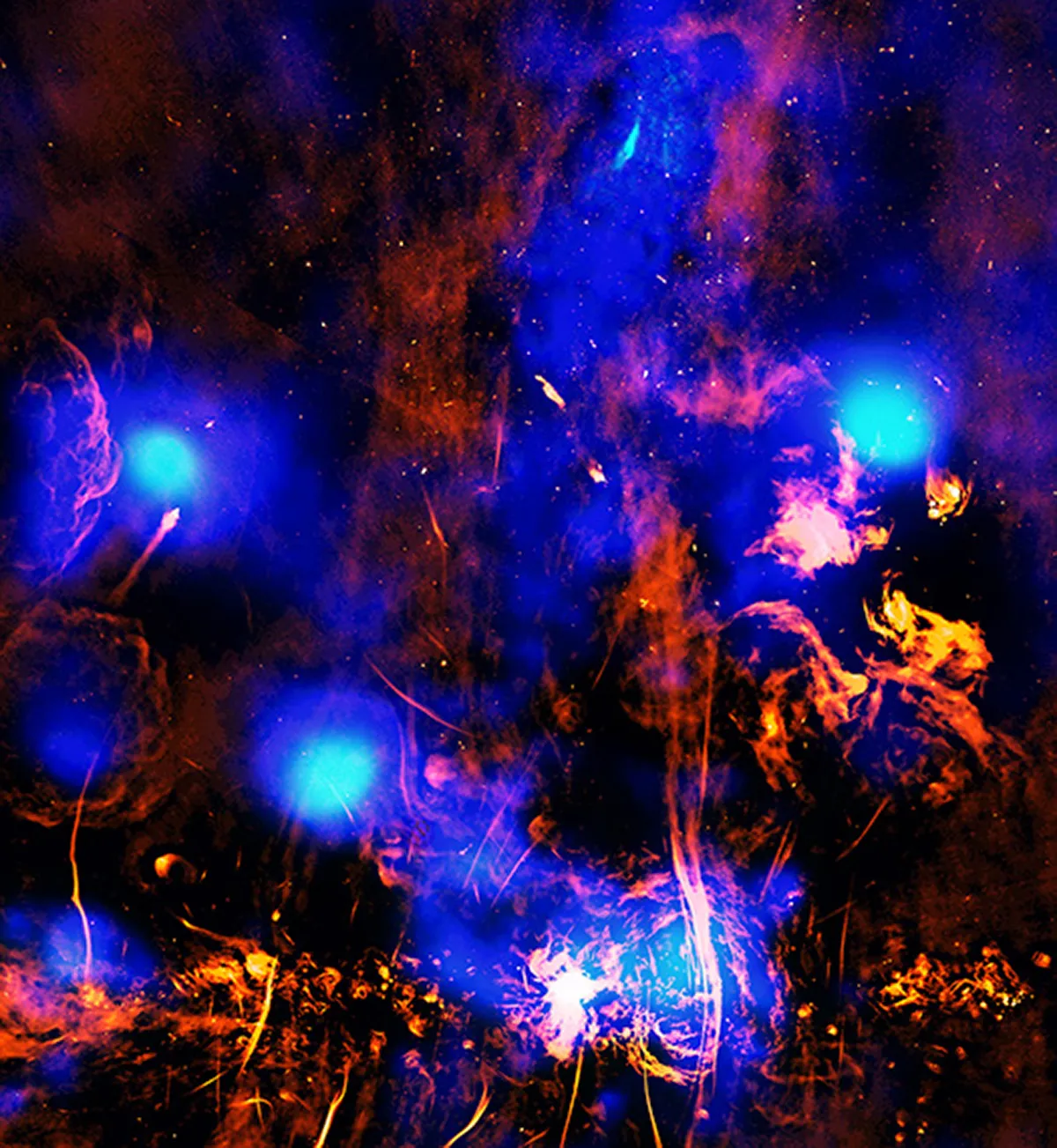 Credit: X-ray: NASA/CXC/Univ. of Chicago/S.C. Mackey et al.; Radio: NRF/SARAO/MeerKAT; Image Processing: NASA/CXC/SAO/N. Wolk
Sonifications of Jupiter, Saturn and Uranus
NASA has released sonifications of Jupiter, Saturn and Uranus, produced using data from the Chandra X-ray Observatory.
Chandra is a NASA space telescope that observes the Universe in X-ray, revealing the secrets of deep-space objects like black holes and galaxy clusters in a wavelength of light beyond what the human eye can directly see.
The Chandra team often produce sonifications, whereby they use data captured by Chandra and turn it into sound.
In addition to X-rays from Chandra, these sonifications of the Solar System planets use data from the Hubble Space Telescope, the Cassini spacecraft and the Keck telescope.
In these sonifications, the three planets can be seen and heard in ways that they can’t from Earth.
The Sun gives off X-rays that travel out across the Solar System and bounce off planets, moons and other bodies.
This gives astronomers unique views of our Solar System, gaining information that wouldn’t be possible using optical light.
Jupiter
Credit: X-ray: NASA/CXC/SAO; Infrared: NASA/ESA/CSA/STScI; Image Processing: NASA/CXC/SAO/J. Major, S. Wolk; Sonification: NASA/CXC/SAO/K.Arcand, SYSTEM Sounds (M. Russo, A. Santaguida)
The video here uses an infrared image of Jupiter captured by the Hubble Space Telescope, with a sonification of X-ray data from Chandra over the top.
Diffuse X-rays from a ring of energetic particles that can be seen in purple to the left and right of Jupiter.
As the scan moves left to right, it interprets the X-ray data as woodwind sounds. The sounds become fuller as we pass over the planet itself, with infrared data represented by other instruments.
The musical pitch descends as the scan passes over the bright band near Jupiter’s equator and its Great Red Spot, which is an enormous storm much bigger than Earth.
Saturn
Credit: X-ray: NASA/MSFC/CXC/A.Bhardwaj et al.; Optical: NASA/JPL-Caltech/SSI; Sonification: NASA/CXC/SAO/K.Arcand, SYSTEM Sounds (M. Russo, A. Santaguida)
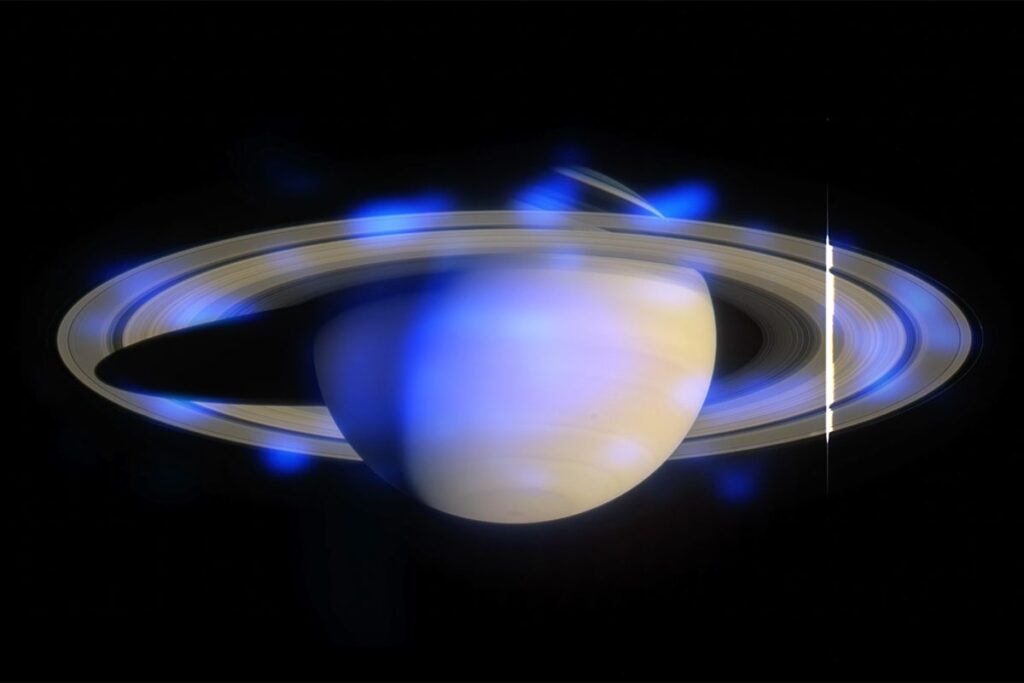
The image of Saturn in this video is an optical image captured by NASA’s Cassini spacecraft.
X-ray data is heard as a siren effect, with the frequency following the arc of Saturn’s rings.
When it reaches the planet, the sound changes to much deeper tones, showing the different between X-rays received from the rings and from Saturn itself.
Chandra X-rays are heard as higher tones, indicating where high-energy activity is found across Saturn, its rings and its poles.
Uranus
Credit: X-ray: NASA/CXO/University College London/W. Dunn et al; Optical: W.M. Keck Observatory; Sonification: NASA/CXC/SAO/K.Arcand, SYSTEM Sounds (M. Russo, A. Santaguida)
The Uranus image seen here is an optical light image from the ground-based Keck Observatory in Hawaii.
X-ray data is represented with a cello sound, tracing Uranus’s ring system and revealing the differences in the amount of light reflected off the rings.
The X-rays originate from the Sun then bounce off Uranus, producing the higher frequencies heard as the scan passes over the planet.