
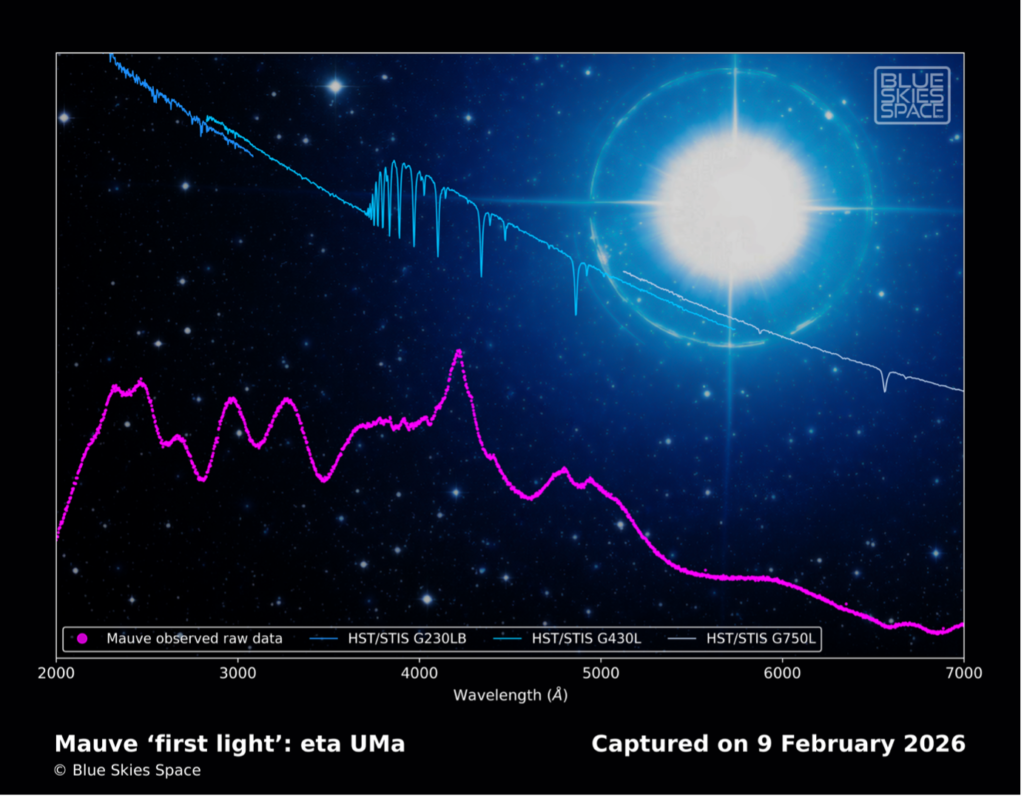
Blue Skies Space has successfully achieved ‘first light’ with Mauve, beginning a new era in astronomical data delivery from small, rapidly built space telescopes. It marks the first time that a commercial space science satellite has successfully launched and sent back data to astronomers about our universe.
Mauve will study stars in the ultraviolet and visible light, enabling a greater understanding of their magnetic activity, powerful flares, and their impact on the habitability of exoplanets.
The satellite carries a 13 cm telescope and is designed to deliver spectrophotometric observations across the 200-700 nm range. Following launch on 28 November 2025, contact with the satellite was established, and commissioning activities were initiated. All spacecraft subsystems and the payload instruments have been powered on and are operational.
As part of early commissioning, Mauve was pointed at its first calibration target, eta Ursae Majoris (eta UMa), a bright star in the constellation Ursa Major, approximately 104 light-years from Earth, for a 5-second observation. Eta UMa is a hot, blue-white star, much hotter than our Sun. Eta UMa shines brightly in ultraviolet light, making it an ideal calibration target for a UV observatory like Mauve.
“Achieving first light with Mauve is a fantastic milestone. It’s great to see Mauve perform brilliantly in orbit. Full instrument performance will be established over the coming weeks as we continue calibration and observe progressively fainter targets,” said Ian Stotesbury, Lead Systems Engineer at Blue Skies Space.
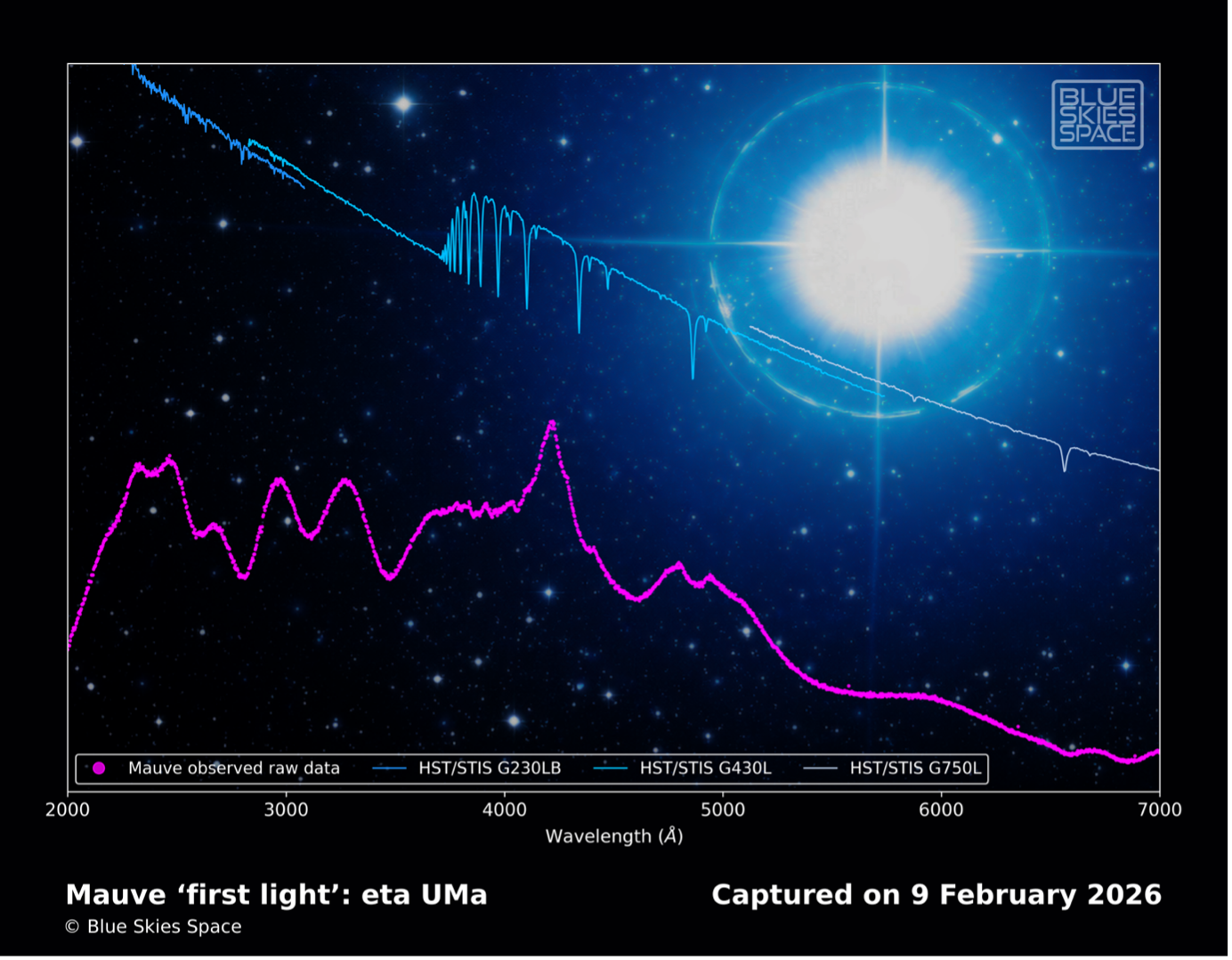 Mauve ‘first light’. Pink: Spectrum of eta UMa acquired in a single capture by Mauve on 9 February 2026 with a 5s integration time. Blue: Hubble Space Telescope STIS spectra of the same star recorded by three grisms. (C) Blue Skies Space.
Dr Arianna Saba, Science Performance Analyst at Blue Skies Space, commented: “We selected eta UMa, a well-observed B-type star, to capture ‘first light’. Eta UMa exhibits a strong ultraviolet continuum and a pronounced Balmer jump, caused by the absorption of hydrogen atoms in the outer layers of the star’s atmosphere. This is a perfect star to start calibrating Mauve’s instrument.”
The science programme for the first year of operations is described here. Scientists interested in acquiring access to Mauve’s data are invited to contact Blue Skies Space.
—ENDS—
Image of eta UMa generated using ESA Sky:
 Image of eta UMa generated using ESA Sky. Credit: ESA/DSS2 (Digitised Sky Survey).
About Mauve
Mauve, Blue Skies Space’s first satellite, was launched on 28 November 2025 aboard SpaceX’s Transporter-15 on a three-year mission to measure the activity of nearby stars, helping scientists understand the impact of powerful stellar flares on exoplanets and the prospects of harbouring life.
Mauve is a small satellite operating in a low-Earth orbit, equipped with a 13 cm telescope to observe stars in the ultraviolet and visible wavelengths (200-700 nm).
Mauve was built by a consortium of European companies and launched within 3 years of conception, a fast timeline for science satellites. C3S LLC (Hungary) is the spacecraft’s prime and platform provider, with ISISPACE (Netherlands) providing the pointing solution. The telescope, supplied by MediaLario (Italy), is connected via optical fibres from CeramOptec (Latvia) to spectrometers provided by Avantes (Netherlands).
Wavelength Coverage200 – 700 nm (UV – Visible)Telescope13 cm CassegrainSpectral Resolution10.5 nm (R= 20-65)DetectorCMOS Linear ArrayMass18.6 kgOrbitLEO 10:30 LTDN, 510 km
Mauve’s data is made available to participating researchers through a three-year science programme, with those who sign up early being able to lead and shape the observational programme each year. Mauve’s current research priorities are:
Stellar flares: Some of the coolest stars are subject to large explosions (flares) that produce high-energy emissions, occasionally outshining the star itself. Studying these events helps scientists understand how magnetic fields accumulate and release large amounts of energy, and understand similar events produced by our Sun.
Young exoplanet hosts: Young stars with planets still taking shape around them reveal the early stages of planetary evolution. By studying these systems, scientists trace how planets grow, migrate, and settle into their mature orbits — offering clues to the history of our own Solar System.
Hot stars: Hot stars emit abundant ultraviolet radiation, and Mauve will study both the youngest ones, surrounded by clouds of gas and dust, and some of the older ones, rapidly rotating and shedding material into surrounding disks of gas, affecting their evolution.
Binary stars: Systems where two stars orbit one another are vital for testing theories of gravity, stellar mass, and evolution. Because their mutual orbits can be measured precisely, binaries offer the most accurate way to determine stellar masses, anchoring models of how all stars live and die.
Research institutions worldwide have already secured subscriptions to access data collected by Mauve. These include Boston University, Columbia University, INAF’s Osservatorio Astrofisico di Arcetri, Konkoly Observatory, Kyoto University, National Astronomical Observatory of Japan, Maynooth University, Rice University, Vanderbilt University, and Western University.
Learn more about the programme for the first year of operations: https://arxiv.org/abs/2512.16675
Request access to the Mauve Payload Simulator that models the instrument’s performance for specific targets: https://bssl.space/mauve/payload-simulator-access-form/
Learn more about Mauve: https://bssl.space/mauve/
Media available at: https://bssl.space/mauve/media-kit/
The project has received funding from the European Union’s Horizon Europe research and innovation programme under grant agreement No. 101082738 and was supported by the UK Research and Innovation (UKRI)’s Horizon Europe Guarantee Scheme.
About Blue Skies Space
Blue Skies Space is a company pioneering a new model to deliver high-quality space science data in accelerated timescales to the global scientific community, helping them to answer humanity’s greatest scientific questions. Through a fleet of low-Earth orbit satellites, the company aims to serve the global demand for high-quality science data across many research areas, including the monitoring of stars, understanding what the atmospheres of faraway exoplanets are made of, as well as the composition of asteroids in our Solar System.
With offices in the UK and Italy, Blue Skies Space has assembled an experienced team that has previously worked at organisations such as NASA, Airbus, Surrey Satellite Technology, Caltech and UCL, bringing a wealth of expertise in space science, satellite engineering, satellite construction and operations.
Learn more about Blue Skies Space: https://bssl.space/
Find out more about Mauve in the latest issue of the Europlanet Magazine.