
Enabling & Support
25/02/2026
30 views
1 likes
In brief
New European rocket engine Greta has completed a hot-fire test campaign, demonstrating stable operations, shutdowns and multiple restarts on a mobile test stand developed by ArianeGroup for the European Space Agency at ArianeGroup’s Trauen site in Germany.
Greta runs on more sustainable propellants than traditional rocket engines in the same thrust class.
The engine could be used on lunar landers or on large kick stages such as Ariane 6 add-on Astris.
In-depth
The Greta project, part of the European Space Agency’s Future Launchers Preparatory Programme (FLPP) is developing a 5 kN thrust class rocket engine that can be restarted reliably several times.
Greta uses hydrogen peroxide and ethanol as propellants, a more sustainable alternative with a lower carbon footprint compared to monomethyl hydrazine propellant used by most traditional rocket engines in this thrust range.
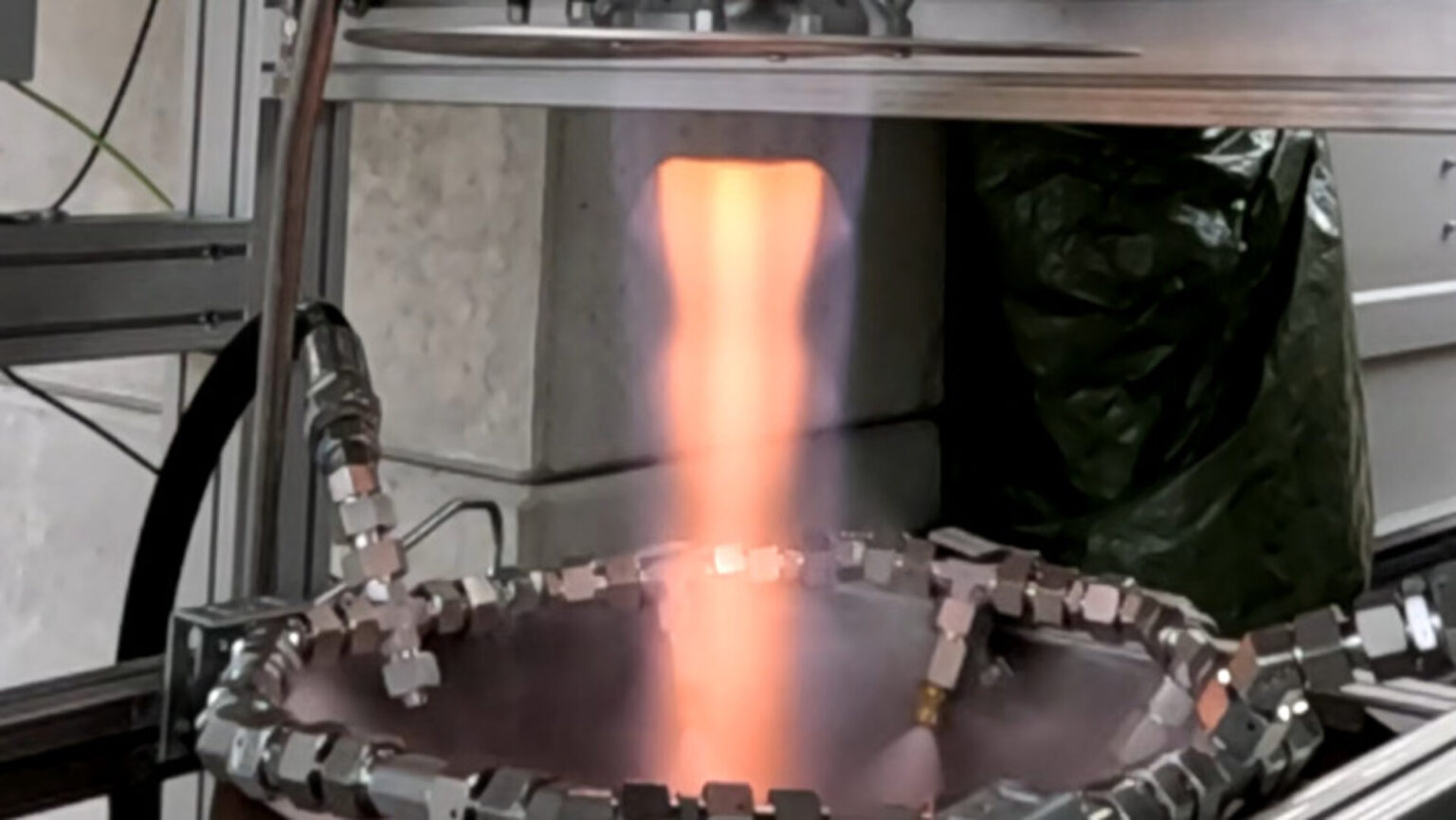
Greta was ignited multiple times from July to November 2025 and showed stable operations, including controlled shutdowns. During the test campaign the engine fired continuously for over 40 seconds at a time.
Greta rocket engine first test-firing campaign
Greta was tested on a new, low-cost and versatile mobile test stand with instruments measuring data such as pressure and temperature, which will be used to further optimise the engine.
Laser melting production techniques
Greta’s 30-cm high combustion chamber is built up in layers by melting metal powders with a laser. This technique allows for complex shapes to be made that would be difficult to achieve with conventional metallurgy. For example, the Greta engine is cooled by passing fluid through complex channels built into the engine as close as possible to the inner wall of the chamber which is in contact with the hot – over 2000°C – combustion gases.
Onwards and upwards
ArianeGroup in Ottobrunn, Germany is the prime contractor for Greta. These tests were part of a €3M contract to further increase knowledge on building and operating hydrogen peroxide engines of this thrust class. This type of engine could be used on lunar landers or on kick stages, such as Astris that is being developed for Europe’s Ariane 6 rocket.
Greta rocket engine in mobile test stand
On 6 February 2026 the next phase was kicked off with Arianegroup to further improve Greta, taking all the lessons learned from the test campaign and other work to make a design for a flight-engine. For this next stage of the project the following subcontractors will provide parts for the flight-like motor design – Safran Aero Boosters in Belgium, the Institute of Aviation in Poland and InPraise Systems from the Czech Republic.
This next evolution of Greta will be tested on the same mobile test bench in Trauen at the end of 2027.
Like