
Images captured in 2023 by NASA’s James Webb Space Telescope of the massive aurora lights on Jupiter reveal unexpected activity in the gas giant’s atmosphere. (Video: NASA, ESA, CSA, STScI)
A Northwestern University-led team of astronomers used NASA’s James Webb Space Telescope to discover a former star that exploded millions of years ago.
The star, which was in a nearby galaxy, exploded over 40 million years ago, spewing material across space and producing a beacon of light. The light then traveled across the cosmos, reaching Earth on June 29, 2025.
Astronomers began studying this supernova thinking it was new to the atmosphere. But one team of scientists immediately turned to the archival images taken by the Hubble Space Telescope to see if the supernova was from a former star.
The astronomers compared the archival images and the images captured by NASA’s Webb Telescope and uncovered the ancestral star.
“We’ve been waiting for this to happen, for a supernova to explode in a galaxy that Webb had already observed,” lead author Charlie Kilpatrick of Northwestern University said.
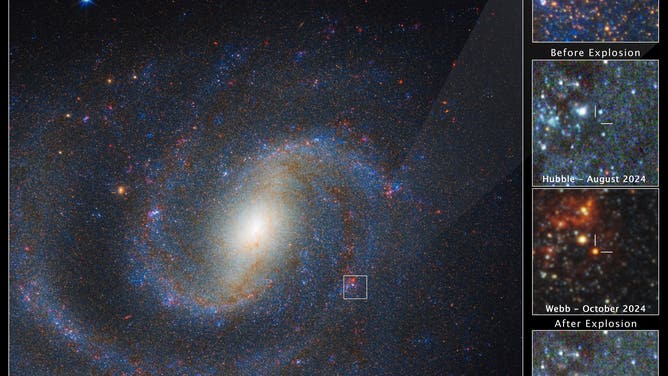
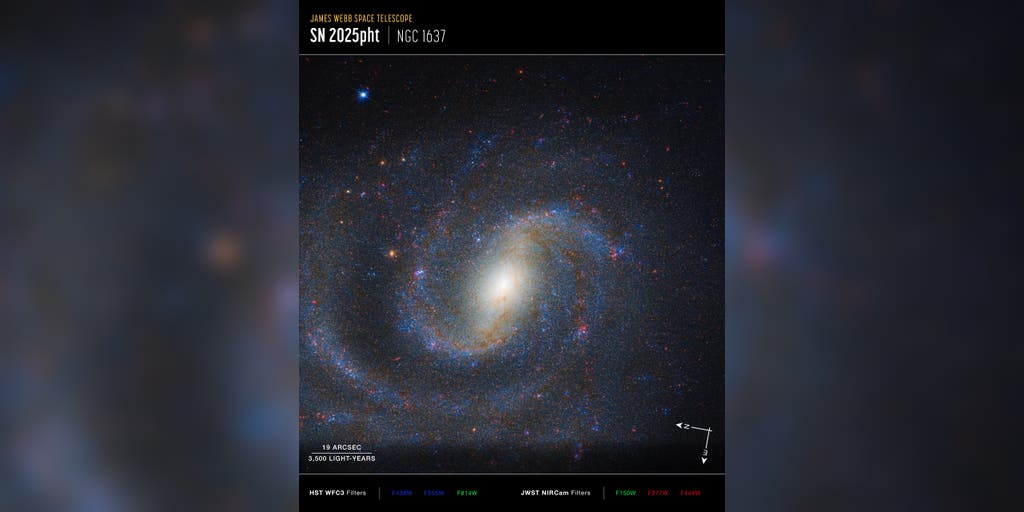
The main image at left shows a combined Webb and Hubble view of spiral galaxy NGC 1637. Panels at right show a detailed view of a red supergiant star before and after it exploded.
(NASA, ESA, CSA, STScI, Charles Kilpatrick (Northwestern), Aswin Suresh (Northwestern) / FOX Weather)
The images taken by the Webb Space Telescope showed “a red supergiant star which is where the supernova now shines.”
The red may indicate that the star is surrounded by dust.
BLOOD MOON TOTAL LUNAR ECLIPSE 2026: WHEN AND WHERE YOU CAN SEE THE ASTRONOMICAL PHENOMENON
“It’s the reddest, most dusty red supergiant that we’ve seen explode as a supernova,” graduate student and co-author Aswin Suresh of Northwestern University said.
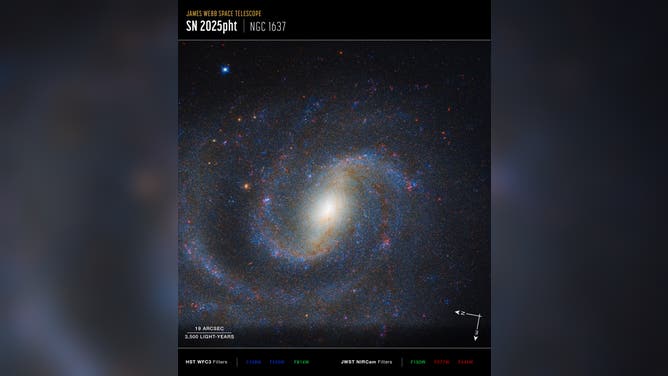
This image is a combined view Webb and Hubble view of the galaxy.
(NASA, ESA, CSA, STScI, Charles Kilpatrick (Northwestern), Aswin Suresh (Northwestern) / FOX Weather)
According to NASA, the discovery of this former star could help explain missing red supergiants.
For years, astronomers assumed that stars would be bright and luminous when they exploded as supernovas.
JAMES WEBB SPACE TELESCOPE REVEALS ‘UNUSUAL’ CHEMICAL MAKEUP OF INTERSTELLAR COMET 3I/ATLAS
However, the discovery of this former star is proving that aging stars are mostly likely surrounded by dust that dims their light.
“I’ve been arguing in favor of that interpretation, but even I didn’t expect to see it as extreme as it was for supernova 2025pht. It would explain why these more massive supergiants are missing, because they tend to be more dusty,” Kilpatrick said.