
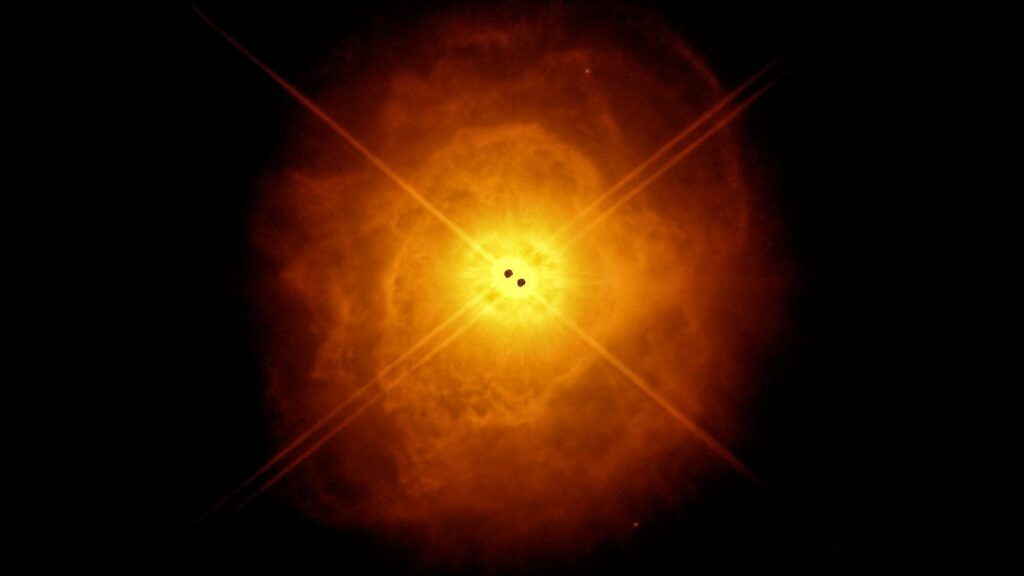
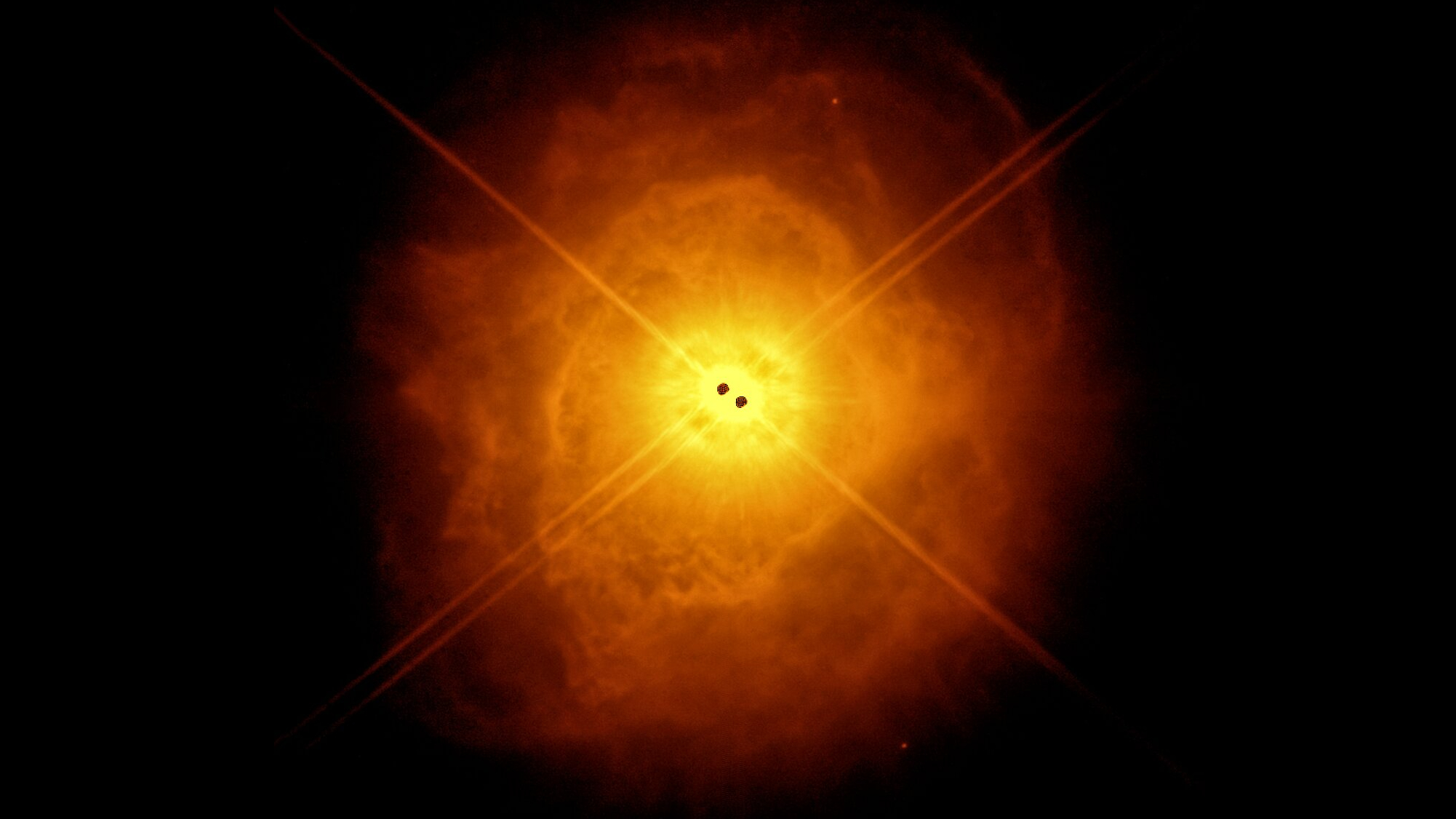
Two ageing stars in the binary system AFGL 4106 sculpt a glowing, egg-shaped nebula as they approach the end of their lives. (Image credit: ESO/G. Tomassini et al.)
Astronomers have captured a spectacular scene of two ageing stars sculpting a cloud of gas and dust, forming an uneven glowing nebula, as they near the end of their lives.
What is it?
At the center of the image are two dark dots, a pair of massive stars orbiting each other in a binary system. Like many stars in our galaxy, they were born as a duo. Now they are nearing the end of their lives and shedding vast amounts of gas and dust into space.
You may like
A binary star system consists of two gravitationally bound stars orbiting a shared center of mass called a barycenter. In fact, most stars are not solitary like our sun, as scientists estimate up to 85% of all stars exist in binary systems or systems with three or more stars.
The stars appear black because their intense brightness saturated the detector. To reveal the faint surrounding material, astronomers used the SPHERE instrument on the VLT, which is specifically designed to handle extreme contrasts in light and to correct for the blurring effects of Earth’s atmosphere.
Why is it amazing?
Instead of expanding out in a perfect sphere, the gas and dust appear warped and shifted into an almost egg-shaped cloud. The distortion is likely caused by the gravitational influence of the companion star, providing clear evidence that stellar partnerships can dramatically reshape how stars die.
These findings were recently published in the journal Astronomy & Astrophysics
Characterising the post-red supergiant binary system AFGL 4106 and its complex nebula with SPHERE/VLT G. Tomassini, E. Lagadec, I. El Mellah, R. D. Oudmaijer, A. Chiavassa, M. N’Diaye, P. de Laverny, N. Nardetto and A. Matter A&A, 706 (2026) A5 DOI: https://doi.org/10.1051/0004-6361/202557705