
Every black hole collision in the universe sends ripples through spacetime. Most of those ripples are too faint, originating too far away, for any detector on Earth to pick up. But they’re out there — a kind of cosmic background noise, an unresolved hum built from billions of distant catastrophes. And now a team of physicists thinks that hum, or rather the fact that we haven’t heard it yet, can tell us something fundamental about the size and age of the universe.
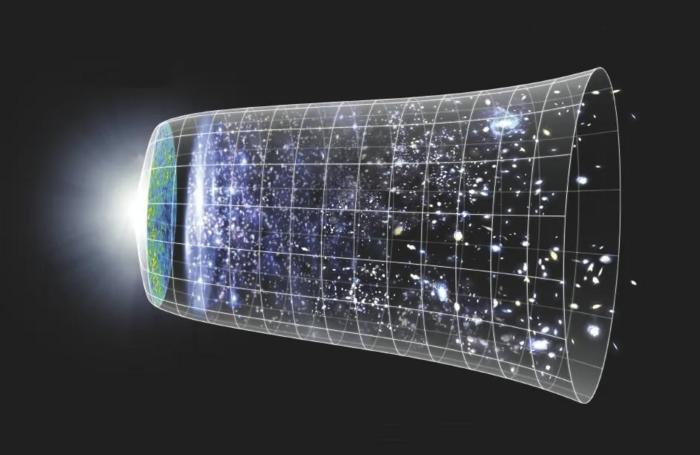
The problem they’re wrestling with goes by the dry name of the Hubble tension, which rather undersells its significance. For roughly a century, cosmologists have been measuring how fast the universe is expanding — a number called the Hubble constant. The tricky bit is that two entirely different ways of measuring it keep coming up with different answers. Calculations based on the early universe, using the cosmic microwave background, suggest a slower expansion rate than measurements made using nearby supernovae and other late-universe yardsticks. The gap between the two is small — maybe ten per cent — but it’s stubborn, and it refuses to go away. Either some of our measurements are wrong, or something genuinely strange is happening in the physics of the cosmos.
“It’s not every day that you come up with an entirely new tool for cosmology,” says Daniel Holz, a physicist at the University of Chicago who worked on the new study. “We show that by using the background gravitational-wave hum from merging black holes in distant galaxies, we can learn about the age and composition of the universe. This is an exciting and completely new direction.”
The idea builds on a method already in use. When two black holes spiral together and merge, they produce a burst of gravitational waves — spacetime ripples that travel outward at the speed of light, eventually washing past Earth. The global network of gravitational wave detectors operated by the LIGO-Virgo-KAGRA collaboration has now caught hundreds of these events. From each one, physicists can extract the distance to the merger directly. Combine that with how fast the source is receding from us due to the expansion of space, and you get an independent estimate of the Hubble constant. It’s called the standard siren method.
The problem is the recessional velocity — the speed at which that patch of space is moving away from us. It can’t be read off the gravitational waves themselves. You need to find the host galaxy in optical telescopes, which is hard, or find some other electromagnetic counterpart to the event, which is even harder. Progress has been slow.
What Bryce Cousins, a graduate student at the University of Illinois Urbana-Champaign and lead author on the new paper, and his collaborators realised is that you can extract information from the mergers you can’t see as well as the ones you can. “Because we are observing individual black hole collisions, we can determine the rates of those collisions happening across the universe,” Cousins explains. “Based on those rates, we expect there to be a lot more events that we can’t observe, which is called the gravitational-wave background.”
Think of it this way. You’re standing at a noisy party and you can make out a few distinct conversations nearby. But underneath those you can just about sense the general murmur of everyone else talking at once. The gravitational-wave background is that murmur — thousands upon thousands of distant mergers whose individual signals blend into collective noise.
Here’s where the Hubble constant comes in. The strength of that murmur depends on how much space there is for collisions to happen in. A lower value of the Hubble constant means a smaller observable universe — less total volume, higher density of mergers, stronger background signal. A higher Hubble constant means more volume, lower density, weaker signal. So if you measure the strength of the background, or even if you just put an upper limit on it by not detecting it at all, you’ve learned something about which values of the Hubble constant are and aren’t plausible.
The team named their approach the stochastic siren method, after the randomness — technically, stochasticity — in how the background mergers are distributed. Applying it to existing LIGO-Virgo-KAGRA data, which hasn’t yet detected the background, they found that non-detection alone was enough to rule out certain slower expansion rates. Combined with measurements from individually detected mergers, it shifted the overall Hubble constant estimate into the range where the tension actually bites — making it, for the first time, a gravitational-wave measurement that directly interrogates the disputed region.
Illinois physics professor Nicolás Yunes, a co-author and the founding director of the Illinois Center for Advanced Studies of the Universe, puts the significance plainly. “This result is very significant — it’s important to obtain an independent measurement of the Hubble constant to resolve the current Hubble tension. Our method is an innovative way to enhance the accuracy of Hubble constant inferences using gravitational waves.”
What keeps this from being a solved problem is sensitivity. Current detectors aren’t yet good enough to see the background directly, only to bound it from above. But detector upgrades are coming, and the gravitational-wave background is expected to be detectable within roughly the next six years. As that detection limit improves, so does the constraint on the Hubble constant — the stochastic siren gets more precise even before the background is formally detected.
“This should pave the way for applying this method in the future as we continue to increase the sensitivity, better constrain the gravitational-wave background, and maybe even detect it,” says Cousins. “By including that information, we expect to get better cosmological results and be closer to resolving the Hubble tension.”
There are several possible resolutions to that tension, none of them comfortable. Early dark energy — a force that drove accelerated expansion in the universe’s first moments — is one candidate. Interactions between dark matter and neutrinos are another. Evolving dark energy dynamics, in which the force driving the current acceleration wasn’t constant through time, is a third. Each would require modifications to the standard cosmological model, and each carries its own implications for the ultimate fate of the universe. The stochastic siren method can’t on its own tell us which solution is correct, but it adds an entirely independent line of evidence to a question that has so far resisted every attempt to make it go away. Sometimes the quietest signals carry the loudest information.
Study link: https://journals.aps.org/prl/accepted/10.1103/4lzh-bm7y
There’s no paywall here, but there are expenses
If our reporting has informed or inspired you, please consider making a donation. Every contribution, no matter the size, empowers us to continue delivering accurate, engaging, and trustworthy science and medical news. Thank you for standing with us!