
The Hubble Space Telescope has a big data problem. Over 35 years, it hasn’t just taken a few stunning space photos – it has collected millions and millions of images.
Together, these images form one of the largest archives in astronomy. Buried inside are rare objects that can change what we know about how galaxies grow and how gravity works.

The challenge isn’t capturing the images, but finding the unusual ones hidden among them.
When humans can’t keep up
Astronomers are very good at noticing odd shapes and patterns. They’ve found warped galaxies and strange arcs of light simply by scanning images carefully.
Sometimes they stumble on something unexpected by chance. But the Hubble archive has grown too large for that method alone.
Citizen science projects have helped. Volunteers around the world have classified galaxies and flagged unusual features.
Still, even thousands of dedicated volunteers can’t fully keep pace with the flood of data from modern telescopes. The sky is being surveyed faster than people can sort.
That challenge pushed researchers to try something new.
Teaching AI to read Hubble’s data
Researchers David O’Ryan and Pablo Gómez of the European Space Agency built a neural network – a type of artificial intelligence that learns patterns in data in a way inspired by the human brain. They named their tool AnomalyMatch.
They trained it to recognize rare objects such as jellyfish galaxies and gravitational arcs. Then they set it loose on the Hubble Legacy Archive.
In just two and a half days, AnomalyMatch sifted through nearly 100 million image cutouts. It marked possible oddities and handed them back for expert review.
Hundreds of new discoveries
The results were striking. After personally checking the most promising candidates, the team confirmed more than 1,300 true anomalies.
More than 800 of those had never been documented before in scientific literature.
“Archival observations from the Hubble Space Telescope now stretch back 35 years, providing a treasure trove of data in which astrophysical anomalies might be found,” said O’Ryan, lead author of the research paper.
Rare objects revealed
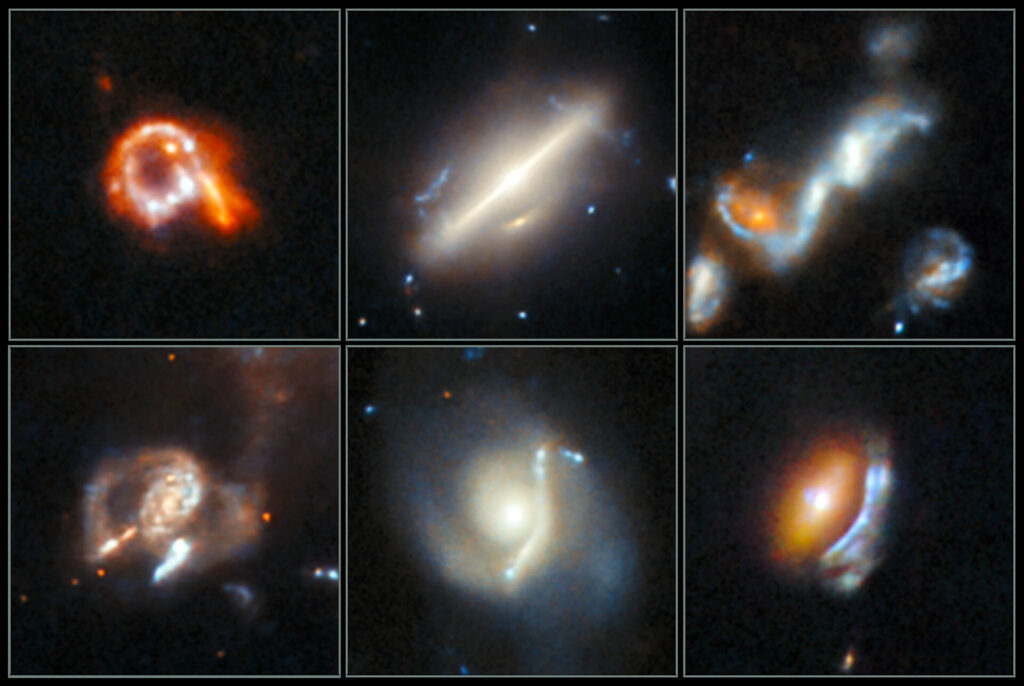
Most of the newly identified objects were galaxies caught in the act of merging or interacting. When galaxies collide, gravity stretches them into odd shapes and pulls out long tails of stars and gas.
These messy encounters help scientists understand how galaxies grow over time.
The team also uncovered many gravitational lenses. In these systems, the gravity of a foreground galaxy bends spacetime and warps the light from a distant galaxy behind it.
The result can look like a glowing ring or arc. These lenses aren’t just beautiful. They let astronomers measure dark matter and study galaxies that would otherwise be too faint to see.
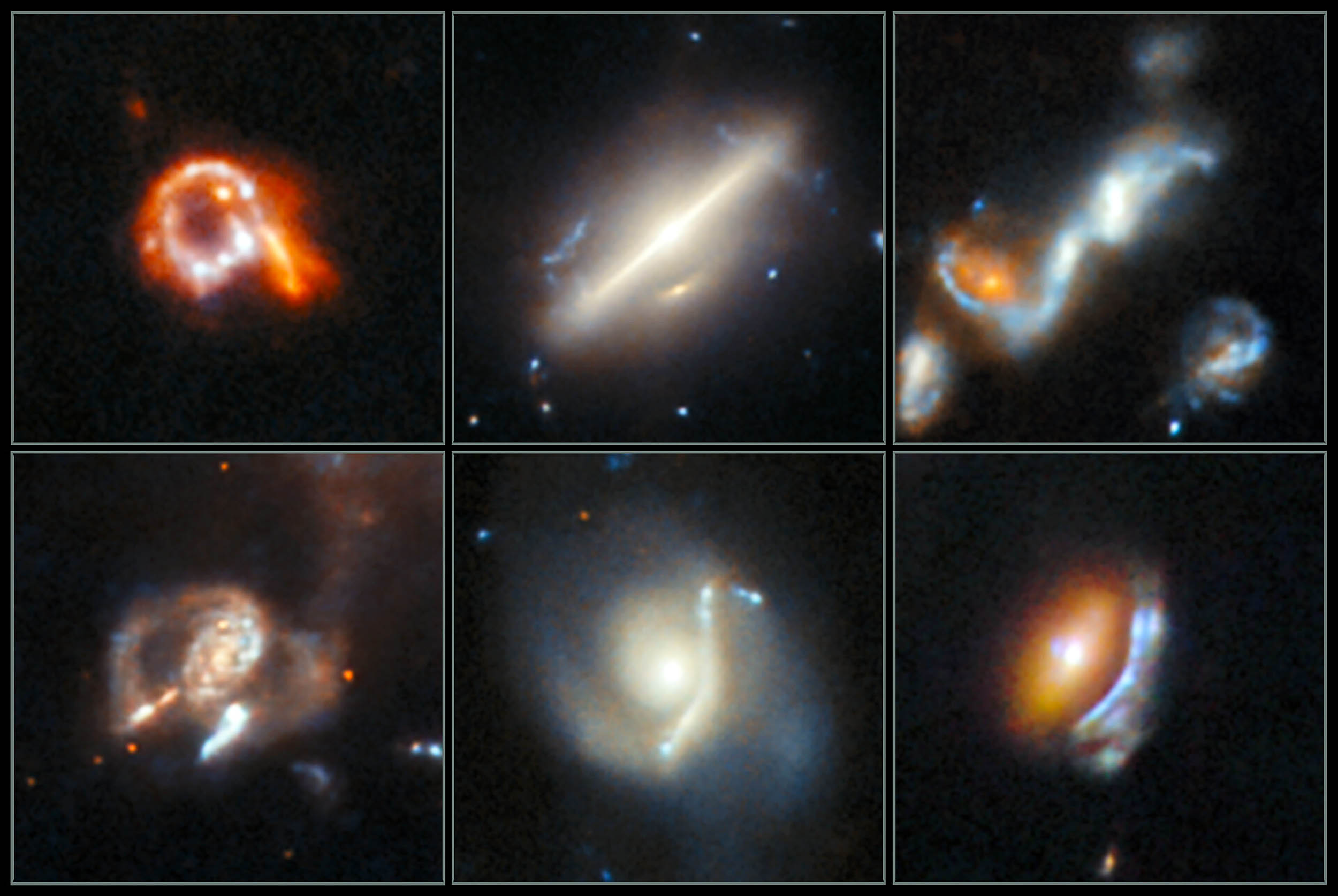 A collage of six images, showing different kinds of “anomalous” astrophysical objects. These are galaxies with unusual shapes, among them a ring-shaped galaxy, a bipolar galaxy, a group of merging galaxies, and three galaxies with warped arcs created by gravitational lensing. Credit: ESA. Click image to enlarge.New anomalies in Hubble data
Other discoveries included galaxies packed with huge clumps of stars, jellyfish galaxies trailing gaseous tentacles, and planet-forming disks seen edge-on that resemble hamburgers or butterflies.
Several dozen objects did not fit any known category at all. Those may turn out to be especially important.
“This is a fantastic use of AI to maximise the scientific output of the Hubble archive,” said Gómez, study co-author.
“Finding so many anomalous objects in Hubble data, where you might expect many to have already been found, is a great result. It also shows how useful this tool will be for other large datasets.”
The coming wave of data
Hubble is only the beginning. In 2023, the European Space Agency’s Euclid mission began surveying billions of galaxies across a third of the night sky.
The NSF–DOE Vera C. Rubin Observatory will soon start a 10-year Legacy Survey of Space and Time, collecting more than 50 petabytes of images.
NASA’s Nancy Grace Roman Space Telescope, scheduled to launch no later than May 2027, will add even more.
Each of these projects will generate data at a scale that would overwhelm any team of humans. Without smart tools, rare discoveries could slip through the cracks.
Human judgment still essential
AI systems like AnomalyMatch don’t replace astronomers. They act more like tireless assistants.
They scan everything quickly, flag what looks unusual, and leave the final judgment to experts.
That mix of speed and human insight may be the only way to handle what’s coming next.
The information was obtained from a press release issued by the European Space Agency.
—–
Like what you read? Subscribe to our newsletter for engaging articles, exclusive content, and the latest updates.
Check us out on EarthSnap, a free app brought to you by Eric Ralls and Earth.com.
—–