
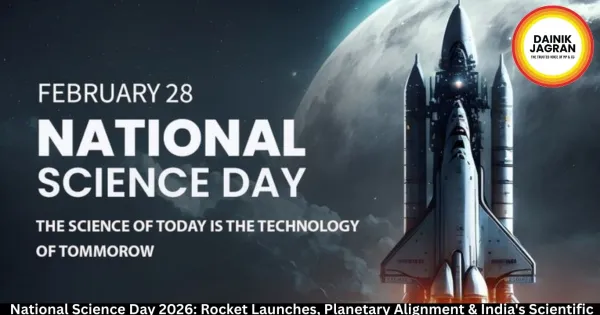
Why February 28 Matters: The Raman Effect Legacy
Every year on February 28, India commemorates the discovery that put the nation on the global scientific map—the Raman Effect. On this day in 1928, Sir Chandrasekhara Venkata Raman announced his groundbreaking finding that light changes wavelength when scattered by molecules, a phenomenon that earned him the Nobel Prize in Physics in 1930 .
The Government of India officially designated February 28 as National Science Day in 1986, with the first celebration taking place in 1987 . Today, it stands as a powerful reminder that scientific curiosity can emerge from anywhere—Raman himself hailed from a small village and went on to become the first Asian to receive a Nobel Prize in science .
National Science Day 2026 Theme: Science for All
This year’s National Science Day 2026 celebrations carry special significance with the theme “Science and Technology for specially abled persons,” selected by the Department of Science and Technology, Government of India .
The theme reflects a growing recognition that scientific progress must be inclusive. Research institutions across the country are organizing programs specifically designed to make science accessible to differently-abled individuals, ensuring that the benefits of technology reach every section of society .
Breaking News: Warangal to Launch Model Rocket ‘Rudrama’
In what promises to be the highlight of this year’s celebrations, the historic city of Warangal is set to host its first-ever model rocket launch on February 28 .
The rocket, named ‘Rudrama V.1’ in honor of Kakatiya queen Rani Rudrama Devi, will be launched at Hayagriva Chary Grounds in Hanamkonda. Organized by space start-up ATDRL and ISRO space tutor Shashank Bhoopathi, the event aims to ignite scientific temper among students and the public .
Key highlights of the Warangal celebrations:
– Star-gazing sessions at Bhadrakali Lake Tank Bund from February 15-27 (6 PM to 11 PM daily)
– Planetary alignment visible on February 28, with experts on hand to explain the phenomenon
– Awareness session on space science from 2 PM to 5 PM, followed by the rocket launch
– Panel discussion featuring ISRO experts and academicians at Kaloji Kalakshetram
The model rocket is expected to reach an altitude of approximately one kilometer—a demonstration mission designed to inspire the next generation of space scientists .
Nationwide Celebrations: From Ooty to Bangalore
Radio Astronomy Centre, Ooty
The Radio Astronomy Centre at the Ooty Radio Telescope—the world’s most powerful radio telescope operating at low radio frequencies—will throw open its doors to the public on February 28. A grand Science Exhibition will feature student projects, interactive exhibits, and live demonstrations by research institutions .
Bangalore’s Inclusive Approach
The Centre for Nano and Soft Matter Sciences (CeNS) in Bangalore has organized a week-long outreach program leading up to National Science Day. Researchers visited special schools including the Association for Persons with Disabilities and ASHA Charitable Trust, designing science demonstration tours specifically for differently-abled students .
The main event on February 28 will feature a lecture on “Science of Colour,” a science-based skit by researchers, and the inauguration of the LitE Gallery—a permanent exhibition hall with hands-on experiments for students .
CV Raman: The Scientist Who Saw Light Differently
Understanding National Science Day 2026 requires appreciating the man behind the discovery. Born on November 7, 1888, in Tiruchirappalli, Raman completed his Master’s in Physics from Presidency College, Madras, by age 19 .
His journey from a small-town student to a Nobel laureate exemplifies the power of scientific temper. Working at the Indian Association for the Cultivation of Science in Kolkata, Raman used simple, inexpensive equipment to make his world-changing discovery—proving that groundbreaking science doesn’t always require massive funding .
Today, the Raman Effect forms the basis of Raman Spectroscopy, a technique used in:
– Chemical analysis and material science
– Medical diagnostics
– Forensic science (detecting drugs in sealed evidence bags)
– Safe nuclear waste analysis
Why National Science Day 2026 Matters Now
In an era of information overload and rising misinformation, National Science Day 2026 carries renewed urgency. The day promotes:
1. Scientific temper—encouraging questioning, observation, and logical thinking over superstition
2. Innovation awareness—showcasing India’s progress in space research, quantum computing, and AI
3. Career inspiration—motivating students to pursue science, technology, and research
India’s scientific ambitions have never been higher. With the Anusandhan National Research Foundation boosting R&D, the National Quantum Mission positioning India as a leader in quantum computing, and BharatGen developing indigenous large language models, the country is betting big on science-driven development .
How to Participate: Your Guide to Science Day 2026
For Students and Families
Attend local events: Check with nearby universities, research institutions, and schools for exhibitions and quizzes. Entry to most programs is free .
Star-gazing in Warangal: If you’re in Telangana, head to Bhadrakali Lake Tank Bund between February 15-27 for free telescope viewing (6 PM to 11 PM) .
Visit Ooty: The Radio Astronomy Centre opens its doors on February 28 from 9:30 AM to 5:00 PM .
For Educators
Organize science exhibitions, poster competitions, and quizzes. The National Science Day 2026 theme provides an excellent opportunity to discuss inclusive design and accessibility in technology .
For Everyone
Watch expert talks, participate in online quizzes, and most importantly—cultivate curiosity. As CV Raman himself said, “The essence of science is independent thinking and hard work” .
Looking Ahead: Science for Viksit Bharat
This year’s celebrations align with India’s vision of becoming a developed nation (Viksit Bharat) by 2047. The Department of Science and Technology emphasizes that National Science Day 2026 objectives include:
– Spreading awareness about science’s role in daily life
– Showcasing India’s scientific achievements
– Encouraging youth participation in innovation
– Discussing new technologies for human welfare
As February 28, 2026 approaches, India stands at an exciting intersection of scientific heritage and future innovation. From CV Raman’s humble laboratory in Kolkata to Warangal’s first model rocket launch, the journey reflects a nation’s growing confidence in its scientific capabilities.
National Science Day 2026 is more than a commemoration—it’s a call to action. Whether you’re a student witnessing the night sky through a telescope, a researcher demonstrating experiments to specially-abled children, or simply someone asking questions about the world around you, you’re part of India’s scientific story.
The rocket named Rudrama will soar, the planets will align, and across the country, young minds will glimpse the beauty of science. That, perhaps, is the most enduring legacy of CV Raman’s discovery—the knowledge that curiosity, properly nurtured, can change the world.