
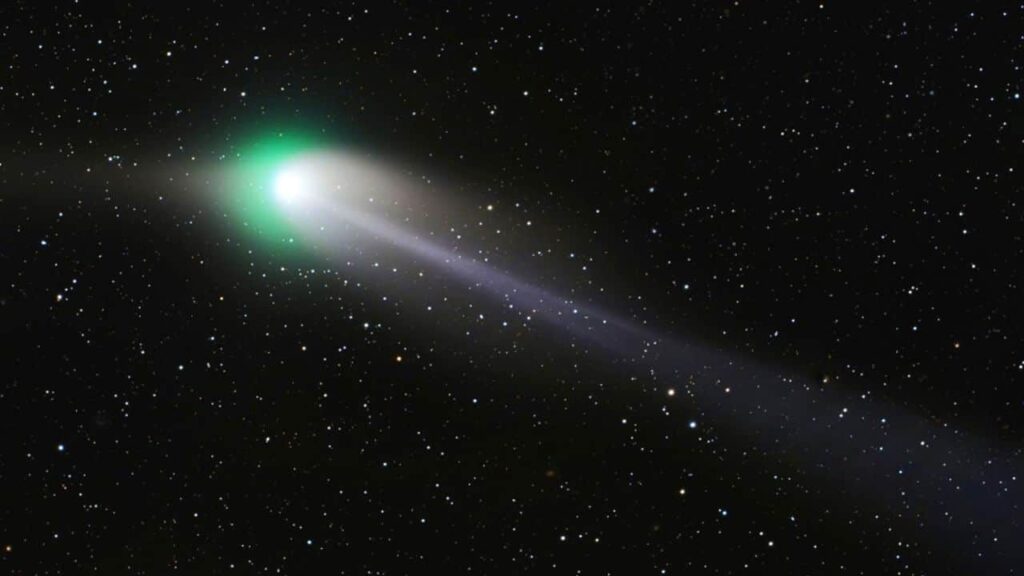
 Comet C/2026 A1 (MAPS), discovered in January 2026 by French amateur astronomers in Chile, belongs to the Kreutz sungrazing family that passes extremely close to the Sun. It could become brighter than Venus when it nears the Sun on April 4 to 5, 2026, with best views expected in the Southern Hemisphere. However, intense solar heat may either make it spectacularly bright or destroy it entirely.
A newly identified comet named C/2026 A1 (MAPS) is drawing worldwide interest after astronomers said it could soon shine brighter than Venus in the evening sky.
The object was first observed in January. Amateur astronomers working in Chile reported the sighting. It belongs to the Kreutz sungrazing family. These comets pass extremely close to the Sun.
Story continues below Advertisement
What Are Kreutz Sungrazer Comets
Sungrazers travel dangerously near the Sun. Unlike typical comets, they skim its surface. The Kreutz group is named after Heinrich Kreutz. He studied their shared orbital paths carefully.
When these icy bodies approach the Sun, intense heat rapidly vaporises frozen material. Gas and dust stream outward brightly. Some become visible even during daylight hours. Their brilliance can rival the brightest planets.
However, the same heat poses danger. Powerful solar forces can tear them apart. Many sungrazers disintegrate before completing orbit. Their survival depends on size and structure.
Story continues below Advertisement
Origins of the Kreutz Family
Astronomers believe these comets share ancestry. A giant nucleus once passed near the Sun. This likely occurred in the third century BCE. The object measured over one hundred kilometres wide.
The enormous body later fragmented repeatedly. Two major pieces separated first. Numerous smaller fragments followed over centuries. Each returned periodically along similar paths.
One famous example was the Great Comet of 1882. It became extraordinarily bright in southern skies. At peak, it outshone the full Moon. Observers reported brilliance lasting several months.
Story continues below Advertisement
Discovery of Comet MAPS
The MAPS programme identified the new comet. French amateur astronomers operate telescopes in Chile. Their project name forms an acronym. It represents Maury, Attard, Parrott and Signoret.
They confirmed discovery on January 13, 2026. At detection, the comet lay unusually distant. It was farther than previous sungrazer discoveries. This suggests the object may be sizeable.
Comet MAPS will approach the Sun closely. Its nearest passage occurs April 4 to 5. Southern Hemisphere observers may see it best. It should appear after sunset in western skies.
In India, southern regions have viewing chances. Northern Hemisphere viewers face lower horizon visibility. The comet will sit near southwestern dusk light.
Whether it becomes spectacular remains uncertain. Everything depends on surviving solar heat. If it endures, evening skies could dazzle. If not, it may vanish silently.
Discover the latest Business News, Sensex, and Nifty updates. Obtain Personal Finance insights, tax queries, and expert opinions on Moneycontrol or download the Moneycontrol App to stay updated!