
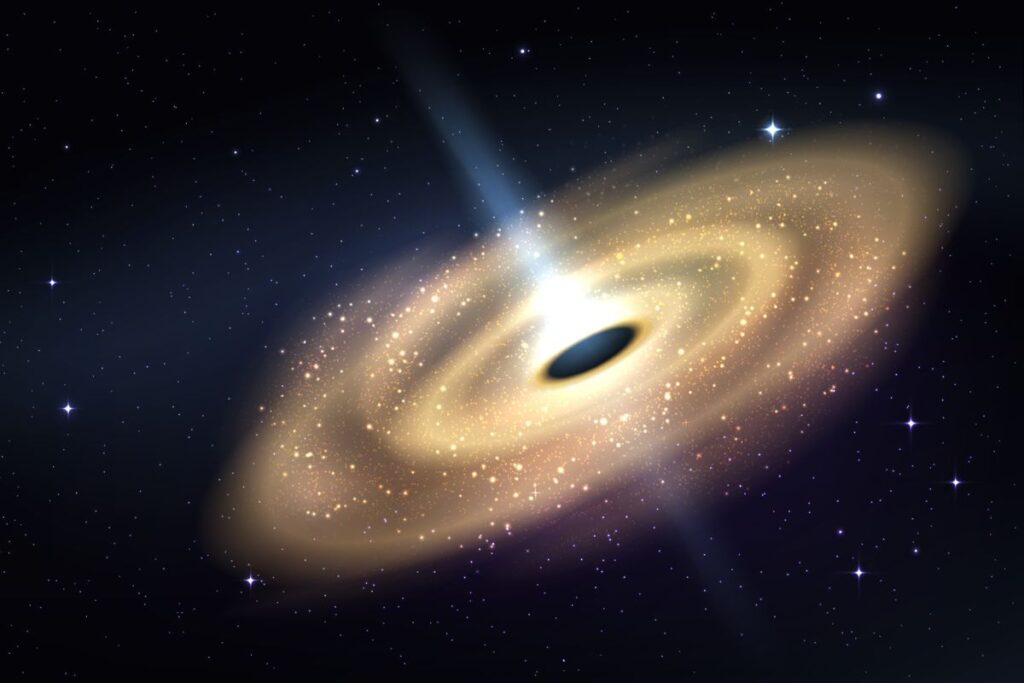
At the heart of most galaxies lies a supermassive black hole — a ginormous entity with a mass so large, it can outweigh millions, if not billions, of suns.
According to new research, published in The Astrophysical Journal Letters, these giants emit radiation so strong that they can slow the formation of stars in galaxies millions of light-years away.
“Now we realize that supermassive black holes may have played a much larger role in galaxy evolution than we once thought — acting as cosmic predators, influencing the growth of stars in nearby galaxies during the early universe,” lead author Yongda Zhu, a postdoctoral researcher at the University of Arizona, said in a statement.
Read More: A Supermassive Black Hole Shredded a Star — and Is Still Burping Out Its Bright Remains
A Universe Teeming With Black Holes
Black holes are objects that boast such a high mass and gravitational pull that they can ensnare matter — and even light — that travels too near.
According to The American Museum of History, the concept can be traced to the eighteenth century, when an English country parson, John Michell, described a star with a gravitational pull so great that light particles cannot escape its reach.
While Michell was ahead of his time, we now know that the universe is littered with such objects. Indeed, according to Harvard and Smithsonian Center for Astrophysics, the Milky Way alone could be home to a hundred million black holes. Only these are not dark stars, as Michell suggested, but form when stars collapse. Of these, the extra-large supermassive black holes are a small subset.
Repressing Star Formation
Black holes eat light, making them tricky to detect. However, supermassive black holes can sometimes be indirectly observed through quasars.
Quasars are among the brightest entities in the universe — powered by supermassive black holes, they can emit trillions of times more energy than the sun.
One of the brightest, J0100+2802, is powered by a supermassive black hole boasting a mass roughly equivalent to 12 billion suns. Observations of this particular quasar offer astronomers a glimpse of the universe when it was less than a billion years old.
Zhu and colleagues monitored emissions of a specific form of ionized oxygen, O III, which can be used to track recent star formation. Lower ratios of the gas in comparison to ultraviolet light imply a poor environment for star formation. Alas, the team found that galaxies within one million light-years of J0100+2802 showed relatively low O III ratios, suggesting that star formation has been repressed.
This, Zhu said, is due to strong levels of radiation: “The intense heat and radiation split the molecular hydrogen that makes up vast, interstellar gas clouds, quenching its potential to accumulate and turn into new stars.”
While previous research has shown that quasars dismantle hydrogen — an essential ingredient of star formation — in their host galaxy, these findings suggest their influence extends to other galaxies, some millions of light-years away.
“Traditionally, people have thought that because galaxies are so far apart, they evolve largely on their own,” said Zhu in a press statement. Instead, this suggests that evolution is “more of a group effort,” which can be summarized as a “galaxy ecosystem.”
Are Galaxies “Missing”?
Astronomers have long puzzled over the absence of evidence for galaxies surrounding quasars during the early universe. This is contrary to what might be expected, as galaxies are rarely lone wolves but tend to cluster together.
This new research suggests that the “missing” galaxies could be there, just hidden because star formation is hindered by supermassive black holes.
Moving forward, Zhu and his colleagues hope to study additional quasars to determine whether the findings can be replicated. While the Milky Way no longer has a quasar, the research could help us better understand how our own galaxy formed.
Read More: Supermassive Black Hole Flare Launched Wind and Debris Into Space at 37,000 Miles Per Second
Article Sources
Our writers at Discovermagazine.com use peer-reviewed studies and high-quality sources for our articles, and our editors review for scientific accuracy and editorial standards. Review the sources used below for this article: