

NASA says comet 3I/ATLAS is an interstellar visitor on a one-way trip through our solar system, and it poses no danger to Earth. Still, the question that keeps getting typed into search bars — ‘Is 3I/ATLAS Returning to Earth?’ — reveals a more interesting truth: people do not just want reassurance; they want a chance to catch it.
3I/ATLAS is the third confirmed interstellar object, moving so fast it cannot be captured by the sun; it will never come close to Earth (its closest approach is about 1.8 astronomical units); and while a direct spacecraft intercept was effectively missed, one new proposal argues a 2035 launch could still chase it down using a brutal close-to-the-sun ‘Solar Oberth’ burn — after a long, long cruise.
NASA’s Answer Is a Flat No
NASA’s public tracking page is unequivocal that 3I/ATLAS ‘poses no threat to Earth’ and will stay far away, with the closest approach around 1.8 AU (about 270 million kilometers). NASA’s own quick facts page repeats that there is ‘no danger’ and ties that same 1.8 AU distance to the safety call.
So why the nagging ‘returning’ framing? Because the name ‘comet’ tends to imply loops — Halley-style homecomings — when 3I/ATLAS is doing the opposite, arriving on a hyperbolic path that does not close back on itself. NASA explains the interstellar label in plain terms: trace its orbit backward and it clearly originates from outside our solar system.
The numbers are part of the drama. NASA says that when it was discovered, 3I/ATLAS was traveling at about 61 km/s (221,000 km/h), and would speed up as it neared the sun. By the time ATLAS reported it on July 1, 2025, it was already ‘within the orbit of Jupiter’ — late, in spacecraft-planning terms, and already deep into the part of the solar system where timing windows start slamming shut.
The ‘Solar Slingshot’ Chase That Could Still Happen
The most intriguing attempt to salvage the moment comes from a team led by Adam Hibberd of the Initiative for Interstellar Studies, alongside T. Marshall Eubanks and Andreas Hein, in a paper titled Catching 3I/ATLAS Using a Solar Oberth. Their core argument is almost fatalistic: a ‘direct’ chemical-rocket dash was always going to be a near-miss because the optimal launch date arrived before discovery, and even a pre-positioned ‘Comet Interceptor’ style spacecraft at sun–Earth L2 would have faced too-high thrust demands ‘in its current form.’
Instead, they model an indirect pursuit that leans on two old-school tricks of celestial mechanics — gravity assists and the Oberth effect — then turns both up to an uncomfortable volume. In their baseline architecture (Earth–Jupiter–Solar Oberth–3I/ATLAS), Jupiter is used to reshape the trajectory so the spacecraft can dive close to the sun, where a burn yields maximum payoff because you’re already moving insanely fast.
Here is the catch, and it is not a small one. The paper says that, for launch years they examined (2031–2037), 2035 offers the most efficient transfer, with intercept after roughly 35–50 years. Their reference case calls for a Solar Oberth maneuver at about 3.2 solar radii from the sun’s center — close enough that the authors flag punishing solar flux (around 6 MW per square meter) and the need for a heat shield that eats into payload.
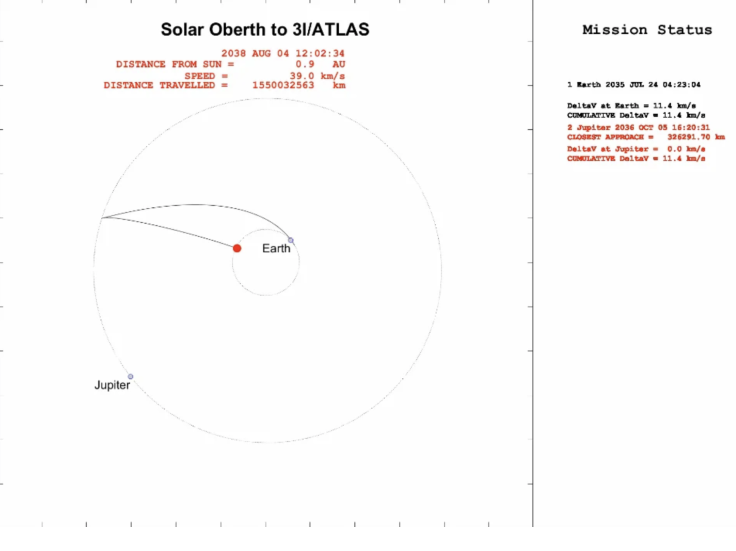
OITS simulation of a spacecraft intercepting 3I/ATLAS using a Solar Oberth maneuver.
Hibberd, et al. 2026/i4is*
The study notes that ‘two or three solid propellant boosters’ could supply the Oberth burn’s needed delta-v, and it sketches a scenario involving a fully refueled ‘Starship Block 3’ upper stage in low Earth orbit to throw the stack onto its escape trajectory. i4is has also framed the concept publicly in blunt terms: Hibberd says his trajectory work indicates ‘a mission exists in the future,’ with a launch ‘in 2035.’
If that sounds less like a mission plan and more like a generational wager, that is because it is — and because 3I/ATLAS will not be ‘returning’ for anyone who misses it the first time.